
Quarterly earnings results are a good time to check in on a company’s progress, especially compared to its peers in the same sector. Today we are looking at Northern Trust (NASDAQ: NTRS) and the best and worst performers in the custody bank industry.
Custody banks safeguard financial assets and provide services like settlement, accounting, and regulatory compliance for institutional investors. Growth opportunities stem from increasing global assets under custody, demand for data analytics, and blockchain technology adoption for settlement efficiency. Challenges include fee pressure from large clients, substantial technology investment requirements, and competition from both traditional players and fintech firms entering the space.
The 16 custody bank stocks we track reported a strong Q1. As a group, revenues beat analysts’ consensus estimates by 2.5%.
Luckily, custody bank stocks have performed well with share prices up 11.4% on average since the latest earnings results.
Northern Trust (NASDAQ: NTRS)
Founded in 1889 during Chicago's post-Great Fire rebuilding boom, Northern Trust (NASDAQ: NTRS) provides wealth management, asset servicing, and banking solutions to corporations, institutions, families, and high-net-worth individuals globally.
Northern Trust reported revenues of $2.21 billion, up 13.8% year on year. This print exceeded analysts’ expectations by 4%. Overall, it was an exceptional quarter for the company with an impressive beat of analysts’ EBITDA and EPS estimates.
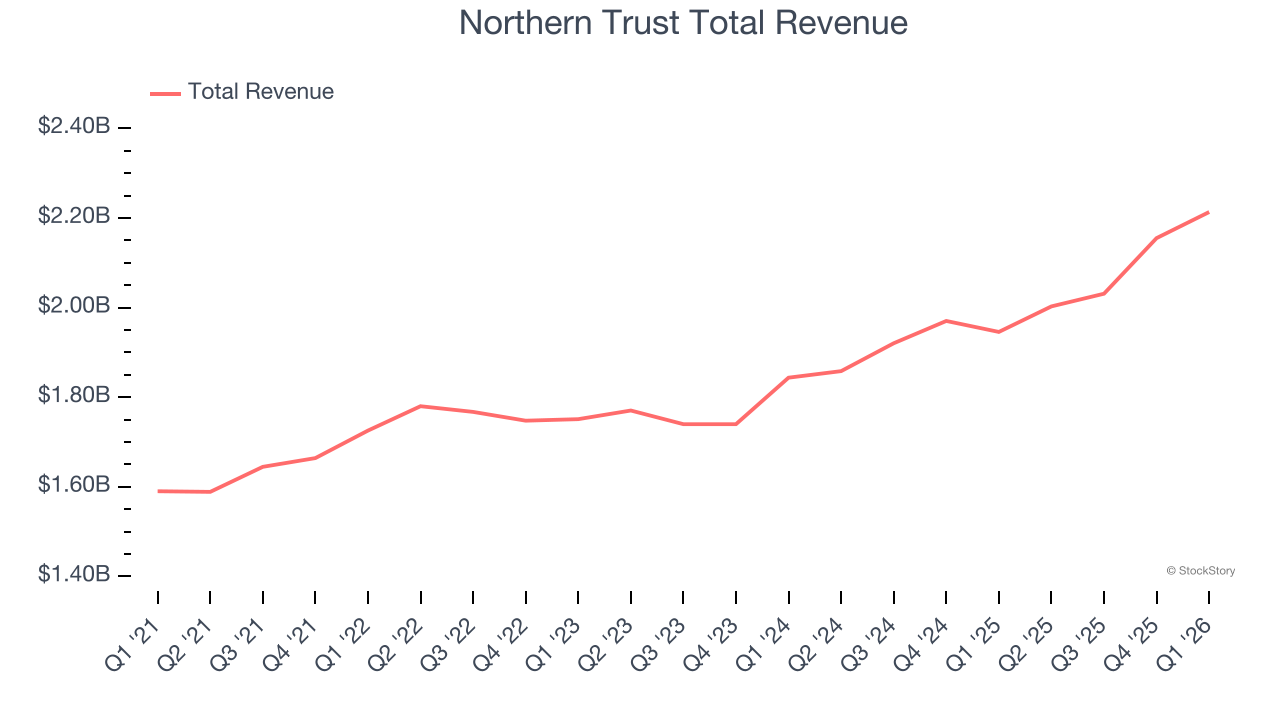
Interestingly, the stock is up 12.6% since reporting and currently trades at $179.05.
Best Q1: Franklin Resources (NYSE: BEN)
Operating under the widely recognized Franklin Templeton brand since 1947, Franklin Resources (NYSE: BEN) is a global investment management organization that offers financial services and solutions to individuals, institutions, and wealth advisors worldwide.
Franklin Resources reported revenues of $2.29 billion, up 8.7% year on year, outperforming analysts’ expectations by 11.8%. The business had an incredible quarter with a beat of analysts’ EPS and AUM estimates.
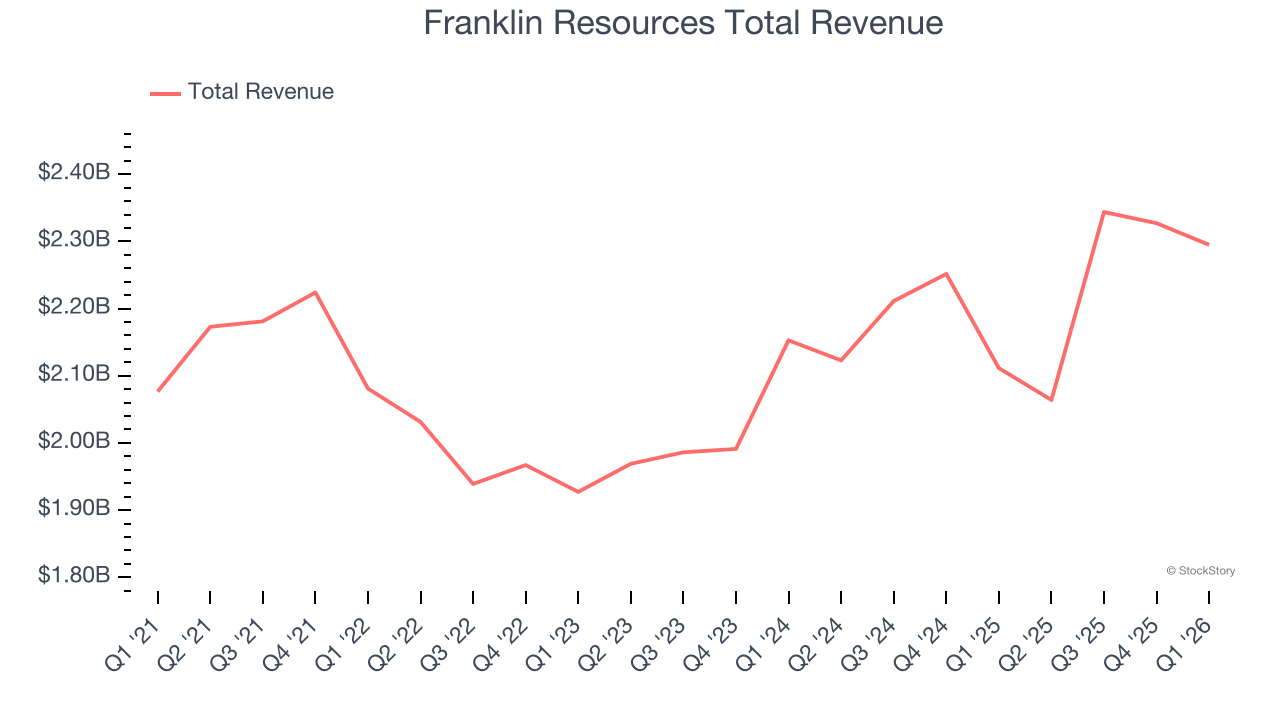
The market seems happy with the results as the stock is up 23.3% since reporting. It currently trades at $34.01.
Is now the time to buy Franklin Resources? Access our full analysis of the earnings results here, it’s free.
Slowest Q1: Hamilton Lane (NASDAQ: HLNE)
With over $100 billion in assets under management and supervision, Hamilton Lane (NASDAQ: HLNE) is an investment management firm that specializes in private markets, offering advisory services and fund solutions to institutional and private wealth investors.
Hamilton Lane reported revenues of $193.6 million, down 2.2% year on year, falling short of analysts’ expectations by 3.4%. It was a slower quarter, leaving some shareholders looking for more.
Hamilton Lane delivered the slowest revenue growth in the group. As expected, the stock is down 3.5% since the results and currently trades at $82.15.
Read our full analysis of Hamilton Lane’s results here.
Ridgepost Capital (NYSE: RPC)
Operating as a bridge between institutional investors and hard-to-access private market opportunities, Ridgepost Capital (NYSE: RPC) is an alternative asset management firm that provides access to private equity, venture capital, impact investing, and private credit opportunities in the middle and lower middle markets.
Ridgepost Capital reported revenues of $75.35 million, up 11.2% year on year. This result came in 3.8% below analysts’ expectations. Overall, it was a slower quarter as it also produced a significant miss of analysts’ EBITDA estimates.
Ridgepost Capital had the weakest performance against analyst estimates among its peers. The stock is down 5.4% since reporting and currently trades at $8.01.
Read our full, actionable report on Ridgepost Capital here, it’s free.
State Street (NYSE: STT)
Dating back to 1792 when Boston's Long Wharf was the center of global shipping and trade, State Street (NYSE: STT) provides custody, investment management, and other financial services to institutional investors like pension funds, asset managers, and central banks worldwide.
State Street reported revenues of $3.80 billion, up 15.6% year on year. This number surpassed analysts’ expectations by 3.3%. It was a very strong quarter as it also put up a beat of analysts’ EPS estimates.
The stock is up 26.8% since reporting and currently trades at $179.89.
Read our full, actionable report on State Street here, it’s free.
Market Update
Late in 2025 into early 2026, there was hand-wringing around artificial intelligence. For software companies, the fear was that AI would erode pricing power and compress margins as new tools made it easier to replicate what once required expensive enterprise platforms. Crypto investors had their own version of the same anxiety: if AI agents could trade, allocate capital, and manage wallets autonomously, what exactly was the long-term value of today’s crypto infrastructure?
These concerns triggered a noticeable rotation away from these sectors and into safer havens. But markets rarely dwell on one narrative for long. Spring 2026 came, and the focus shifted abruptly from technological disruption to geopolitical risk. The US’ conflict with Iran became the dominant driver of market psychology, and when geopolitics takes center stage, the script changes quickly. Investors stop debating growth rates and start worrying about oil supply, inflation, and global stability.
Want to invest in winners with rock-solid fundamentals? Check out our Strong Momentum Stocks and add them to your watchlist. These companies are poised for growth regardless of the political or macroeconomic climate.