The end of the earnings season is always a good time to take a step back and see who shined (and who not so much). Let’s take a look at how vehicle retailer stocks fared in Q1, starting with CarMax (NYSE: KMX).
Buying a vehicle is a big decision and usually the second-largest purchase behind a home for many people, so retailers that sell new and used cars try to offer selection, convenience, and customer service to shoppers. While there is online competition, especially for research and discovery, the vehicle sales market is still very fragmented and localized given the magnitude of the purchase and the logistical costs associated with moving cars over long distances. At the end of the day, a large swath of the population relies on cars to get from point A to point B, and vehicle sellers are acutely aware of this need.
The 5 vehicle retailer stocks we track reported a strong Q1. As a group, revenues beat analysts’ consensus estimates by 0.5%.
In light of this news, share prices of the companies have held steady. On average, they are relatively unchanged since the latest earnings results.
Best Q1: CarMax (NYSE: KMX)
Known for its transparent, customer-centric approach and wide selection of vehicles, Carmax (NYSE: KMX) is the largest automotive retailer in the United States.
CarMax reported revenues of $5.95 billion, flat year on year. This print exceeded analysts’ expectations by 3.9%. Overall, it was a stunning quarter for the company with a beat of analysts’ EPS and EBITDA estimates.
“We are moving with urgency to improve execution, drive efficiencies, and sharpen our customer offering,” said Keith Barr, President and Chief Executive Officer.
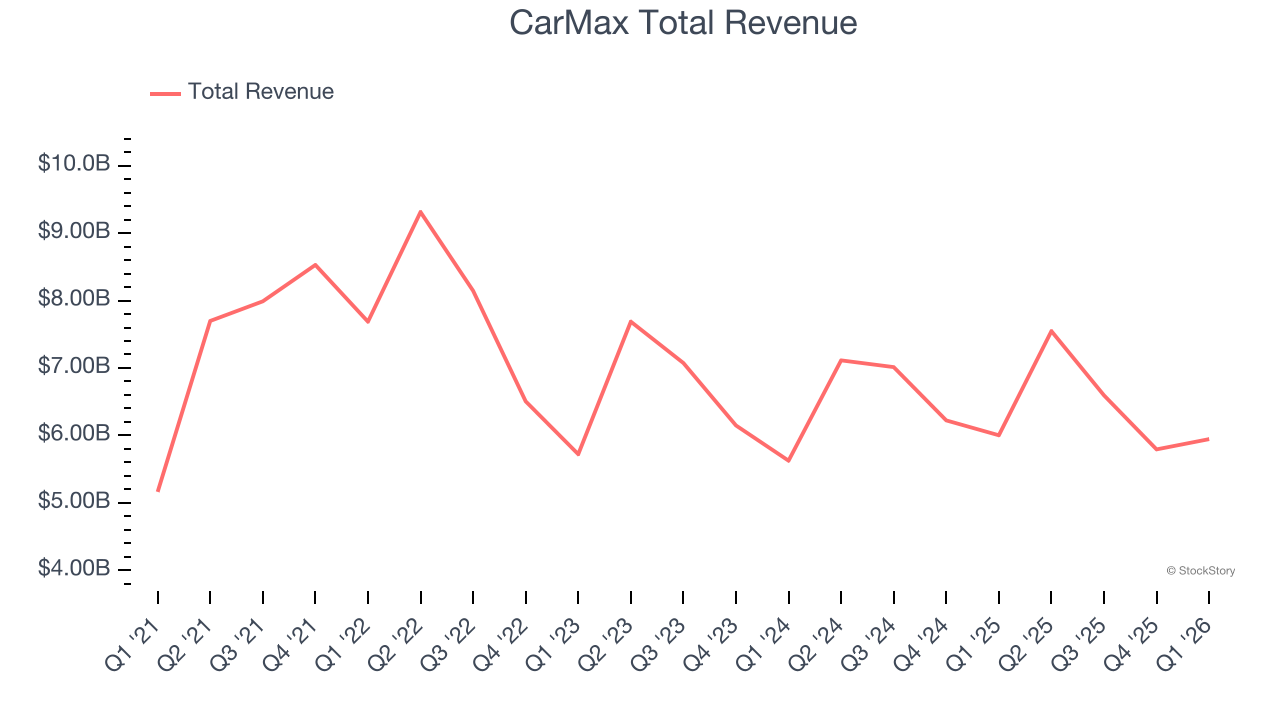
CarMax scored the biggest analyst estimates beat of the whole group. Investor expectations, however, were likely higher than Wall Street’s published projections, leaving some wishing for even better results (analysts’ consensus estimates are those published by big banks and advisory firms, not the investors who make buy and sell decisions). The stock is down 19.7% since reporting and currently trades at $39.40.
Is now the time to buy CarMax? Access our full analysis of the earnings results here, it’s free.
Lithia (NYSE: LAD)
With a strong presence in the Western US, Lithia Motors (NYSE: LAD) sells a wide range of vehicles, including new and used cars, trucks, SUVs, and luxury vehicles from various manufacturers.
Lithia reported revenues of $9.27 billion, up 1% year on year, outperforming analysts’ expectations by 1%. The business had a very strong quarter with an impressive beat of analysts’ EBITDA and gross margin estimates.
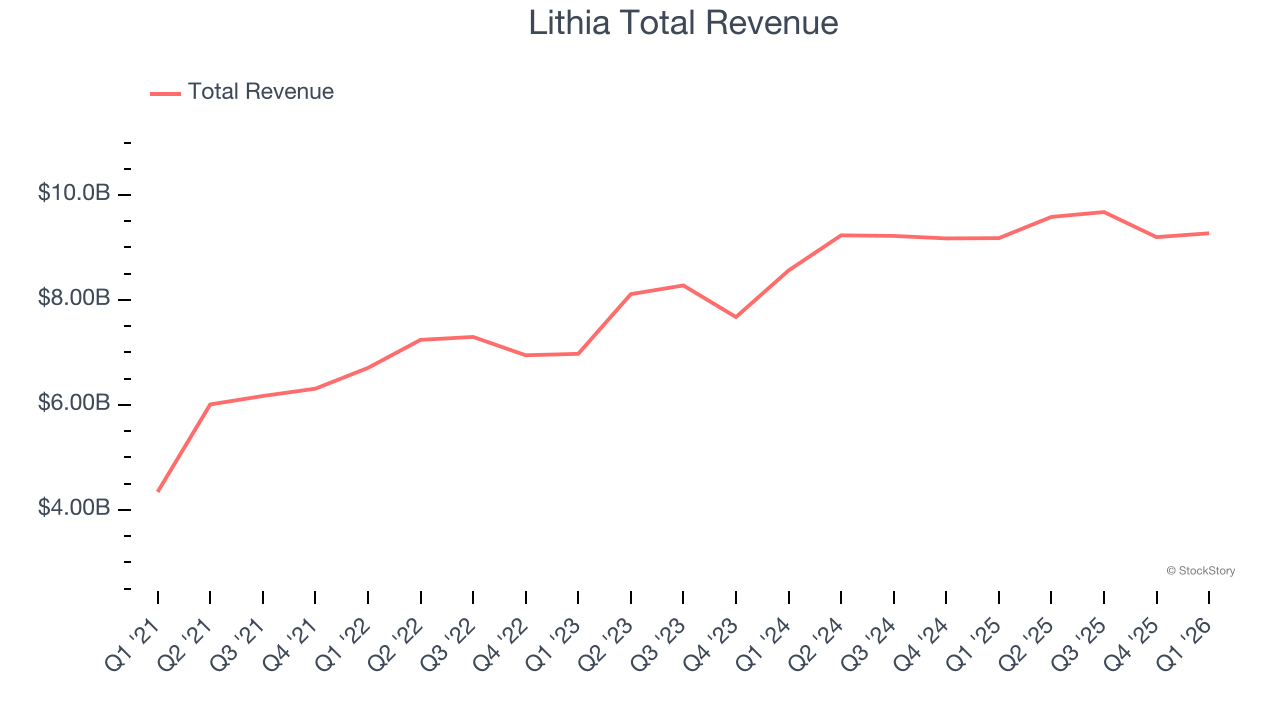
The market seems content with the results as the stock is up 4.4% since reporting. It currently trades at $289.41.
Is now the time to buy Lithia? Access our full analysis of the earnings results here, it’s free.
Weakest Q1: AutoNation (NYSE: AN)
With a vast network of over 300 locations strategically concentrated in America's Sunbelt region, AutoNation (NYSE: AN) operates one of America's largest networks of automotive dealerships, selling new and used vehicles, parts, and services across multiple brands.
AutoNation reported revenues of $6.55 billion, down 2.1% year on year, falling short of analysts’ expectations by 1.3%. It was a slower quarter as it posted a miss of analysts’ EBITDA and revenue estimates.
As expected, the stock is down 3.6% since the results and currently trades at $204.83.
Read our full analysis of AutoNation’s results here.
Penske Automotive Group (NYSE: PAG)
With a diverse global network spanning the US, UK, Canada, Germany, Italy, Japan, and Australia, Penske Automotive Group (NYSE: PAG) operates automotive and commercial truck dealerships across the globe, selling new and used vehicles while providing service, parts, and financing options.
Penske Automotive Group reported revenues of $7.86 billion, up 3.4% year on year. This print topped analysts’ expectations by 2.8%. It was a very strong quarter as it also produced an impressive beat of analysts’ revenue and EBITDA estimates.
Penske Automotive Group delivered the fastest revenue growth among its peers. The stock is up 5.1% since reporting and currently trades at $169.73.
Read our full, actionable report on Penske Automotive Group here, it’s free.
Camping World (NYSE: CWH)
Founded in 1966 as a single recreational vehicle (RV) dealership, Camping World (NYSE: CWH) still sells RVs along with boats and general merchandise for outdoor activities.
Camping World reported revenues of $1.35 billion, down 4.2% year on year. This result missed analysts’ expectations by 3.7%. Zooming out, it was actually a strong quarter as it produced a beat of analysts’ EPS and EBITDA estimates.
Camping World had the weakest performance against analyst estimates and slowest revenue growth among its peers. The stock is up 16.1% since reporting and currently trades at $8.05.
Read our full, actionable report on Camping World here, it’s free.
Market Update
Late in 2025 into early 2026, there was hand wringing around artificial intelligence. For software companies, the fear was that AI would erode pricing power and compress margins as new tools made it easier to replicate what once required expensive enterprise platforms. Crypto investors had their own version of the same anxiety: if AI agents could trade, allocate capital, and manage wallets autonomously, what exactly was the long-term value of today’s crypto infrastructure?
These concerns triggered a noticeable rotation away from these sectors and into safer havens. But markets rarely dwell on one narrative for long. Spring 2026 came, and the focus shifted abruptly from technological disruption to geopolitical risk. The US’ conflict with Iran became the dominant driver of market psychology, and when geopolitics takes center stage, the script changes quickly. Investors stop debating growth rates and start worrying about oil supply, inflation, and global stability.
Want to invest in winners with rock-solid fundamentals? Check out our Hidden Gem Stocks and add them to your watchlist. These companies are poised for growth regardless of the political or macroeconomic climate.
StockStory’s analyst team — all seasoned professional investors — uses quantitative analysis and automation to deliver market-beating insights faster and with higher quality.