Nutrition products company Bellring Brands (NYSE: BRBR) fell short of the market’s revenue expectations in Q1 CY2026 as sales only rose 1.8% year on year to $598.7 million. The company’s full-year revenue guidance of $2.35 billion at the midpoint came in 2.9% below analysts’ estimates. Its non-GAAP profit of $0.14 per share was 55.3% below analysts’ consensus estimates.
Is now the time to buy BellRing Brands? Find out by accessing our full research report, it’s free.
BellRing Brands (BRBR) Q1 CY2026 Highlights:
- Revenue: $598.7 million vs analyst estimates of $608.8 million (1.8% year-on-year growth, 1.7% miss)
- Adjusted EPS: $0.14 vs analyst expectations of $0.31 (55.3% miss)
- Adjusted EBITDA: $53.8 million vs analyst estimates of $79.71 million (9% margin, 32.5% miss)
- The company dropped its revenue guidance for the full year to $2.35 billion at the midpoint from $2.44 billion, a 3.7% decrease
- EBITDA guidance for the full year is $325 million at the midpoint, below analyst estimates of $421.8 million
- Operating Margin: 11%, down from 16.2% in the same quarter last year
- Organic Revenue rose 1.8% year on year (miss)
- Sales Volumes rose 10.8% year on year (17.8% in the same quarter last year)
- Market Capitalization: $2.04 billion
Company Overview
Spun out of Post Holdings in 2019, Bellring Brands (NYSE: BRBR) offers protein shakes, nutrition bars, and other products under the PowerBar, Premier Protein, and Dymatize brands.
Revenue Growth
A company’s long-term performance is an indicator of its overall quality. Any business can put up a good quarter or two, but the best consistently grow over the long haul.
With $2.33 billion in revenue over the past 12 months, BellRing Brands is a small consumer staples company, which sometimes brings disadvantages compared to larger competitors benefiting from economies of scale and negotiating leverage with retailers. On the bright side, it can grow faster because it has a longer list of untapped store chains to sell into.
As you can see below, BellRing Brands’s sales grew at a solid 15.9% compounded annual growth rate over the last three years as consumers bought more of its products.
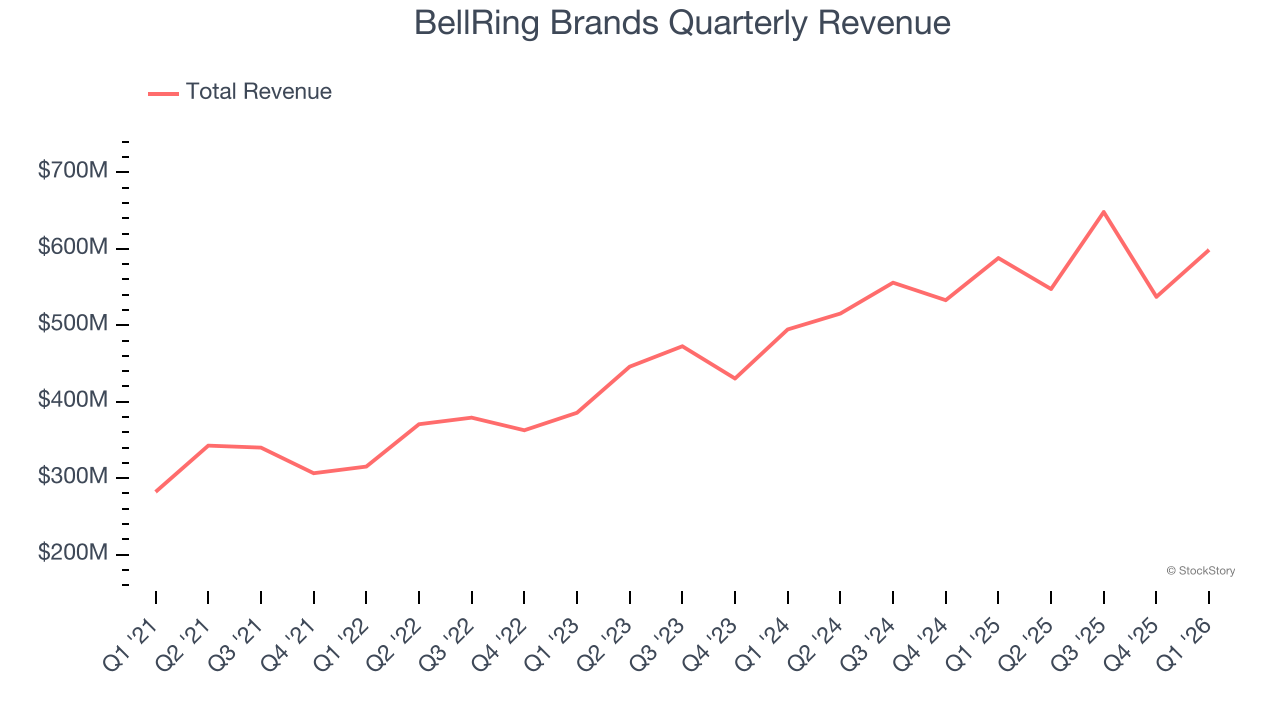
This quarter, BellRing Brands’s revenue grew by 1.8% year on year to $598.7 million, falling short of Wall Street’s estimates.
Looking ahead, sell-side analysts expect revenue to grow 6% over the next 12 months, a deceleration versus the last three years. Still, this projection is above average for the sector and suggests the market is forecasting some success for its newer products.
WHILE YOU’RE HERE: The Next Palantir? One satellite company captures images of every point on Earth. Every single day. The Pentagon wants it. Hedge funds are using it to beat earnings. You’ve probably never heard of it.
This is what the early days of Palantir looked like before it became a $437 billion giant. Same playbook. Different technology. If you missed Palantir, you need to see this. Claim The Stock Ticker for Free HERE.
Volume Growth
Revenue growth can be broken down into changes in price and volume (the number of units sold). While both are important, volume is the lifeblood of a successful staples business as there’s a ceiling to what consumers will pay for everyday goods; they can always trade down to non-branded products if the branded versions are too expensive.
To analyze whether BellRing Brands generated its growth from changes in price or volume, we can compare its volume growth to its organic revenue growth, which excludes non-fundamental impacts on company financials like mergers and currency fluctuations.
Over the last two years, BellRing Brands’s average quarterly volume growth of 13.8% has outpaced the competition by a long shot. In the context of its 12.9% average organic revenue growth, we can see that most of the company’s gains have come from more customers purchasing its products.
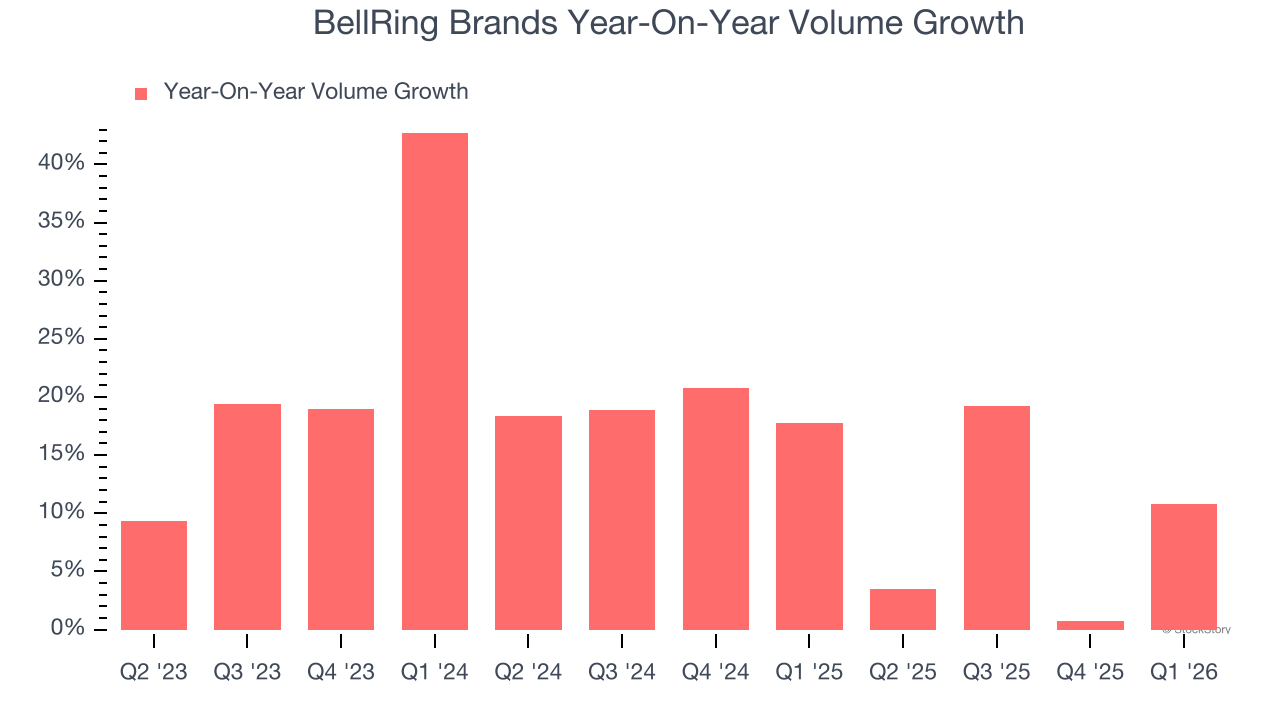
In BellRing Brands’s Q1 2026, sales volumes jumped 10.8% year on year. This result shows the business is staying on track, but the deceleration suggests growth is getting harder to come by.
Key Takeaways from BellRing Brands’s Q1 Results
We struggled to find many positives in these results. Its full-year EBITDA guidance missed and its EBITDA fell short of Wall Street’s estimates. Overall, this was a softer quarter. The stock traded down 17.1% to $14.40 immediately following the results.
BellRing Brands didn’t show it’s best hand this quarter, but does that create an opportunity to buy the stock right now? The latest quarter does matter, but not nearly as much as longer-term fundamentals and valuation, when deciding if the stock is a buy. We cover that in our actionable full research report which you can read here (it’s free).