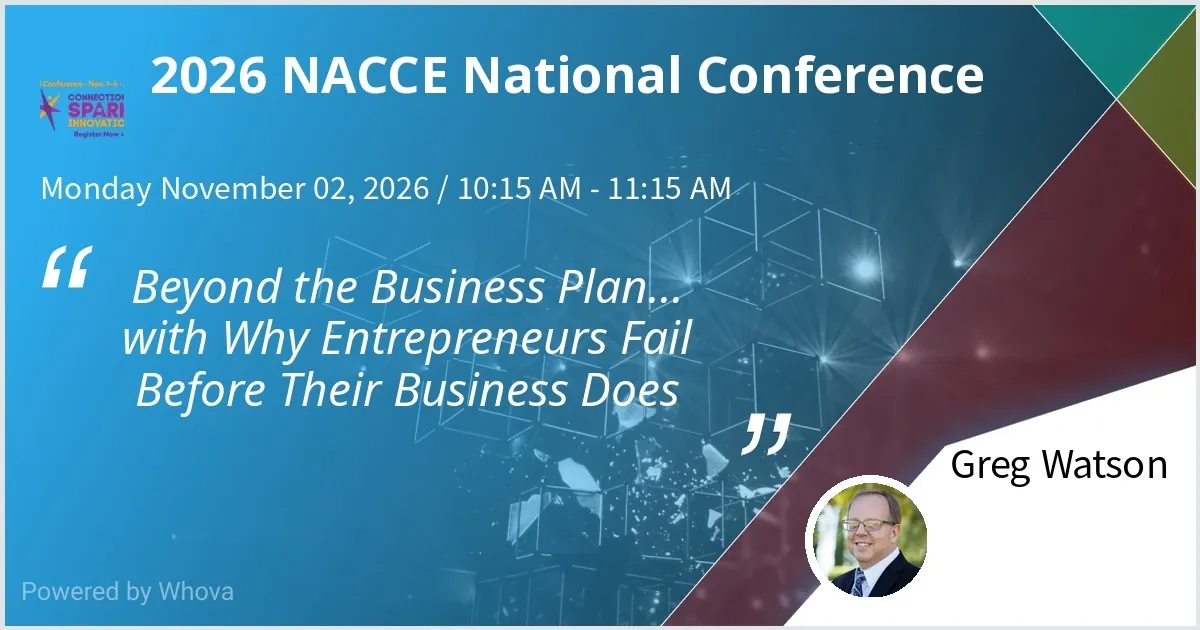
Dr. Greg Watson, Professor of Business at Pima Community College and a serial entrepreneur, presented an emerging educational approach called the Capacity Framework during an interactive workshop at the 2026 National Association for Community College Entrepreneurship (NACCE) Annual Conference in Boston on November 2, 2026. The session, titled "Why Entrepreneurs Fail Before Their Business Does," addressed a potential gap in traditional entrepreneurship education: students may master entrepreneurial mindset, opportunity recognition, and business planning without learning to identify the organizational capacity required to execute their business models.
The central thesis of the workshop reframes how business failure is understood. "Financial bankruptcy is an event, but organizational failure is a process," Watson stated. He argues that warning signs of organizational failure frequently emerge long before financial collapse becomes apparent. A business can experience growing sales and customer demand while simultaneously developing weaknesses in its operational systems, staffing, financial management, and ability to scale.
The Capacity Framework offers a conceptual approach for examining whether an enterprise has the organizational resources, people, processes, and systems needed to carry out its business model. Watson pairs this with what he calls Capacity Development Literacy, the educational competency of recognizing, assessing, and addressing organizational capacity gaps. A practical diagnostic activity, the Capacity Gap Assessment, allows students, educators, and entrepreneurs to apply the competency to real situations.
During the NACCE 2026 workshop, participants completed an interactive assessment of a growing artisan bakery whose founder worked roughly 75 hours per week while contending with inconsistent production scheduling, unreliable inventory management, delivery challenges, and excessive founder dependency. Participants identified organizational improvements such as delegation, staff training, demand forecasting, and the development of operational systems.
Watson encourages entrepreneurship educators to connect the knowledge already taught across accounting, finance, marketing, operations, human resources, and leadership courses with practical organizational gap recognition. "A capable entrepreneur does not automatically build a capable organization," he noted. He also pressed educators to consider how programs develop internal awareness among students. "We do a great job of problem recognition and opportunity recognition. Those are all external. But do we do a really good job of thinking about internal opportunity recognition, internal problem recognition?"
Watson reported during the session that a capacity assessment was being tested at seven colleges. He described this as ongoing educational development rather than independently validated research demonstrating improved business survival rates. The Capacity Framework is presented as an emerging educational approach, not a proven method of preventing business failure.
Educators and entrepreneurs seeking detailed information, including the explanation of the framework and the workshop recording, can access the published article at ProfessorWatson.com. The Workshop recording documents the full session and the bakery case study discussed by participants.
https://www.youtube.com/watch?v=AcJln1BMw7Y
Dr. Greg Watson is a Professor of Business at Pima Community College in Tucson, Arizona, and has previously taught at the University of Arizona's Eller College of Management. He has founded 14 businesses and authored the open textbook Entrepreneurship Essentials, used at numerous institutions. His academic work spans entrepreneurship education, entrepreneurial mindset, new venture development, and organizational capacity.
###
For more information about Professor Watson, contact the company here:
Professor Watson
Greg Watson
(520) 270-7020
gregwatson@professorwatson.com
1255 N. Stone Ave. Tucson, AZ 85709-3000
(520) 270-7020
gregwatson@professorwatson.com