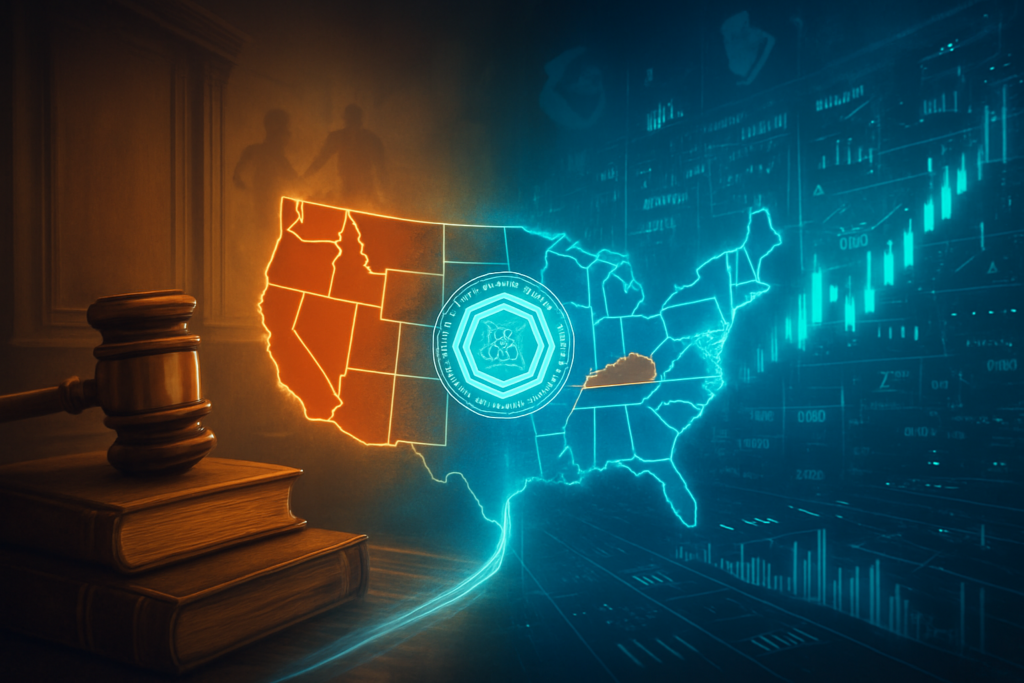
As of January 30, 2026, the meteoric rise of prediction markets faces its most existential threat yet: a "jurisdictional civil war" between federal regulators and state gaming authorities. While platforms like Kalshi have successfully argued their case before the Commodity Futures Trading Commission (CFTC) and federal courts, a new wave of state-level cease-and-desist orders is threatening to fragment the market. The core of the dispute centers on whether a contract predicting a sports outcome is a sophisticated financial derivative or simply an unlicensed bet.
Market participants are currently pricing in a high degree of uncertainty regarding Kalshi's geographic reach. While the platform processed a staggering $23.8 billion in notional volume in 2025, recent legal setbacks in Massachusetts and looming hearings in Connecticut have forced traders to consider a future where prediction markets are geofenced state-by-state. This "regulatory design problem" has become the primary driver of market sentiment, as the industry waits to see if federal preemption will shield these exchanges from the heavy hand of state gambling commissions.
The Market: What's Being Predicted
The current focus of the prediction market community isn't just on the outcomes of the events themselves, but on the survival of the markets that host them. On Kalshi and competing platforms like Polymarket, the most liquid contracts currently involve high-stakes sports events, including the upcoming Super Bowl LX and the 2026 NBA playoffs. For instance, the market for "Will the Kansas City Chiefs win Super Bowl LX?" is seeing massive liquidity, with shares trading at $0.34 (implying a 34% probability), despite the legal clouds gathering over the platform's right to host such contracts.
Kalshi, which operates as a CFTC-regulated Designated Contract Market (DCM), has seen its weekly trading volume surge to over $2.3 billion this month. However, the platform's liquidity is increasingly bifurcated by geography. Following a preliminary injunction in Massachusetts on January 20, 2026, and a cease-and-desist in Tennessee, traders in those states have been sidelined. This has created a "phantom liquidity" scenario where national price discovery is hampered by the sudden exit of users from key markets, leading to wider spreads on certain state-contested contracts.
The resolution criteria for these legal battles are clear: a federal court hearing in Connecticut scheduled for February 12, 2026, is expected to determine whether the "federal preemption" defense holds water. If Kalshi loses this round, the platform may be forced to exit up to 15 states by the end of the year, a move that would drastically alter the volume outlook for 2026.
Why Traders Are Betting
Traders are flocking to Kalshi’s sports-event contracts primarily because of the "vig" gap. Traditional sportsbooks, managed by giants like DraftKings (NASDAQ: DKNG) and Flutter Entertainment (NYSE: FLUT), typically charge a significant house edge, often between 5% and 10%. In contrast, Kalshi’s peer-to-peer exchange model allows for much tighter spreads, often effectively reducing the cost of a "bet" to a fraction of a percent. This has attracted high-frequency traders and institutional "whales" who view these contracts as efficient hedging tools rather than mere gambling.
The narrative driving current positions is one of "hedging vs. consumption." Proponents argue that a contract on the price of a touchdown is no different than a contract on the price of corn; both provide a "truth signal" and allow parties to manage risk. For example, a local business in a host city might buy "No" contracts on a home team's victory to hedge against the loss of local economic activity that follows a playoff exit. This sophisticated financial logic is what traders are betting will eventually win over federal judges.
However, the opposition is equally motivated. State gaming boards in Nevada and Connecticut argue that Kalshi is exploiting a "regulatory design problem." By structuring bets as $0 or $1 binary options, Kalshi is accused of "engineering preemption"—deliberately designing gambling products to look like commodities to bypass state taxes and consumer protection laws. Large positions are being taken by speculators who believe a "federal legislative solution" is the only way out, betting that the current administration will favor a "future-proof" regulatory framework for fintech.
Broader Context and Implications
This conflict highlights a significant shift in the prediction market landscape. In 2024 and 2025, the industry's biggest hurdle was scaling user demand; in 2026, the problem is one of legal architecture. If states like Massachusetts and Nevada succeed in classifying these markets as "gaming," the regulatory burden could become insurmountable. Traditional sportsbooks are currently taxed at rates as high as 51% in some jurisdictions, a cost that would destroy the low-margin exchange model Kalshi relies on.
The real-world implications are profound. Prediction markets have historically been more accurate than polls or pundits, offering real-time data on everything from inflation to election outcomes. If these markets are geofenced or shut down, the world loses a critical "truth engine." Furthermore, the entry of traditional finance players like Robinhood (NASDAQ: HOOD) into the space—following their own legal skirmishes in Connecticut—suggests that the "financialization of everything" is a trend that state regulators may be unable to stop, only delay.
Historically, the CFTC has had a complicated relationship with event contracts. While the agency under Chairman Michael Selig has signaled a more permissive approach, the "Gaming Clause" of the Commodity Exchange Act remains a potent weapon for states. The outcome of this struggle will decide if the United States maintains a unified national market for information or a fragmented patchwork of state-regulated betting shops.
What to Watch Next
The immediate milestone for every trader in this space is February 12, 2026. The hearing in the Connecticut Department of Consumer Protection case will be the first major test of whether the federal pause on state enforcement will hold. A victory for Kalshi there would likely lead to a "legal rally," where liquidity returns to the platform as traders gain confidence in its nationwide longevity. Conversely, a defeat would likely trigger a wave of geofencing across the Northeast.
Additionally, keep a close eye on the "Massachusetts model." If other states adopt the logic that event contracts are "substantively indistinguishable" from wagering, we may see a mass exodus of prediction market startups to offshore jurisdictions or decentralized protocols. Investors should also watch for any movement from the Tennessee Sports Wagering Council, which has ordered a cease-operations deadline for the end of this month.
Finally, the total notional volume projections for 2026—estimated by analysts at Piper Sandler to reach $222.5 billion—hinge entirely on these court dates. Any sign of a Supreme Court petition regarding federal preemption could send shockwaves through the industry, as it would represent the final word on the legality of the "regulatory design" Kalshi has pioneered.
Bottom Line
The battle over Kalshi’s sports-event contracts is about more than just football or basketball; it is a fundamental test of the United States' regulatory agility in the face of financial innovation. Kalshi has proven that there is a massive, multi-billion dollar appetite for low-cost, transparent event contracts. However, the "regulatory design problem" has created a friction point where state-level police powers meet federal commodity oversight.
As of early 2026, the market remains in a state of "cautious expansion." While the volume numbers are record-breaking, the legal foundation is at its most precarious. For prediction markets to fulfill their potential as a global utility for price discovery, they must first survive a domestic gauntlet of gaming regulators who see them not as the future of finance, but as a threat to the established order of the betting industry.
The next few months will determine if Kalshi remains a nationwide powerhouse or becomes a niche platform serving only a handful of "permissive" states. For now, the odds favor a prolonged legal stalemate, with the ultimate resolution likely requiring an act of Congress to finally bridge the gap between "hedging" and "gaming."
This article is for informational purposes only and does not constitute financial or betting advice. Prediction market participation may be subject to legal restrictions in your jurisdiction.
PredictStreet focuses on covering the latest developments in prediction markets.
Visit the PredictStreet website at https://www.predictstreet.ai/.