61% of historical holes returned intervals above 0.15% eU3O8; 18 priority intercepts screened clear of mined-out ground form a drill-ready target list adjacent to the historic Whirlwind Mine
Vancouver, British Columbia--(Newsfile Corp. - November 10, 2026) - Manhattan Uranium Discovery Corp. (TSXV: MANU) (OTCQB: MAUUF) (FSE: J5B0) ("Manhattan" or the "Company") is pleased to provide an update on ongoing technical work at its October uranium project (the "October Project") located in the Gateway uranium district in Colorado.
The October Project comprises 11 claims covering 220 acres along the 70-mile-long Uravan Mineral Belt, which produced 14.6 million tons of ore grading 0.24% U₃O₈ and 14.5 million tons of ore grading 1.24% V₂O₅ between 1947 and 1979¹. The property is adjacent to Energy Fuels' historic Whirlwind Mine in the Beaver Mesa area of the Gateway district, where the U.S. Atomic Energy Commission reported production of 1.2 million tons of ore through 1971², and lies within trucking distance of Energy Fuels' White Mesa Mill, the only operating conventional uranium mill in the United States.
The eU₃O₈ values disclosed in this news release are derived from historical downhole gamma-probe logging, not chemical assays. These values have not been independently verified by the Company and are used solely for exploration targeting purposes only. See "Technical Disclosure" below.
Key Highlights
1.16% eU₃O₈ over 4.8 ft in hole O-217: The highest-grade intercept of meaningful thickness in the compiled database, and roughly five times the 0.24% average grade the Uravan Mineral Belt produced between 1947 and 19791.
336 historical drill holes compiled into a single modern database: The database forms the basis for the Company's 3D targeting model, and additional legacy records are still being recovered and added.
61% of historical holes returned intervals above 0.15% eU₃O₈: Approximately 205 of the 336 compiled holes intersected mineralization above a 0.15% eU₃O₈ threshold, demonstrating that the Salt Wash host is mineralized across most of the drilled footprint at the October Project.
18 high-priority historical intercepts ranked for follow-up: Filtered to exclude mined-out ground and intervals within 15 feet of known workings, providing the Company with a drill-ready target list.
Historical estimate of approximately 140,000 lb U₃O₈: Atlas Corporation reported 21,788 short tons grading 0.320% U₃O₈ on the property effective June 30, 1984³.
"With American utilities and policymakers focused on securing domestic uranium, we believe past-producing, infrastructure-connected districts are the foundation the next generation of U.S. supply will be built on. The Uravan Mineral Belt produced more than 14 million tons of ore between 1947 and 1979, and our work at the October Project shows how much of that ground the last mining cycle left untested," stated William Sheriff, Chairman of Manhattan.
"The October Project is the latest example of our compilation work advancing our targeting across the portfolio. Each project we bring into a modern database helps us prioritize drill targets with greater confidence. We've taken 336 historical holes from legacy operator files and mine maps and narrowed them to 18 priority intercepts, after screening out mined-out ground and intervals within 15 feet of known workings. That provides a prioritized basis for planning follow-up drilling. As we keep recovering records and refining our 3D model, we expect the target picture to keep improving and to guide how we plan and sequence our next phase of work," stated Galen McNamara, CEO and Director of Manhattan.
Overview
The Company has completed a historical data compilation and digitization effort focused on building a modern drillhole and geological database for the October Project. Manhattan compiled the historical record for the October Project from legacy operator files, project maps, and archive holdings covering exploration and mining from the 1970s and 1980s. The resulting database contains 336 drill collars with matching survey records and digitized underground workings traced from 12 mine level maps. Manhattan is using the dataset to model potential mineralized sandstone horizons across the property in 3D and to rank targets for follow-up drilling.
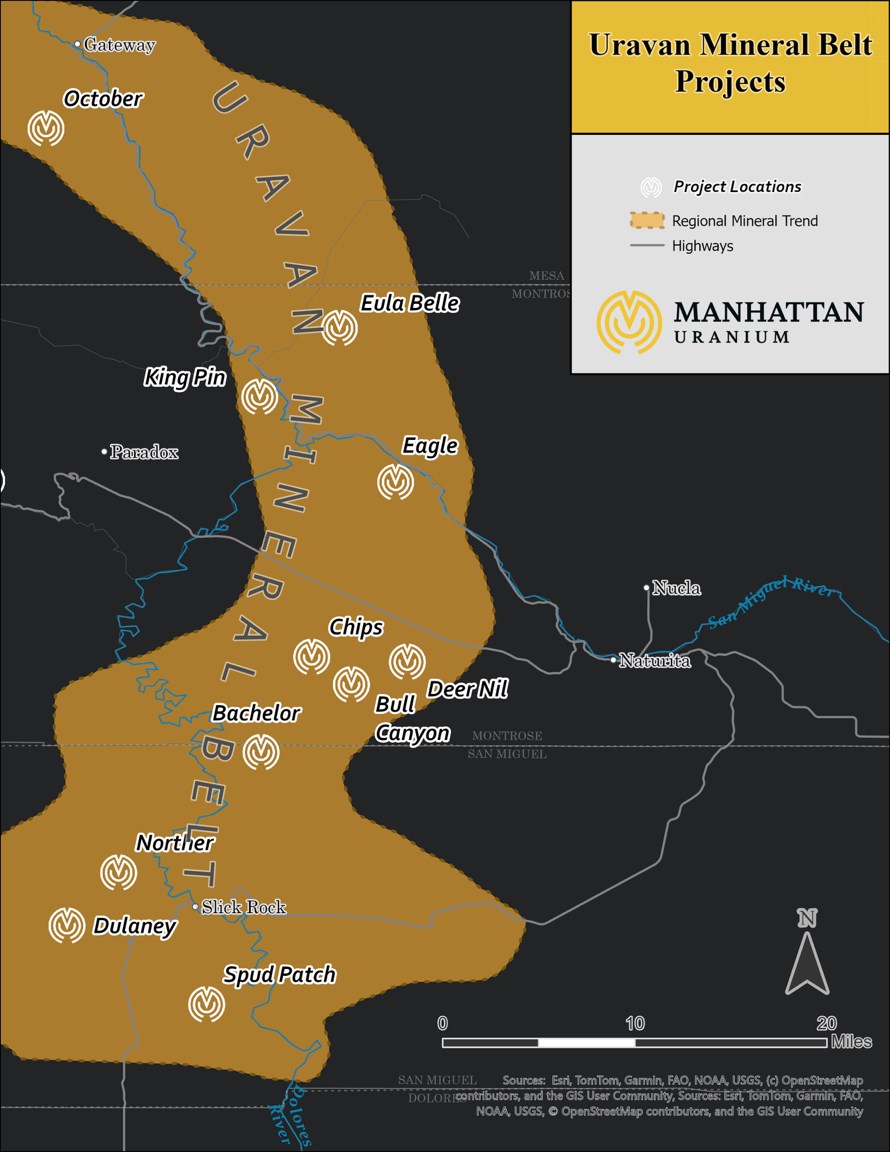
Figure 1: Manhattan Uranium's Uravan Mineral Belt projects.
To view an enhanced version of this graphic, please visit:
https://images.newsfilecorp.com/files/8126/323263_4d6d4c9a545aa8ee_001full.jpg
Historical Estimate
A historical estimate prepared for Atlas Corporation ("Atlas") reported 21,788 short tons grading 0.32% U₃O₈ and 0.88% V₂O₅, containing approximately 140,000 pounds of U₃O₈ and 383,000 pounds of V₂O₅, in a category Atlas described as indicated³. The estimate was prepared as part of Atlas's inventory of uranium and vanadium ore reserves tributary to its Moab mill in Utah, effective June 30, 1984.
The historical estimate is presented for reference only. It predates National Instrument 43-101 and the CIM Definition Standards, and the category assigned by Atlas is not a CIM category and is not equivalent to a current mineral resource or mineral reserve. The key assumptions, parameters, and methods used to prepare the estimate are not documented in the records available to the Company. A Qualified Person has not done sufficient work to classify the historical estimate as a current mineral resource or mineral reserve, and Manhattan is not treating it as such. Verification would require recovering the original drill and sample data underlying the estimate, twinning historical holes, and confirming grades by chemical assay. The Company has not completed that work.
Selected High-Priority Historical Intercepts
The table below presents 18 high-priority historical intercepts identified to date from the Company's ongoing review of the database.
| Drill Hole ID | From (ft) | To (ft) | Thickness (ft) | eU₃O₈ (%)* |
| O-2 | 640.9 | 641.9 | 1 | 1.98 |
| BM-155-80 | 483.0 | 485.0 | 2 | 1.74 |
| O-121 | 425.5 | 427.0 | 1.5 | 1.57 |
| O-17 | 629.1 | 629.9 | 0.8 | 1.37 |
| O-217 | 625.2 | 630.0 | 4.8 | 1.16 |
| O-30 | 628.4 | 632.0 | 3.6 | 1.13 |
| O-5 | 644.0 | 648.7 | 4.7 | 1.03 |
| BM-157-80 | 505.0 | 507.0 | 2 | 0.89 |
| O-19 | 664.4 | 667.6 | 3.2 | 0.82 |
| O-101 | 525.5 | 526.0 | 0.5 | 0.81 |
| O-21 | 631.3 | 633.2 | 1.9 | 0.76 |
| O-21 | 642.8 | 644.3 | 1.5 | 0.62 |
| BM-349-88 | 623.3 | 626.8 | 3.5 | 0.62 |
| BM-176-81 | 526.2 | 528.7 | 2.5 | 0.60 |
| O-95 | 499.8 | 501.0 | 1.2 | 0.54 |
| O-197 | 507.7 | 509.4 | 1.7 | 0.49 |
| O-280 | 549.0 | 554.0 | 5 | 0.47 |
| BM-153-80 | 535.3 | 536.3 | 1 | 0.35 |
| O-197 | 558.8 | 562.8 | 4 | 0.26 |
* eU₃O₈ = equivalent U₃O₈ from historical downhole gamma (radiometric) logging, not chemical assays. Values assume secular equilibrium; disequilibrium, if present, may cause them to over- or under-state true uranium grades. Reported intervals are downhole lengths, not true thicknesses. Historical and unverified, for exploration reference only.
Geology and Project Context
The October Project is located in the Beaver Mesa area of the Gateway district, at the north end of the Uravan Mineral Belt in Mesa County, Colorado, one of the most productive uranium-vanadium areas in the United States. Uranium mineralization at the project is hosted within the Salt Wash Member of the Morrison Formation, a sequence of stacked fluvial sandstones that served as the primary host for uranium and vanadium production throughout the belt during the 1947 to 1979 mining cycle. The largest deposits in the belt occur in the uppermost sandstone package, known locally as the Top Rim. The district has a well-documented production history and existing infrastructure including roads, power, and historical mine workings.
The Company's lithology model is being used to constrain uranium-bearing horizons and to support 3D interpretation of gamma-defined mineralized trends. Using the updated drillhole database, digitized underground workings, and interpreted lithology model, Manhattan has begun generating preliminary 3D uranium target domains designed to identify areas where historical gamma intercepts, favorable stratigraphy, and nearby underground development suggest potential for additional uranium mineralization.
Technical Work Completed to Date
- Consolidated historical drillhole collar, survey, and assay/gamma records into a modern digital database.
- Compiled approximately 336 drill collar locations and matching downhole survey records.
- Added missing survey records where required using vertical-hole assumptions for legacy holes lacking survey data.
- Reviewed and corrected interval gaps, overlaps, duplicate records, and missing-value codes.
- Built an initial lithology model focused on the Salt Wash Member of the Morrison Formation.
- Generated preliminary 3D uranium target domains to guide follow-up drilling.
Next Steps
- Continued validation and reconciliation of historical gamma data with underground workings and modern exploration results.
- Refinement of the lithology model and 3D uranium target domains.
- Continued recovery of historical records and expansion of the database as the review of legacy material proceeds.
Technical Disclosure
The historical drillhole and gamma data referenced in this news release were compiled from legacy maps and historical records believed to be reliable. The Company has not yet completed sufficient work to independently verify these data and/or results. In addition, historical gamma values may not be directly comparable to modern chemical assay results and are being used by the Company for exploration targeting and modeling purposes only.
No current mineral resource or mineral reserve estimate has been established at the October Project.
Mineralization, historical production and processing infrastructure at nearby or regional properties, including the historic Whirlwind Mine and White Mesa Mill, are not necessarily indicative of mineralization, development potential or processing availability at the October Project.
The uranium grades in this news release are expressed as equivalent U₃O₈ (eU₃O₈) and are derived from historical downhole gamma-probe (radiometric) measurements, not chemical assays. Equivalent grades are calculated from gamma response and assume secular equilibrium between uranium and its radioactive decay products. Uranium in sandstone-hosted systems such as at the October Project is mobile and may occur in radioactive disequilibrium, in which case eU₃O₈ values may materially overstate or understate true uranium grades. The gamma-probe equipment, calibration standards, and conversion parameters used by the historical operators are not fully documented, and the Company has not independently verified the original measurements or conversions. Reported intervals represent downhole lengths, not true thicknesses. These historical values are used for exploration targeting and 3D modeling only. The Company encourages readers to exercise appropriate caution when evaluating these data and/or results.
Qualified Person
The technical and scientific information in this news release has been reviewed and approved by Galen McNamara, P.Geo., CEO and a director of Manhattan, who is a Qualified Person as defined by National Instrument 43-101 - Standards of Disclosure for Mineral Projects ("NI 43-101"). Mr. McNamara is not independent of Manhattan under NI 43-101.
About Manhattan Uranium Discovery Corp.
Manhattan Uranium Discovery Corp. (TSXV: MANU) (OTCQB: MAUUF) (FSE: J5B0) is a newly consolidated North American uranium company committed to the discovery, development, and advancement of high-quality uranium assets. Following the successful acquisitions of Urano Energy and Pegasus Resources, Manhattan now holds a premier portfolio of 15 past-producing uranium mines across 25 underexplored properties covering 25,099 acres in the United States, complemented by high-grade exploration potential in Canada's Athabasca Basin. Backed by an experienced technical and management team with decades of uranium discovery, project advancement, and capital markets experience, Manhattan is strategically positioned to capitalize on the growing demand for domestic uranium and the American nuclear renaissance. For more information about Manhattan, please visit: www.manhattanuranium.com.
Neither the TSX Venture Exchange nor its Regulation Services Provider (as that term is defined in the policies of the TSX Venture Exchange) accepts responsibility for the adequacy or accuracy of this release.
Follow Manhattan on social media for the latest updates
On behalf of Manhattan Uranium Discovery Corp.
"Galen McNamara"
Chief Executive Officer and Director
604-288-8046
Info@manhattanuranium.com
REFERENCES
¹ Chenoweth, W.L. "The Uranium-Vanadium Deposits of the Uravan Mineral Belt and Adjacent Areas, Colorado and Utah." In Western Slope (Western Colorado), edited by R.C. Epis and J.F. Callender, 165-70. New Mexico Geological Society, 1981.
2 Peters, D.C. (2011). Updated Technical Report on Energy Fuels Resources Corporation's Whirlwind Property (Including Whirlwind, Far West, and Crosswind Claim Groups and Utah State Metalliferous Minerals Lease ML-49312), Mesa County, Colorado and Grand County, Utah. NI 43-101 technical report prepared for Energy Fuels Inc. by Peters Geosciences, Golden, Colorado, effective March 15, 2011.
3 Gillingham, Thomas, E., Consulting Mining Engineer, 1984, (August 16, 1984), Atlas Controlled Uranium and Vanadium Ore Reserve Tributary to Moab (Utah) Mill as of 6/30/84: Personal communication to Mr. Edward Farley, Jr., President, Atlas Corporation, 11p.
FORWARD-LOOKING STATEMENTS
This news release contains "forward-looking statements" and "forward-looking information" within the meaning of applicable Canadian and United States securities legislation (collectively, "forward-looking statements"). All statements in this release, other than statements of historical fact, are forward-looking statements. Forward-looking statements are frequently, but not always, identified by words such as "may", "will", "expect", "intend", "believe", "anticipate", "estimate", "target", "plan", "potential", "could" or similar terminology. Forward-looking statements in this release include, without limitation, statements relating to: the Company's ongoing review, compilation, validation and interpretation of historical drillhole, gamma and mine-working data; the reliability and usefulness of historical information for exploration targeting; the refinement of the Company's 3D geological and uranium target model; the recovery of additional historical records; the ranking, planning and execution of future exploration and drilling at the October Project; the potential to identify additional uranium mineralization; the Company's exploration strategy and project advancement plans; requirements for additional capital; commodity prices; government regulation; and future plans, projections, objectives, estimates and forecasts and the timing related thereto.
Forward-looking statements are based on management's current beliefs, expectations and assumptions, including, without limitation: that historical information is reliable; that future exploration activities will proceed as currently anticipated; that permits, equipment, personnel and contractors will be available on commercially reasonable terms; and that current commodity prices, labour availability, cost and regulatory frameworks will remain consistent with management's expectations. Although management considers these assumptions to be reasonable based on currently available information, they may prove to be incorrect.
Forward-looking statements are subject to known and unknown risks, uncertainties and other factors that may cause actual results, performance or achievements to differ materially from those expressed or implied by such forward-looking statements. Such risks and uncertainties include, without limitation: the risk that historical data may prove to be inaccurate or unverifiable; that exploration results may not support further work or drilling; that exploration activities may be delayed, restricted or not carried out as planned; that permits may be delayed or revoked; the absence of adverse conditions at mineral properties; the price of uranium and other metals remaining at levels that render mineral properties economic; the Company's ability to continue raising necessary capital to finance operations; the absence of current mineral resources or mineral reserves at the October Project; the Company's ability to complete its planned exploration programs; environmental regulations or hazards and compliance with complex regulations associated with mining activities; climate change and climate change regulations; fluctuations in exchange rates; the business objectives of the Company; whether mineralization can be confirmed by modern drilling and chemical assays; the uncertainty that any mineralization encountered on adjacent properties continues on to any of the Company's properties; the uncertainty that geological and/or geophysical and/or any trends, interpretations, or conclusions related to adjacent properties have relevance to any of the Company's properties; the uncertainty that the exploration season can be extended; changes in project parameters as plans continue to be refined; the consequences and implications of the historical mining activities on the environment and whether such affects the potential exploration and/or development of any mining operation on the Company's properties; the implications of claims from First Nations, Tribes, Tribal Councils or Tribal Governments and land claims settlements on the Company's projects; accidents, labour disputes and other risks of the mining industry, conclusions of economic evaluations; future prices of metals; possible variations of mineral grade; whether historical gamma values can be confirmed by modern chemical assays; geological, mining and exploration technical problems; title to properties; operational, technical and geological risks inherent in mineral exploration; changes in capital markets, economic conditions, regulatory developments and stakeholder relations; the other risks set out in the Company's public disclosure record under its profile on SEDAR+ (www.sedarplus.ca) and management's ability to anticipate and manage the foregoing risks and uncertainties.
The Company provides no assurance that forward-looking statements will prove to be accurate, as actual results and future events could differ materially from those anticipated in such statements. Accordingly, readers should not place undue reliance on forward-looking statements. The Company does not undertake to update any forward-looking statements, other than as required by law.
To view the source version of this press release, please visit https://www.newsfilecorp.com/release/323263