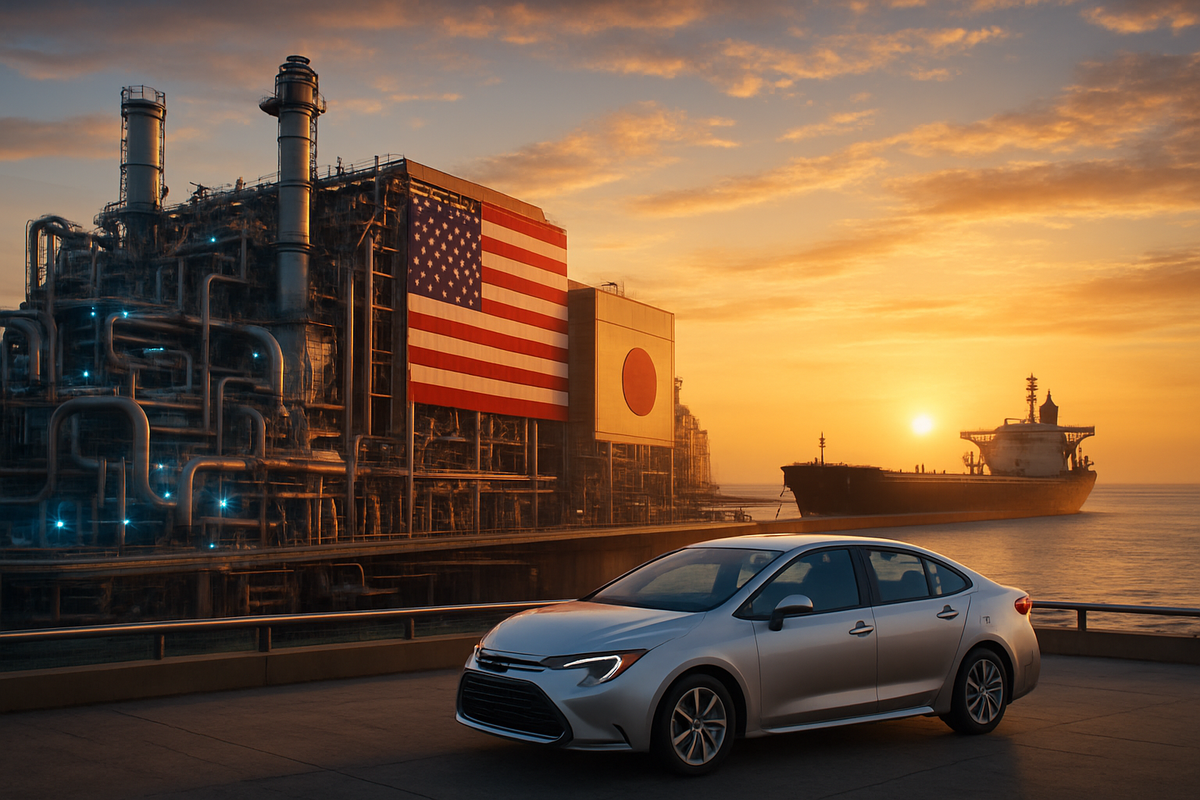
In a historic realignment of global economic power, the United States and Japan have finalized a massive $550 billion Strategic Trade and Investment Agreement. This landmark pact, touted as a "New Golden Age" for the two nations, involves a staggering commitment by Japanese firms to bankroll the re-industrialization of the American heartland. At its core, the deal trades guaranteed Japanese capital for strategic sectors—ranging from massive energy infrastructure to high-tech manufacturing—in exchange for a stabilized tariff environment that provides a much-needed relief valve for Japan’s powerhouse automotive sector.
As of April 7, 2026, the immediate implications are already rippling through the markets. The agreement formally codifies a 15% cap on reciprocal tariffs for Japanese automobiles and auto parts, effectively ending years of uncertainty that had threatened to push import levies as high as 25%. Beyond trade barriers, the deal greenlights two of the most ambitious infrastructure projects in recent North American history: a $33 billion natural gas-fired power facility in Ohio and a $2.1 billion deepwater crude oil terminal in Texas. These projects represent a fundamental shift toward "transactional diplomacy," where market access is increasingly tied to direct investment in domestic energy and technology security.
The Architecture of a $550 Billion Alliance
The agreement, which was finalized earlier this spring after months of high-stakes negotiations, centers on Japan’s pledge to deploy $550 billion in capital into the U.S. by 2029. The timeline leading to this moment began with the 2025 "Energy Addition" policy framework, which sought to pair foreign capital with U.S. natural resources to meet the skyrocketing electricity demands of the artificial intelligence boom. Key players in the negotiation included the U.S. Department of Commerce and Japan’s Ministry of Economy, Trade and Industry (METI), alongside heavyweights like SoftBank Group (OTCPK: SFTBY).
The centerpiece of this industrial surge is the Portsmouth Powered Land Project in Ohio. This $33 billion facility is slated to become the largest gas-fired power plant in history, capable of generating 9.2 gigawatts (GW) of power. It is specifically designed to feed the massive "data center alley" emerging in the Midwest, where AI workloads have outpaced the existing electrical grid's capacity. Groundbreaking is scheduled for later this year, signaling a major win for the "baseload power" movement which argues that intermittent renewables must be supplemented by large-scale natural gas generation to sustain the AI revolution.
Simultaneously, the $2.1 billion Texas GulfLink project in Brazoria County marks a significant expansion of U.S. energy dominance. This deepwater crude oil export terminal will allow Very Large Crude Carriers (VLCCs) to load up to 2 million barrels of oil directly offshore, bypassing the logistical bottlenecks of nearshore ports. This project is expected to facilitate between $20 billion and $30 billion in annual crude exports, further cementing the U.S. role as a primary energy supplier to the Pacific.
Market Winners and Industrial Realignment
The clear winners in this new trade regime are the Japanese automotive giants, led by Toyota Motor Corp (NYSE: TM) and Honda Motor Co (NYSE: HMC). By securing a 15% tariff cap, these companies avoid the catastrophic 25% "national security" tariffs that had been under consideration. While 15% is higher than historical norms, the certainty it provides allows for long-term supply chain planning. Investors have already responded, with Toyota shares seeing a significant uptick as the company announced plans to integrate more U.S.-manufactured models into its Tokyo showrooms as part of the deal’s reciprocity requirements.
In the energy and industrial sectors, GE Vernova (NYSE: GEV) stands to gain immensely as a primary supplier of high-efficiency turbines for the $33 billion Ohio plant. The scale of the Portsmouth project provides a multi-year backlog for GE Vernova’s gas power division. Similarly, ExxonMobil (NYSE: XOM), a joint venture partner in the pipelines feeding the Texas GulfLink terminal, will benefit from the increased export capacity and the streamlined offshore loading process. Mitsui O.S.K. Lines (OTCPK: MSLOY) is also positioned to win, as it will likely handle a significant portion of the shipping logistics for the crude oil and liquefied natural gas (LNG) flowing toward Japanese ports under the new long-term contracts.
However, the agreement is not without its losers. Smaller domestic U.S. manufacturers who had been hoping for the full 25% protectionist tariff may find themselves facing stiffer competition from Japanese imports than they had anticipated. Furthermore, environmental advocacy groups have expressed concern over the sheer scale of the natural gas expansion, potentially setting the stage for protracted legal battles over the Ohio facility’s carbon footprint, despite its role in powering the digital economy.
Wider Significance and Geopolitical Shifts
This $550 billion pact is more than a trade deal; it is a strategic maneuver to decouple critical supply chains from China. By anchoring Japanese capital in the American Midwest and Gulf Coast, the U.S. is creating a "resilient corridor" for energy and high-tech manufacturing. This mirrors broader industry trends where "friend-shoring" has evolved into "on-shoring with foreign capital." The move to build the world’s largest gas plant to power AI specifically addresses the growing fear that the U.S. energy grid is the primary bottleneck to maintaining a lead in the global AI race.
The historical precedent for this agreement can be found in the 1980s Plaza Accord, though the 2026 agreement is far more collaborative and focused on infrastructure than currency manipulation. The 15% tariff baseline also signals a new era of "Reciprocal Trade" as a permanent fixture of U.S. policy, regardless of the political administration. It suggests that the era of low-to-zero tariffs is effectively over, replaced by a "pay-to-play" model where market access is granted in exchange for massive direct investment in the host country’s strategic infrastructure.
Moreover, the Texas GulfLink project carries heavy geopolitical weight. By expanding the ability to flood global markets with American crude, the U.S. and Japan are placing indirect economic pressure on energy-dependent adversaries. The ability to load VLCCs efficiently reduces global shipping costs and provides a buffer that allows the U.S. to enforce stricter energy sanctions elsewhere without triggering a global price spike.
The Road Ahead: 2027 and Beyond
In the short term, the market will be watching for the formal groundbreaking of the Portsmouth facility and the regulatory finalization of the Texas terminal. Any delays in these projects could dampen investor enthusiasm for the "New Golden Age" narrative. Companies like Hitachi Ltd (OTCPK: HTHIY) and Mitsubishi Electric (OTCPK: MIELY), who are expected to provide the sophisticated electrical grid components for the Ohio plant, will need to ramp up their U.S. operations to meet the aggressive 2028 operational targets.
Long-term, the 15% tariff cap may serve as a template for future trade agreements with other key allies, such as South Korea or the European Union. Strategic pivots are already underway; Japanese automakers are increasingly "localizing" their R&D and manufacturing in the U.S. to mitigate the remaining 15% tariff. This will likely lead to a surge in domestic jobs in the "Auto Alley" of the South and the Midwest, but it may also lead to higher vehicle prices for consumers as the costs of this re-industrialization are passed down.
The most significant challenge moving forward will be the integration of these massive projects into the existing U.S. regulatory and environmental framework. While the federal government has signaled a "fast-track" for these strategic assets, local opposition and state-level regulations could still present hurdles. Investors should keep a close eye on the "vapor recovery" technologies being piloted at the Texas terminal, as successful implementation could set a new global standard for "green" crude exports, further insulating the project from environmental pushback.
Conclusion: A Pivot Toward Strategic Stability
The $550 billion US-Japan trade agreement represents a paradigm shift in how global powers manage economic competition and national security. By tying the health of the Japanese automotive industry to the success of American energy and AI infrastructure, the two nations have created a symbiotic relationship that is difficult to untangle. The Portsmouth Powered Land Project and Texas GulfLink are the physical manifestations of this bond—colossal bets on the future of energy and digital dominance.
As we move through 2026, the market appears cautiously optimistic. The removal of the "tariff sword of Damocles" has brought stability to the auto sector, while the massive influx of Japanese capital provides a clear growth trajectory for the U.S. energy and industrial sectors. For investors, the key will be monitoring the execution of these megaprojects. The ability of the U.S. to deliver on its promise of a modernized, high-capacity energy grid will be the ultimate litmus test for the success of this agreement.
Moving forward, the focus will shift from the high-level diplomacy of the signing ceremony to the "boots-on-the-ground" reality of construction and integration. The $550 billion commitment is a monumental start, but its lasting impact will be measured in gigawatts, barrels, and the resilience of a supply chain that now stretches more firmly than ever across the Pacific.
This content is intended for informational purposes only and is not financial advice.