In a trading session characterized by a sharp retreat in major indices, the semiconductor sector emerged as a rare bastion of growth, defying a wave of selling that swept through the broader market. On April 2, 2026, as the S&P 500 and the Nasdaq Composite grappled with a "growth scare" driven by rising energy costs and persistent inflation, two of the industry’s most storied players posted significant gains. Intel Corp (NASDAQ: INTC) saw its shares climb 3.8%, while Advanced Micro Devices (NASDAQ: AMD) added 2.4%, signaling a decoupling of high-performance computing from the macroeconomic malaise.
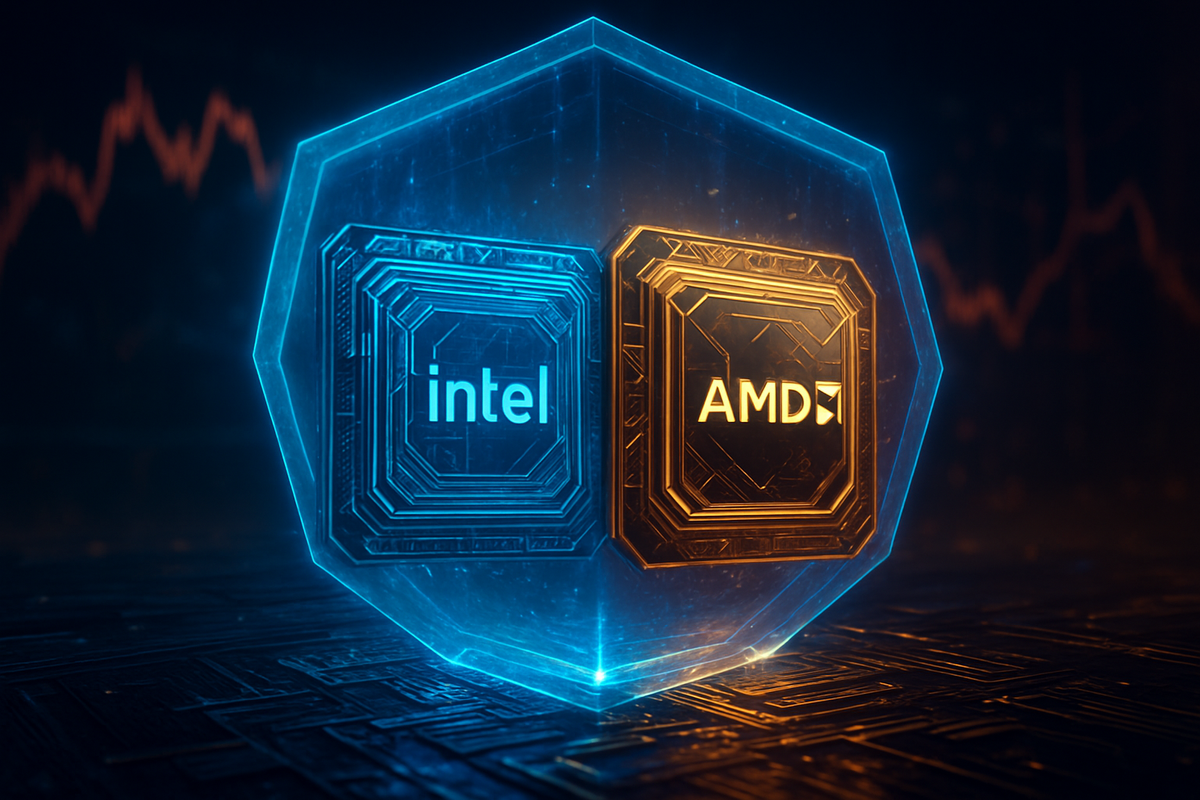
The divergence underscores a fundamental shift in investor sentiment: the transition of Artificial Intelligence from a speculative "hype" cycle to a tangible "productivity" boom. As enterprises move beyond experimental chatbots toward autonomous "Agentic AI" and hardware-intensive local processing, the infrastructure providers—once seen as cyclical and volatile—are increasingly viewed as the essential utility of the 21st century. This "AI safety net" appears to be providing a floor for large-cap technology leaders, even as the rest of the market faces a structural correction.
A Tale of Two Tapes: Semiconductors Defy the Correction
The market action on April 2, 2026, was stark. A combination of Brent crude oil prices hovering above $100 per barrel and a "hawkish pause" from the Federal Reserve sent the S&P 500 into a tailspin, with the index testing its 200-day moving average as investors feared a "higher-for-longer" interest rate environment would finally dampen consumer spending. However, the semiconductor sector, led by Intel and AMD, refused to follow the script. The rally was catalyzed by several key milestones reached in the first quarter of the year.
For Intel, the 3.8% jump represents a significant validation of its "IDM 2.0" strategy. After years of trailing TSMC, Intel’s 18A (1.8nm) manufacturing node has reportedly reached a critical yield threshold of 70%, making it economically viable for mass-market production. Meanwhile, AMD’s 2.4% gain followed reports of massive pre-orders for its MI400 series accelerators, which are the first to utilize high-bandwidth HBM4 memory to break the "memory wall" that has plagued large language model (LLM) training.
The timeline leading to this moment was paved by the 2025 "Windows 10 Cliff." With Microsoft (NASDAQ: MSFT) officially ending support for Windows 10 in late 2025, a massive global PC refresh cycle took hold in early 2026. This wasn't a standard upgrade; it was the first "AI-first" refresh, where every enterprise-grade machine shipped requires an NPU (Neural Processing Unit) capable of at least 40 TOPS (Tera Operations Per Second). Intel and AMD, having secured the lion's share of this market, are now reaping the rewards of a forced hardware replacement cycle.
Winners and Losers in the Agentic Era
The resilience of Intel and AMD highlights a "Great Bifurcation" in the technology sector. The winners are those providing the physical compute density required for the next phase of automation. Intel’s "Geopolitical Shield"—its status as the only advanced-logic foundry on U.S. soil—has made it a darling for fabless designers like Qualcomm (NASDAQ: QCOM) and even Apple (NASDAQ: AAPL), who are seeking to de-risk their supply chains amid ongoing tensions in the Taiwan Strait.
On the other hand, the "losers" of this market shift are becoming more apparent. Small-cap software companies that built simple "wrappers" around foundational models are seeing their valuations evaporate as companies like Microsoft and Google (NASDAQ: GOOGL) integrate those features natively into their OS environments. Furthermore, legacy hardware makers like Oracle (NYSE: ORCL) are facing "CapEx Shock," where the astronomical cost of building 2026-grade data centers is beginning to compress margins, leading to the broader market drag seen on April 2.
The industrial sector is also feeling the heat. While chipmakers thrive, traditional manufacturers are struggling with the "Power Wall." As data centers consume an estimated 4% of global electricity in 2026, energy prices have surged, leaving non-AI industrial firms with higher overhead and lower priority on the grid. This has created a paradoxical market where the very tools designed to increase productivity (AI) are indirectly raising the costs for traditional sectors.
The Productivity Shield: Beyond the Hype
The wider significance of the April 2 price action lies in the maturation of AI technology. We have entered the era of Agentic AI, where software no longer just "suggests" or "summarizes" but actively executes complex workflows—such as managing supply chains or performing real-time financial audits—without human intervention. This has shifted the ROI (Return on Investment) conversation from "if" to "how much."
Historically, such transitions have precedents in the build-out of the internet (1998-2001) and the mobile revolution (2010-2012). However, the 2026 semiconductor boom is distinct because of its "hybrid" nature. Unlike the cloud-only models of 2023, the 2026 ecosystem relies on a mix of massive data center clusters and "Edge AI" running on local hardware. This ensures that even if cloud spending slows, the consumer and enterprise hardware cycles (driven by Intel's Panther Lake and AMD's Ryzen AI series) provide a secondary engine of growth.
Regulatory tailwinds are also playing a role. The U.S. government’s continued subsidies under the CHIPS Act 2.0 have incentivized domestic manufacturing, effectively de-risking the capital expenditure of companies like Intel. This has turned what was once a highly sensitive cyclical industry into a strategic national asset, attracting "defensive" capital during market downturns.
The Road Ahead: 2H 2026 and the Energy Challenge
Looking toward the second half of 2026, the primary challenge for Intel and AMD will not be demand, but the "physical limits of growth." The "Power Wall"—the ability to secure enough electricity to run the next generation of 2nm fabs and massive HBM4-equipped server farms—is the new bottleneck. Strategic pivots are already underway, with both companies investing heavily in "silicon photonics" and advanced liquid cooling technologies to reduce the energy footprint of their chips.
Short-term, the market remains "pensive." While semiconductors are leading, the broader S&P 500 is facing a "valuation reality check." Investors should watch for the Q2 earnings season, which will be the first true test of whether the "Agentic AI" deployments are actually hitting the bottom line of the Fortune 500. If productivity gains do not materialize as expected, even the semiconductor "safety net" could be tested by a broader capex slump.
However, the long-term outlook remains bullish for the large-cap leaders. The integration of AI into every facet of the global economy is a "genie that won't go back in the bottle." For Intel and AMD, the goal is now to maintain their execution on 2nm-and-beyond processes while navigating an increasingly complex energy and geopolitical landscape.
Summary and Investor Outlook
The trading events of April 2, 2026, serve as a potent reminder that the semiconductor industry is no longer just a proxy for the PC market; it is the fundamental architecture of the global economy. Intel's 3.8% rise and AMD's 2.4% gain amidst a broader market decline highlight a flight to quality and a recognition that the AI productivity boom is a structural, not cyclical, event.
Moving forward, investors should keep a close eye on three key metrics:
- 18A Yield Consistency: For Intel, any deviation from its manufacturing roadmap could quickly erode its newly found "resilience."
- HBM4 Supply Chains: For AMD, the ability to secure enough high-bandwidth memory from partners like Micron (NASDAQ: MU) or SK Hynix will determine its ability to meet MI400 demand.
- The Energy Nexus: Watch for partnerships between chipmakers and energy providers (Small Modular Reactors or private grids), as power availability becomes the ultimate competitive advantage.
As we navigate the volatility of mid-2026, the "Silicon Fortress" built by Intel and AMD appears to be one of the few places where growth remains not just possible, but inevitable.
This content is intended for informational purposes only and is not financial advice.