
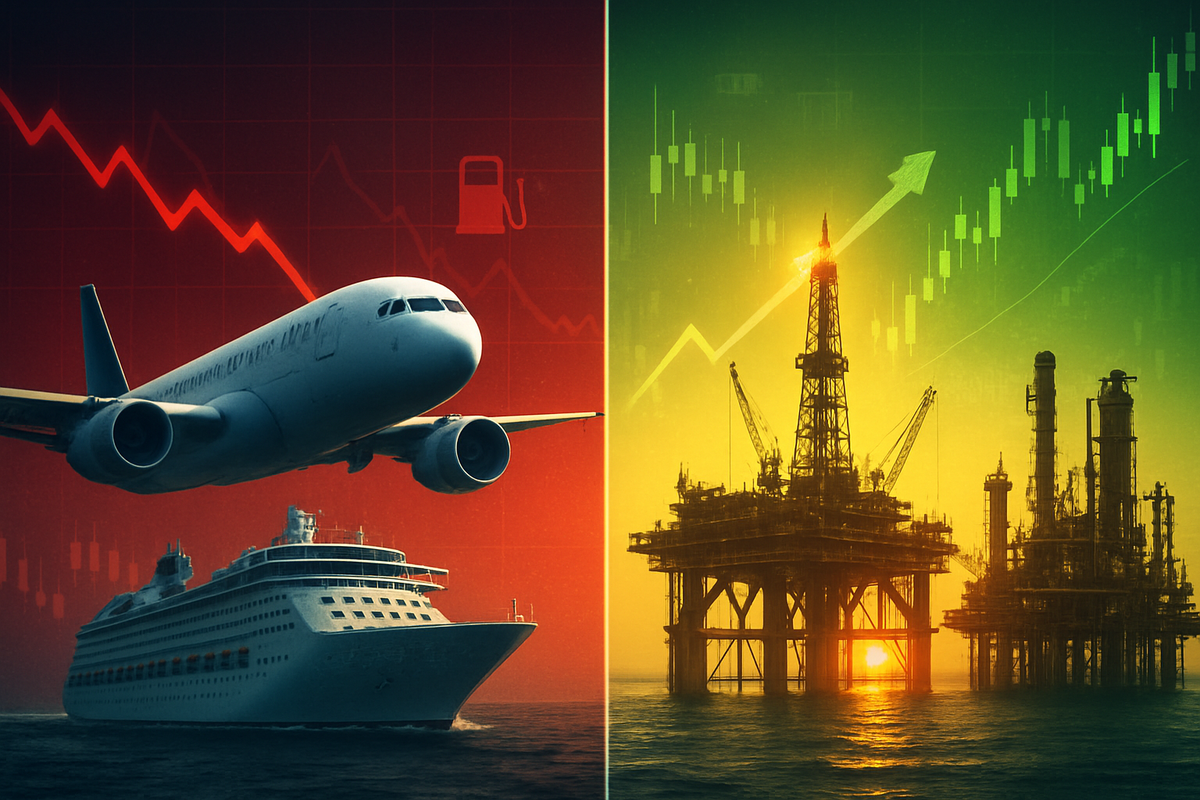
The financial markets witnessed a stark divergence on April 2, 2026, as a sudden surge in global crude oil prices sent shockwaves through the equity landscape. While the energy sector basked in a sea of green, travel and transportation stocks faced a punishing sell-off. The day’s trading session highlighted the growing fragility of the post-pandemic travel boom when faced with the harsh reality of escalating input costs, effectively splitting the S&P 500 into those who harvest energy and those who are consumed by its price.
The immediate implications are clear: the "disinflation" narrative that dominated early 2026 forecasts is being challenged by supply-side pressures. For investors, this shift marks a return to a high-volatility regime where sector selection outweighs broad index momentum. As energy costs eat into corporate margins and consumer discretionary income, the market is quickly repricing the earnings potential of major transport players, favoring instead the integrated oil giants that serve as a natural hedge against geopolitical instability.
The Flare-Up: A Day of Reckoning for Global Logistics
The catalyst for today’s market volatility was a confluence of supply disruptions and a surprise revision in global demand forecasts. Early in the trading session, Brent crude futures breached the psychological $95 per barrel mark, a level not seen in nearly eighteen months. The surge followed reports of renewed technical bottlenecks in major Atlantic pipelines and a decision by key OPEC+ members to extend production caps through the end of the year. This supply tightness coincided with a stronger-than-expected manufacturing report out of East Asia, suggesting that global demand for energy remains resilient despite central bank efforts to cool the economy.
By mid-day, the impact on the stock market was visceral. United Airlines (Nasdaq: UAL) saw its shares plummet by 6.1%, as analysts scrambled to adjust their fuel cost assumptions for the second quarter. The airline, which has famously maintained a strategy of not hedging its fuel costs, found itself fully exposed to the spot market’s volatility. The rapid descent in United's stock price triggered a broader retreat across the airline industry, as investors feared that the "no-hedge" gamble of major carriers would lead to significant margin compression just as the summer travel season approaches.
The cruise industry suffered a similar fate. Carnival Corporation (NYSE: CCL) saw a 5% decline in its share price by the closing bell. Unlike some of its peers, Carnival's fuel exposure is largely unhedged, making it a primary target for sellers whenever crude prices spike. The market’s reaction reflects a deep-seated concern that cruise operators, still carrying significant debt from the early 2020s, have limited room to absorb higher operating expenses without sacrificing the profitability they have worked so hard to recover.
The atmosphere on the trading floor was one of frantic recalibration. Traders shifted capital out of high-burn industries and into "old economy" energy plays. This rotation was not a slow migration but a swift tactical pivot, as the realization set in that the "energy tax" on the global economy was returning with a vengeance. The day served as a reminder that in the high-stakes environment of 2026, the cost of moving people and goods remains the most volatile variable in the corporate profit equation.
Winners and Losers: The Bifurcated S&P 500
In the winner’s circle today were the titans of the fossil fuel era. Exxon Mobil (NYSE: XOM) and Chevron (NYSE: CVX) emerged as the primary beneficiaries of the crude rally, with both stocks gaining more than 3% during the session. These integrated energy giants are uniquely positioned to profit from both ends of the price spike. Their upstream divisions see immediate margin expansion as the selling price of extracted oil rises against relatively fixed production costs. Meanwhile, their refining arms benefit from widening "crack spreads"—the profit margin derived from turning crude into products like jet fuel and diesel—which often expand when supply is tight.
Exxon Mobil, in particular, has utilized its massive cash reserves to bolster share buybacks and dividends, making it a "safe haven" for capital during energy-led inflationary periods. For investors, XOM and CVX represent a dual-threat defense: they provide exposure to rising commodity prices while maintaining the balance sheet strength to weather broader market downturns. The divergence today confirms that these companies are no longer just cyclical plays but are essential components of a defensive equity strategy in an era of persistent energy uncertainty.
Conversely, the losers—United Airlines and Carnival—face a daunting uphill climb. For United, fuel typically accounts for between 30% and 40% of total operating expenses. Without a hedging program to soften the blow, every dollar increase in the price of jet fuel flows directly to the bottom line as a loss. The company’s leadership has historically argued that hedging is a costly insurance policy that doesn't pay off in the long run, but on days like today, that philosophy is tested by shareholders who favor more predictable earnings.
Carnival Corporation finds itself in an even more precarious position. While it has the contractual right to implement fuel surcharges on passengers when prices hit certain thresholds, doing so is a risky move. In a competitive leisure market where consumers are already pinched by general inflation, adding a $10-per-day "fuel tax" to a cruise ticket could dampen demand. Carnival's high fixed costs and substantial debt load mean that any erosion in net income is magnified, leading to the outsized stock price drops seen in today’s session.
Broad Significance: The Return of the Energy Tax
The divergence between energy and travel is not merely a one-day market quirk; it signifies a broader shift in the global economic narrative. This event fits into a recurring trend where energy volatility acts as a "silent tax" on both corporations and consumers. When fuel costs rise, the ripple effects extend far beyond the gas pump. For competitors like Delta Air Lines (NYSE: DAL) and American Airlines (Nasdaq: AAL), the pressure to raise fares to offset fuel costs is immense. However, if they raise prices too high, they risk cooling the very travel demand that has fueled their recent growth.
This situation also has significant regulatory and policy implications. As energy prices climb, central banks, including the Federal Reserve, are forced to reconsider their interest rate paths. High energy costs are a primary driver of headline inflation, and if they persist, the "pivot" to lower rates that many market participants were expecting in late 2026 may be delayed. This creates a "double whammy" for capital-intensive companies like Carnival: they face higher operating costs from fuel and higher interest expenses on their debt for a longer period.
Historically, periods of rising crude prices have led to a "survival of the fittest" among airlines. We saw this in the late 2000s and again in the mid-2010s, where carriers with superior fuel efficiency and better hedging strategies were able to gain market share while weaker players were forced into consolidation or bankruptcy. The 2026 energy spike may trigger a similar round of strategic re-evaluations, forcing airlines to retire older, less fuel-efficient aircraft faster than planned and accelerating the push toward Sustainable Aviation Fuel (SAF), though the latter remains a more expensive alternative in the short term.
Furthermore, the strength of Exxon and Chevron highlights the enduring importance of traditional energy in a world that is supposedly transitioning to green power. The reality of 2026 is that the global economy still runs on oil, and the transition period is proving to be far more volatile than many predicted. This "energy gap"—where demand for oil outpaces the growth of renewable infrastructure—ensures that the energy sector will continue to hold a "veto power" over the performance of the broader market for the foreseeable future.
The Road Ahead: Strategic Pivots and Pricing Power
Looking forward, the travel sector must decide whether to absorb these costs or pass them on to an increasingly price-sensitive consumer. In the short term, expect United Airlines and its peers to lean heavily on "revenue management" algorithms to stealthily increase base fares and international surcharges. If crude remains above $90, we may see the first implementation of cruise fuel supplements in years—a move that will be a litmus test for the resilience of the leisure travel market.
In the long term, this energy crisis may force a permanent shift in how travel companies manage commodity risk. The "no-hedge" strategy that became popular during the low-inflation years of the early 2020s may fall out of favor, replaced by a more conservative approach to fuel procurement. Additionally, market opportunities may emerge for companies that specialize in fuel-efficiency technologies or carbon-capture solutions, as the high cost of traditional fuel makes these alternative investments more economically viable.
The potential scenarios for the next six months range from a stabilization of prices if OPEC+ relents, to a full-blown energy "shock" if geopolitical tensions escalate further. If the latter occurs, the divergence we saw today will likely widen into a chasm. Investors should prepare for a period where "energy-intensive" becomes a derogatory term in the eyes of analysts, and where pricing power—the ability to raise prices without losing customers—becomes the single most important metric for evaluating a company's survival prospects.
Final Reflections: Navigating the New Energy Reality
Today’s performance gap between the energy giants and travel mainstays is a clear signal that the era of "easy growth" for the travel sector may be hitting a ceiling. The key takeaway for investors is the absolute necessity of sector diversification. While the S&P 500 as a whole may appear stable, the underlying churn reveals a market that is increasingly sensitive to the price of a barrel of oil. The dominance of Exxon Mobil and Chevron as "portfolio stabilizers" has been reaffirmed, while the vulnerability of United Airlines and Carnival serves as a cautionary tale about the risks of unhedged exposure.
Moving forward, the market will be laser-focused on the next round of earnings calls, where CEOs will be grilled on their fuel strategies and their ability to maintain margins. Investors should watch for any signs of "demand destruction"—where travel bookings start to drop because of higher ticket prices. If the consumer continues to pay up despite the higher costs, the travel sector may yet recover. But if the "energy tax" begins to bite too hard into the average household budget, today’s 6% drops may just be the beginning of a larger correction.
Ultimately, the events of April 2, 2026, remind us that the global economy is still bound by the laws of thermodynamics: energy can neither be created nor destroyed, but its cost can certainly destroy a quarterly earnings report. In this environment, the winners will be those who can either produce energy or pass its costs along efficiently, while the losers will be those left holding the bill for an increasingly expensive world.
This content is intended for informational purposes only and is not financial advice