
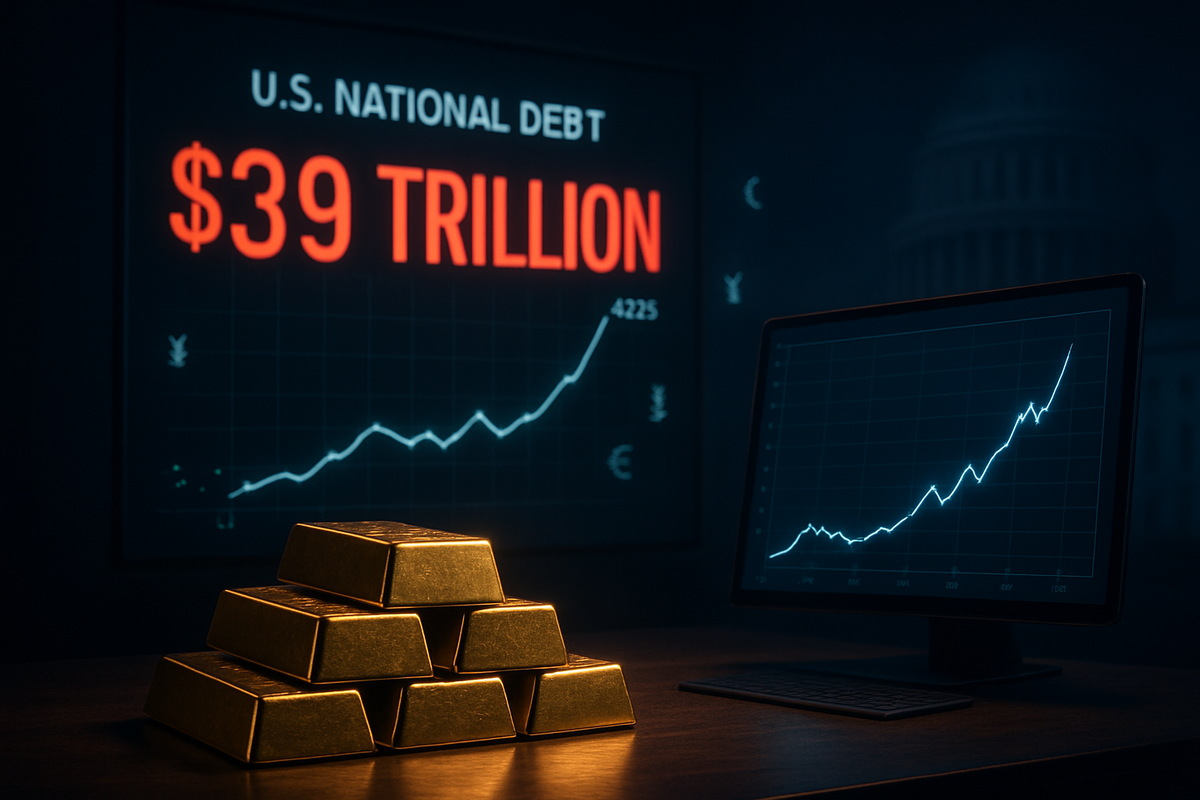
As the global financial landscape navigates the second quarter of 2026, a seismic shift in U.S. monetary policy expectations has sent tremors through every asset class. The "Warsh Shock"—a term coined by traders following the nomination of Kevin Warsh to lead the Federal Reserve—has fundamentally altered the trajectory of the U.S. dollar and its primary rival, gold. With U.S. national debt officially crossing the $38.98 trillion mark this week, just a breath away from the psychological $40 trillion threshold, the stakes for "sound money" have never been higher.
Gold prices, which reached historic highs throughout 2025, are currently locked in a high-stakes battle around the $4,725 per ounce technical pivot. The market is caught between two powerful forces: a potential return to strict monetary discipline under a Warsh-led Fed and a fiscal reality where the U.S. government is adding over $6 billion to its debt every single day. This tension has transformed the gold market from a simple inflation hedge into a central theater for the future of the global reserve system.
The Nomination That Rattled the World
The catalyst for the current market volatility began on January 30, 2026, when the White House officially tapped Kevin Warsh to succeed the outgoing Fed Chair. Warsh, a former Fed Governor known for his critical stance on the central bank's massive balance sheet, represents a departure from the "data-dependent" era of the last decade. His "sound money" philosophy emphasizes price stability above all else, advocating for a formal separation between the Treasury’s debt management and the Fed’s monetary policy—a move many believe would end the era of "easy money" used to finance federal deficits.
Initially, the "Warsh Shock" caused a sharp 10% intraday correction in gold as investors bet on a rejuvenated U.S. dollar. However, as the national debt hit $39 trillion this April, the narrative shifted. Investors realized that even a "sound money" Fed Chair cannot easily erase the $1.04 trillion in annual interest payments the U.S. now faces. This realization has stabilized spot gold, keeping it firmly above the $4,725 support level as of April 14, 2026.
The timeline leading to this moment has been one of accelerating fiscal pressure. Since 2024, the U.S. has struggled to find sufficient private buyers for its debt, often relying on internal mechanisms that Warsh has promised to dismantle. The reaction in the bond market has been equally fierce, with long-dated Treasury yields spiking as the "term premium"—the extra compensation investors demand for holding long-term debt—returns to the market for the first time in years.
Winners and Losers in the Shift to Sound Money
The primary beneficiaries of this volatility have been the massive gold-backed exchange-traded funds. Both the SPDR Gold Shares (NYSE Arca: GLD) and the iShares Gold Trust (NYSE Arca: IAU) have seen record-breaking inflows over the past three months as institutional investors rotate out of Treasuries. With the "Warsh Shock" threatening to stop the Fed from acting as the "buyer of last resort" for government bonds, gold has become the preferred "neutral" asset for those seeking a sanctuary from fiscal instability.
Major gold producers are also seeing a resurgence in interest despite the cost-push inflation affecting their operations. Newmont Corporation (NYSE: NEM) and Barrick Gold Corporation (NYSE: GOLD) have outperformed the broader S&P 500 in the first quarter of 2026, as their margins expand along with the gold price. Similarly, Agnico Eagle Mines Limited (NYSE: AEM) has benefited from its lower-risk jurisdiction profile as geopolitical tensions drive a premium for "safe" mining jurisdictions.
On the losing side are the traditional "risk-free" assets. U.S. Treasuries, long the bedrock of global finance, are facing a crisis of confidence. Banks and insurance companies heavily weighted in long-duration government bonds have seen their portfolios pressured by the spike in yields. Furthermore, highly leveraged sectors that grew accustomed to the Fed’s balance sheet expansion are now facing a "liquidity desert" as the prospect of aggressive quantitative tightening (QT) under Warsh becomes a reality.
De-Dollarization and the Structural Bull Case
Beyond the immediate "Warsh Shock," a deeper structural shift is occurring: the aggressive de-dollarization by global central banks. For the first time in modern history, foreign central banks now collectively hold more gold in their reserves than U.S. Treasuries. This trend accelerated in 2025 and has reached a fever pitch in early 2026, as nations like China, India, and members of the ASEAN bloc seek to insulate themselves from the "weaponization" of the dollar and the looming U.S. debt crisis.
The $39 trillion debt milestone is more than just a number; it is a signal of "fiscal dominance," where the government's borrowing needs begin to dictate monetary policy. Warsh’s philosophy aims to fight this, but his success is far from guaranteed. If the Fed stops supporting the Treasury market, the resulting volatility could actually drive more investors toward gold as a "stateless" currency. This creates a paradoxical situation where a "hawkish" Fed Chair could accidentally fuel a gold bull market by highlighting the fragility of the sovereign debt market.
Historically, this environment mirrors the late 1970s, but with significantly higher debt-to-GDP ratios. The broader industry trend is a move toward "hard assets" as the 58.5% share of the dollar in global reserves continues to slip. As central banks buy roughly 850 tonnes of gold annually, the floor for the metal has been raised, making the $4,725 level a critical battleground for 2026.
The Road Ahead: Gold’s Path to $5,000
In the short term, all eyes remain on the $4,725 pivot. If gold can maintain this level through the end of April, technical analysts expect a "melt-up" toward $5,400 by year-end. However, if the Warsh-led Fed manages to successfully implement its "supply-side" monetary policy—cutting rates to foster productivity while simultaneously shrinking the balance sheet—we could see a period of dollar strength that temporarily caps gold's gains.
The strategic pivot for investors in the coming months will likely involve moving away from traditional 60/40 portfolios in favor of real assets. The primary challenge will be navigating the "liquidity shocks" that may occur as the Fed retreats from the bond market. Scenarios range from a "controlled deleveraging" of the U.S. economy to a more chaotic "re-pricing" of all dollar-denominated assets.
Summary of the Market Moving Forward
The arrival of Kevin Warsh at the helm of the Federal Reserve marks the end of an era. The "Warsh Shock" has forced a long-overdue conversation about the sustainability of $39 trillion in debt and the role of the central bank in financing it. For the gold market, this is a "double-edged sword" moment: while a stronger dollar is a headwind, the underlying fiscal instability provides the strongest tailwind in decades.
Investors should watch the $4,725 gold level and the 10-year Treasury yield closely over the next quarter. As the transition to a "sound money" regime begins, the volatility in these markets will serve as a barometer for the health of the U.S. financial system. The ultimate test will be whether the Fed can maintain its independence in the face of a government that needs trillions of dollars in constant refinancing.
This content is intended for informational purposes only and is not financial advice.