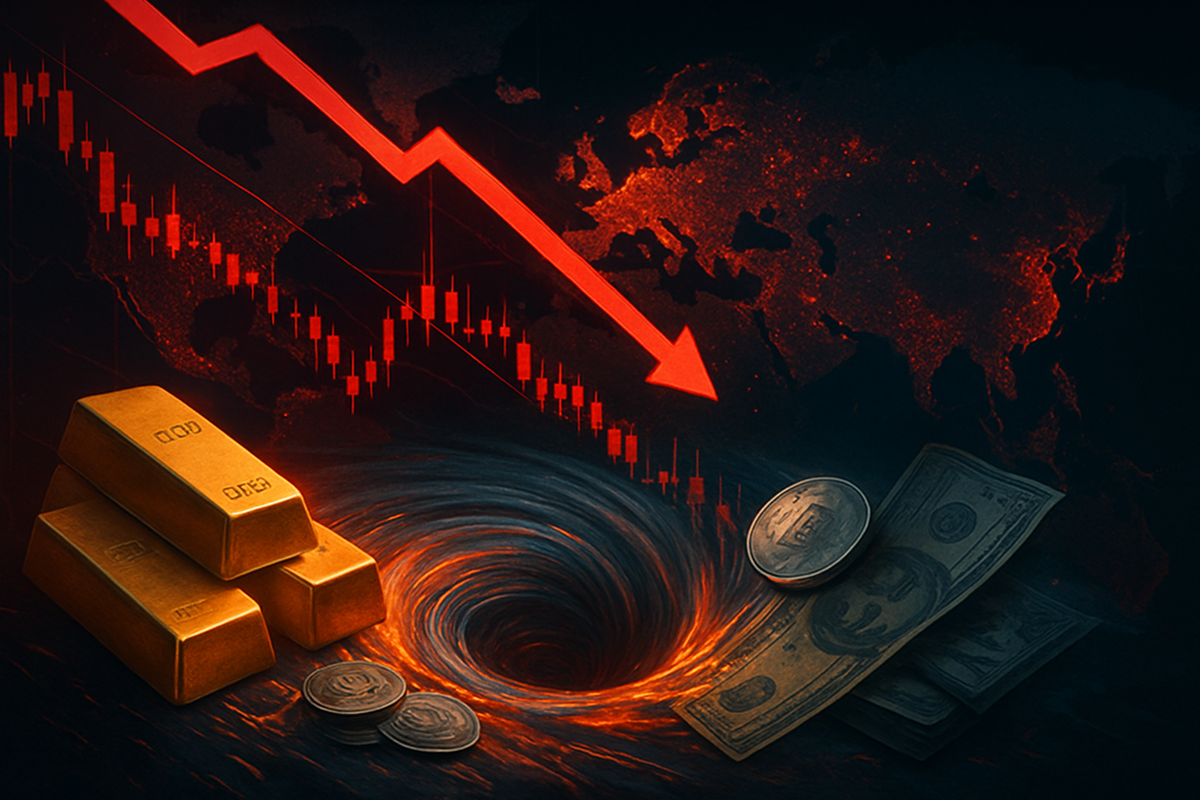
The global financial landscape was indelibly altered on March 19, 2026, as a phenomenon known as the "Liquidity Flush" sent shockwaves through the commodities markets. While the outbreak of "Operation Epic Fury"—a massive military escalation in the Middle East—initially sent Brent Crude soaring to an intraday peak of $119 per barrel, the expected flight to safety in precious metals failed to materialize. Instead, the market witnessed a paradoxical collapse: gold prices plummeted by 5.9%, while silver took an even more brutal 8.2% hit, leaving investors stunned as traditional safe-havens were sold off with reckless abandon.
The immediate implications of this "Liquidity Flush" are profound, signaling a shift in how institutional players manage risk during high-velocity crises. In a world where margin calls are triggered by surging energy costs and collapsing bond portfolios, the "safe-haven" status of an asset becomes secondary to its "liquidity" status. On March 19, gold and silver were not treated as stores of value, but rather as the market's emergency "ATM," liquidated at any price to satisfy the insatiable demand for cash across the broader financial system.
The Anatomy of a Forced Liquidation
The chaos of March 19 was the culmination of a tense multi-week buildup. Following the commencement of Operation Epic Fury—the U.S.-led campaign against regional infrastructure in the Middle East—the Strait of Hormuz was effectively shuttered, removing nearly 20% of the world's oil supply overnight. As Brent Crude (BZ=F) spiked toward $119, the inflationary pressure on global markets reached a breaking point. This surge coincided with a "hawkish hold" from Federal Reserve Chair Kevin Warsh, who signaled that interest rates would remain elevated to combat the energy-driven price spiral, sending the U.S. Dollar Index (DXY) to multi-year highs and crushing expectations for a monetary pivot.
The timeline of the "Flush" began at the London open, where institutional desks found themselves underwater on massive short positions in energy and long positions in sovereign debt. As energy prices skyrocketed, the cost of maintaining levered equity and bond portfolios became unsustainable. By mid-day in New York, the "dash for cash" was in full swing. Macro hedge funds, facing multi-billion dollar margin calls from prime brokers, had no choice but to sell their most liquid and profitable positions. Gold, which had been trading near record highs, was the most accessible source of immediate liquidity.
Key stakeholders in this drama included large-scale commodity trading advisors (CTAs) and private credit firms like Blue Owl Capital (NYSE: OWL), which reportedly began "gating" redemptions as the crisis deepened. This trapping of capital forced a secondary wave of selling in the precious metals space, as investors who couldn't pull cash from private funds were forced to dump their gold and silver ETFs to meet obligations. The result was a systemic "flush" that cleared out both weak hands and institutional stalwarts alike.
Energy Titans Rise as Miners Retreat
The divergence between energy producers and precious metals miners on March 19 was one of the most stark in modern market history. Large-cap energy firms like ExxonMobil (NYSE: XOM) and Chevron (NYSE: CVX) saw their valuations reach record highs intraday as the world braced for a sustained period of $100+ oil. However, even these gains were tempered by operational risks; Shell (NYSE: SHEL) and TotalEnergies (NYSE: TTE) were forced to declare force majeure on several shipments due to the blockade in the Persian Gulf, highlighting that high prices are a double-edged sword when physical delivery is compromised.
Conversely, the precious metals mining sector suffered one of its worst single-day routs. Newmont (NYSE: NEM), the world’s largest gold producer, saw its shares plummet 8%, losing the critical support level it had built over the previous six months. Barrick Gold (NYSE: GOLD) followed suit, dropping 7% as the 5.9% slide in bullion prices forced analysts to slash near-term earnings projections. The silver miners fared even worse; First Majestic Silver (NYSE: AG) and Pan American Silver (NYSE: PAAS) saw double-digit percentage declines, reflecting silver’s higher volatility and its dual role as both an industrial metal and a monetary asset.
For the miners, the "Liquidity Flush" represents a crisis of confidence. Despite the inflationary environment—which should theoretically benefit hard assets—the sheer force of institutional deleveraging proved that in a systemic crisis, "beta" to the downside is often unavoidable. Companies like Agnico Eagle (NYSE: AEM) and Kinross Gold (NYSE: KGC) now face the difficult task of reassuring shareholders that the drop was a technical liquidity event rather than a fundamental shift in the value of their underlying reserves.
The Supremacy of Liquidity Over Safety
The events of March 19 fit into a broader historical trend where, in the initial stages of a massive market shock, correlations go to one. Similar to the "dash for cash" seen in the early days of the 2008 financial crisis and the March 2020 COVID-19 lockdowns, the 2026 Liquidity Flush proves that when the "market plumbing" breaks, investors sell what they can, not what they want. This event has rewritten the playbook for the safe-haven trade, showing that during a period of extreme institutional leverage, even gold is not immune to the gravitational pull of a margin call.
The ripple effects of this paradox are likely to be felt across the regulatory landscape. Policymakers may look closer at "cross-margining" practices where hedge funds use precious metals as collateral for highly levered bets in the energy or private credit markets. When energy prices move too fast—as they did with the $119 Brent spike—the resulting margin calls create a contagion that spills over into unrelated asset classes. This "contagion of liquidity" is a growing concern for the Federal Reserve and other central banks as they weigh the stability of the financial system against the need to fight inflation.
Furthermore, the "Warsh Shock" at the Federal Reserve has added a layer of complexity to this crisis. By maintaining high interest rates while the energy market was in flames, the Fed effectively prioritized the strength of the dollar over market stability. This policy stance ensured that the dollar remained the ultimate "safe-haven," effectively sucking liquidity out of every other asset class, including gold and silver.
Navigating the Post-Flush Reality
In the short term, the precious metals market remains in a state of shock, with many technical support levels shattered. Investors should expect continued volatility as the market searches for a new floor. However, historical precedents suggest that once the initial "liquidity flush" concludes and margin calls are satisfied, the fundamental reasons for owning gold and silver—war, inflation, and currency debasement—usually reassert themselves. The question for the coming months is how quickly the "weak hands" can be replaced by "strong hands" looking for long-term protection.
Strategically, this event may force a pivot among institutional asset managers. The "60/40" portfolio, already under pressure, may need to be re-evaluated to include a "liquidity buffer" of cash or short-term Treasuries that can be deployed specifically during these "flush" events. For energy companies, the challenge will be navigating a world of $119 oil while the global economy slows under the weight of higher costs and geopolitical instability. The emergence of a "stagflationary" environment could lead to a permanent shift in capital allocation toward domestic energy production and away from more speculative or high-leverage assets.
Potential scenarios include a secondary "aftershock" if Operation Epic Fury expands into a broader regional conflict, or a slow recovery if diplomatic channels can reopen the Strait of Hormuz. Regardless, the "Liquidity Flush" of 2026 has served as a brutal reminder that in a crisis, cash is the only true king, and even the most "golden" of safe-havens can be sacrificed at the altar of the margin call.
The Lasting Legacy of March 19
The "Liquidity Flush" paradox of March 19, 2026, will be studied by financial historians for years to come. It serves as a definitive case study in how modern, interconnected financial markets react under extreme duress. The primary takeaway for investors is that a "safe-haven" asset is only safe if it can be held through the storm; those who were forced to sell gold and silver at the bottom of the flush did so not because they lost faith in the metals, but because they had no other choice to keep their portfolios afloat.
Moving forward, the market will likely be more cautious regarding leverage in the commodities space. The "dash for cash" revealed significant vulnerabilities in the institutional framework, particularly in how private credit and macro hedge funds interact with traditional "hard" assets. For the public companies involved, the path ahead is fraught with volatility but also offers an opportunity for those with strong balance sheets to acquire assets from distressed competitors.
In the coming months, investors should watch the U.S. Dollar Index and the Fed's rhetoric closely. If the dollar remains the only source of true liquidity, precious metals may continue to struggle despite the geopolitical tailwinds. However, if the "Liquidity Flush" has truly cleared the deck of over-leveraged players, the stage could be set for a significant rebound in the metals as they regain their status as the ultimate hedge against a world in turmoil.
This content is intended for informational purposes only and is not financial advice.
Authored by the MarketMinute Editorial Team April 14, 2026