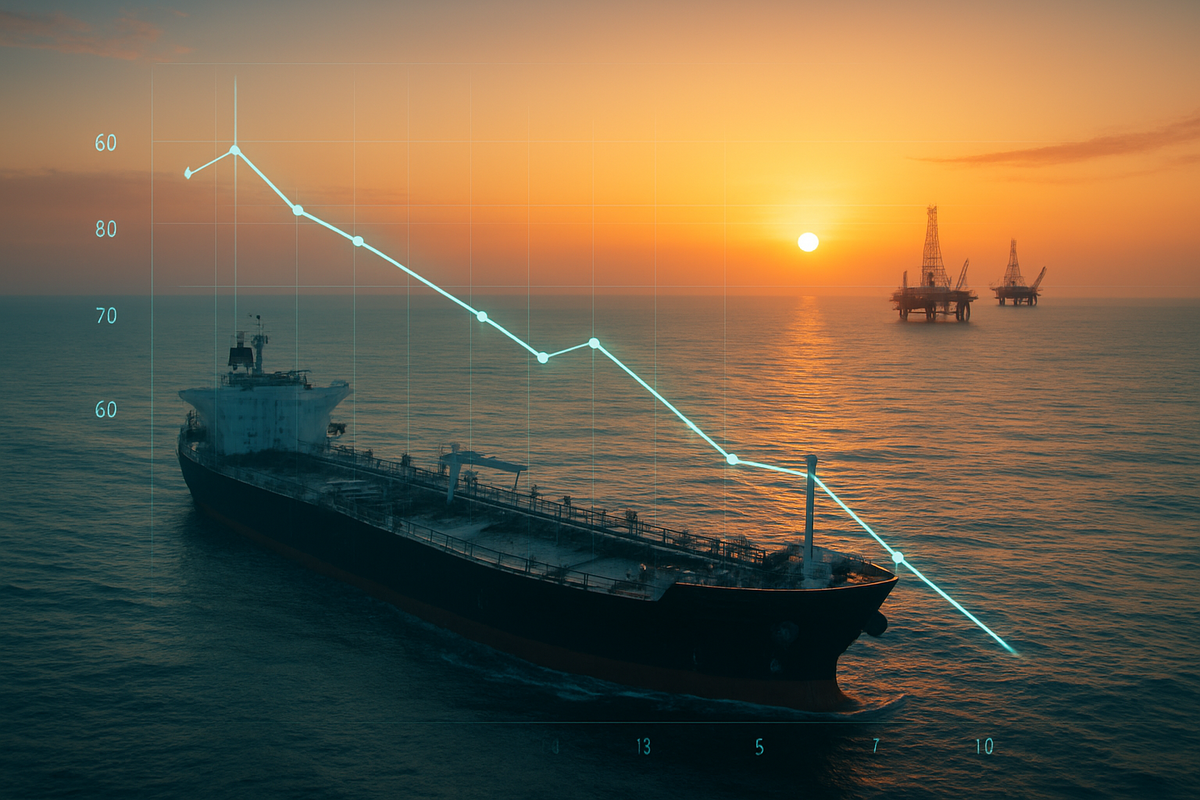
Global energy markets witnessed a significant cooling on April 14, 2026, as West Texas Intermediate (WTI) futures tumbled toward $91 per barrel and Brent crude eased to approximately $95. This retreat marks a sharp departure from the triple-digit peaks seen just weeks ago, as investors pivot from fears of a protracted regional war toward burgeoning optimism for a diplomatic resolution between the United States and Iran. The sudden shift in sentiment follows reports of renewed backchannel negotiations and a potential extension of the fragile April 7 ceasefire, offering a critical "relief valve" for a global economy that has been teetering on the edge of a stagflationary crisis.
The immediate implications of this price pullback are being felt across the financial spectrum. For central banks currently grappling with "Operation Epic Fury"-induced price spikes, the move toward $90 oil represents a transition from an acute emergency to a manageable economic headwind. Market analysts suggest that if these prices hold, the probability of a global recession in late 2026 could drop significantly, as the "tax on consumption" represented by high gasoline prices begins to lift. However, with the current ceasefire slated to expire in just one week, the market remains on a knife-edge, balancing the hope of a permanent treaty against the risk of a return to naval blockades in the Strait of Hormuz.
From Conflict to Islamabad: The Path to the April Pullback
The current easing of prices is the culmination of a volatile two-month period that began on February 28, 2026, with the outbreak of the "2026 Iran War." Following a period of "Maximum Pressure 2.0" initiated by the U.S. administration in 2025, regional tensions boiled over into a series of decapitation strikes and retaliatory attacks on energy infrastructure. By mid-March, Brent crude had spiked to nearly $120 per barrel as the Strait of Hormuz—the world’s most vital oil artery—was effectively closed to commercial traffic, removing nearly 20 million barrels of daily supply from the global market.
The tide began to turn on April 7, 2026, when a temporary two-week ceasefire was brokered to allow for humanitarian aid and diplomatic intervention. While high-level talks held in Islamabad, Pakistan, over the weekend of April 11–12 initially appeared to end in a stalemate, traders have latched onto rumors of a "Swiss-mediated" framework that could see Iran freeze its uranium enrichment in exchange for the lifting of the newly announced U.S. naval blockade. This "mounting hope" has triggered a wave of profit-taking in the energy pits, leading to today’s 4.4% decline in Brent futures.
Initial market reactions have been characterized by a "risk-on" rotation. As oil prices retreated, the S&P 500 and the Nasdaq Composite saw gains, driven by the realization that the "energy-led inflation" spike of Q1 2026 might be transitory if diplomacy prevails. Key stakeholders, including OPEC+ leadership and IEA officials, have signaled that they are monitoring the Islamabad follow-up closely, with any formal announcement of a "Phase Two" diplomatic roadmap likely to drive WTI back toward the $80 level.
Winners and Losers: A Shift in Corporate Fortunes
The retreat in crude prices has created a stark divergence in the equities market, particularly among the heavyweights of the energy and transport sectors. Exxon Mobil Corporation (NYSE: XOM) and Chevron Corporation (NYSE: CVX), which both saw record profit margins during the February-March price surge, experienced a cooling of their share prices today. These energy giants have benefited from a massive geopolitical risk premium, but as that premium erodes, investors are shifting capital toward sectors that were previously crushed by high input costs.
On the winning side, the airline and logistics industries are breathing a collective sigh of relief. Delta Air Lines, Inc. (NYSE: DAL) and United Airlines Holdings, Inc. (NASDAQ: UAL) saw their shares rally by over 5% in early trading, as the prospect of jet fuel prices stabilizing below $3.00 per gallon improves their H2 2026 earnings outlook. Similarly, logistics powerhouses like FedEx Corporation (NYSE: FDX) and United Parcel Service, Inc. (NYSE: UPS) are expected to see a reversal of the fuel surcharges that have dampened shipping volumes over the last quarter.
Consumer-facing tech and retail giants are also poised to benefit from improved household discretionary income. Amazon.com, Inc. (NASDAQ: AMZN) stands to gain from lower fulfillment costs, while broader retail sentiment is expected to rise as the national average for gasoline in the U.S. retreats from its $4.30 per gallon peak toward $3.70. For these companies, $90 oil is the "sweet spot" that allows for continued economic growth without the margin-killing impact of $120 "war prices."
Wider Significance: Inflation and the Macroeconomic Pivot
The pullback in oil is more than just a sector story; it is a fundamental shift in the global macroeconomic narrative for 2026. Earlier this year, the IMF and OECD warned that sustained $120 oil would push global inflation toward 5.8%, forcing central banks to hike interest rates even as growth stalled—a classic stagflation scenario. The move to $91 WTI and $95 Brent moves the needle back toward a "manageable slowdown." Historically, every 10% decline in oil prices can shave 0.2 to 0.3 percentage points off headline CPI within two months, suggesting that the current retreat could significantly cool inflation prints by June 2026.
This event also signals a potential shift in U.S. foreign policy strategy. The "Maximum Pressure 2.0" campaign of 2025 has clearly reached its tactical limit, as the economic fallout of a shuttered Strait of Hormuz became too great for even the most hawkish policymakers to ignore. The willingness to engage in the Islamabad talks, despite their rocky start, suggests that the U.S. is prioritizing "energy security and price stability" over a total regional overhaul. This pivot echoes the energy-driven diplomacy seen in the post-2022 period, where geopolitical goals were often balanced against the political potency of the "price at the pump."
Furthermore, the stabilization of oil prices provides critical breathing room for emerging markets, particularly India and Japan, which are almost entirely dependent on imported crude. For these nations, $90 oil prevents a fiscal collapse and allows their respective central banks to avoid emergency currency interventions. The "ripple effect" of this price retreat will likely be seen in a strengthening of the Yen and Rupee against the Dollar in the coming weeks, as the "oil-driven" trade deficits begin to narrow.
What Comes Next: The April 21 Deadline
The short-term trajectory of the market depends entirely on the events of the next seven days. The current ceasefire is set to expire on April 21, 2026. If a formal "Agreement of Intent" is not signed in the coming week, analysts warn that the "relief rally" could quickly evaporate. A return to hostilities would likely see Brent gap higher, potentially challenging the $130 level if Iran resumes its threats against regional energy infrastructure.
Long-term, the market is looking for a "permanent de-escalation" that would allow for the full reopening of the Strait of Hormuz. Strategic pivots are already underway; many European utilities are accelerating their transition to non-fossil alternatives to avoid the "geopolitical volatility trap" of the Middle East, while U.S. shale producers are being urged to increase output to provide a "security buffer" should the Islamabad talks fail.
Investors should watch for two scenarios: a "Peace Dividend" scenario where oil settles into a $70-$80 range by Q4 2026, or a "Low-Intensity Conflict" scenario where prices remain "sticky" near $90-$100 due to persistent security risks. The outcome will dictate whether 2026 is remembered as a year of recovery or one of sustained economic hardship.
Summary: A Fragile Peace for Global Markets
The pullback in oil prices on April 14, 2026, represents a cautious "bet on peace" by the global financial community. By pricing in the success of U.S.-Iran diplomacy, the market has effectively signaled that it no longer views a total regional war as the most likely outcome. This shift has provided an immediate boost to inflation expectations and consumer-facing equities, offering a glimpse of the "normalization" that could occur if a permanent ceasefire is achieved.
However, the market's optimism is tempered by the reality of the failed Islamabad round and the looming April 21 deadline. Investors should remain vigilant, as any sign of renewed aggression or a breakdown in backchannel talks could spark a rapid re-pricing of risk. Moving forward, the "Hormuz Factor" will remain the single most important variable for global energy costs.
For the coming months, the key indicators to watch will be the "Islamabad Follow-up" statements, weekly IEA supply reports, and the performance of transport-heavy sectors. While the current retreat to $91 WTI is a welcome reprieve, the lasting impact of this moment will depend on whether diplomacy can transform a temporary ceasefire into a durable regional stability.
This content is intended for informational purposes only and is not financial advice.