
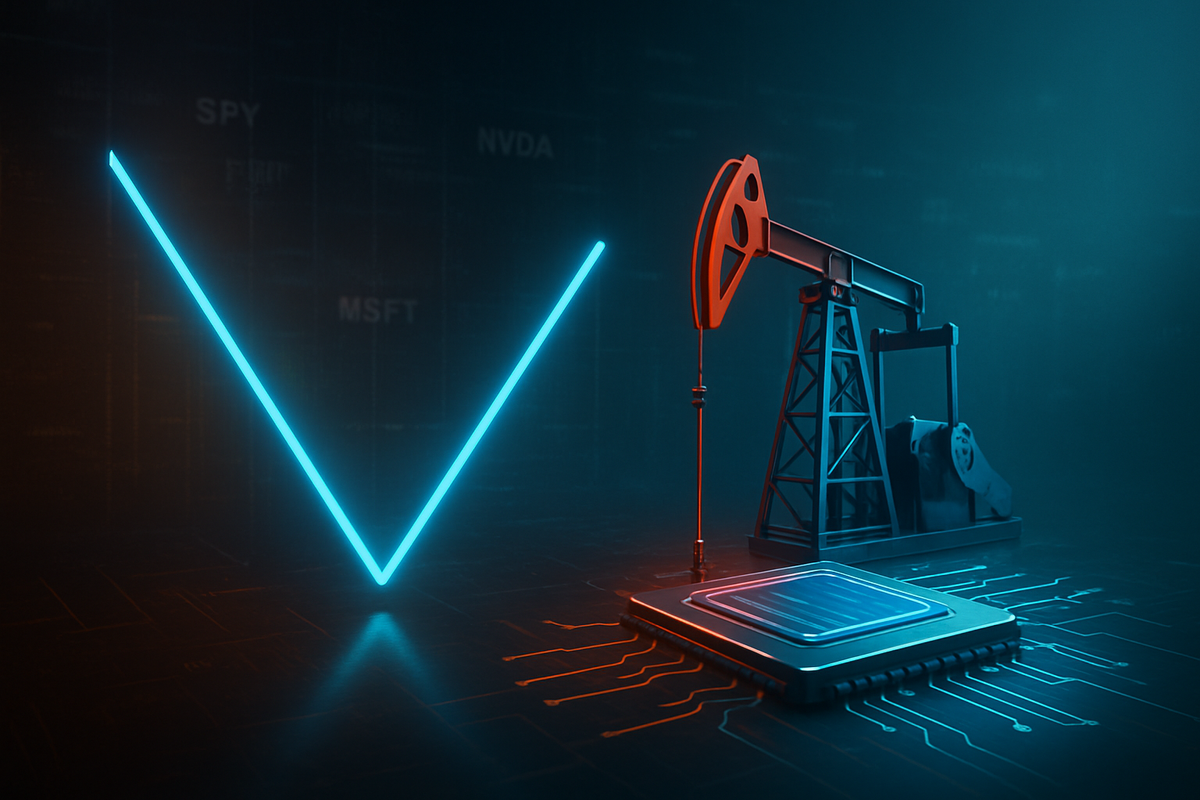
After a tumultuous start to 2026 that saw markets gripped by geopolitical instability and a "valuation reset" for Big Tech, the S&P 500 (NYSE: SPY) has staged a remarkable recovery. As of mid-April, the index is now within 1% of its year-to-date break-even point, effectively erasing the steep losses incurred during a frantic February and March. This "relief rally" has been fueled by a combination of easing energy costs and a renewed investor appetite for technology leaders who have demonstrated clear paths to AI profitability.
The resilience of the broader market underscores a shift in investor sentiment from panic to pragmatism. While the early weeks of the year were defined by the "Great Rotation" into safe-haven energy stocks and defensive industrials, the recent cooling of oil prices and robust guidance from semiconductor giants have restored confidence in the growth narrative. For the average investor, this pivot marks a return to fundamental-driven trading, even as the specter of "higher-for-longer" interest rates remains a constant backdrop.
From Volatility to Recovery: The Story of Q1
The first quarter of 2026 will likely be remembered for its extreme sensitivity to global events. The primary catalyst for the early-year slump was "Operation Epic Fury," a significant military escalation in the Middle East that briefly sent Brent crude oil prices skyrocketing to near $120 per barrel in late February. This energy shock triggered immediate fears of a second-wave inflation spike, causing the S&P 500 to shed over 8% of its value in a matter of weeks. The volatility index, or VIX, surged past 23%, its highest level in nearly two years, as traders braced for a potentially hawkish pivot from the Federal Reserve.
However, the tide began to turn in early April following a ceasefire agreement that restored some stability to the Strait of Hormuz. As oil prices receded toward the $90 per barrel range, the immediate inflationary pressure began to dissipate. This "relief" provided the necessary breathing room for the market to refocus on the strong corporate earnings baseline that had been largely ignored during the height of the crisis. Analysts noted that S&P 500 earnings-per-share (EPS) growth remained surprisingly resilient at 13.2% year-over-year, providing a structural floor for the index's recovery.
The recovery was further accelerated by a "tech rebound" that caught many short-sellers off guard. After a brutal January valuation reset, tech investors moved back into the sector, encouraged by strong AI infrastructure demand. The timeline of this rebound coincided perfectly with the cooling of the energy market, allowing capital to flow back into high-growth names that had been oversold during the peak of the oil crisis.
The Titans of Resilience: Sector Winners and the AI Reset
The primary beneficiaries of this recovery have been the technology titans that survived the early-year "digestion phase." NVIDIA (NASDAQ: NVDA) has once again led the charge, with its stock rising nearly 45% over the trailing twelve months. The company’s successful rollout of the "Vera Rubin" platform and a reported $1 trillion order pipeline for its Blackwell architecture have solidified its position as the bedrock of the AI era. While other tech firms struggled with valuation questions, NVIDIA's transition from AI training to high-margin AI inference has kept investor sentiment overwhelmingly bullish.
Conversely, Microsoft (NASDAQ: MSFT) experienced a more complex start to the year. Despite record revenue, the stock faced a 22% correction early in 2026 as investors questioned the ROI on the company’s massive $120 billion annual AI capital expenditure. However, by mid-April, MSFT has begun to claw back its losses as Azure demand continues to outpace supply. The market is increasingly viewing Microsoft's "AI superfactories" as essential long-term infrastructure rather than speculative spending.
The energy sector, represented by giants like ExxonMobil (NYSE: XOM) and Chevron (NYSE: CVX), served as a vital hedge during the Q1 volatility. ExxonMobil saw its stock rise 41% in the first quarter, hitting a 52-week high of $176 as it reallocated capital back into the Permian Basin to capture high spot prices. Chevron also performed admirably, leveraging its successful integration of Hess and record production in Guyana. While these stocks have seen some profit-taking as oil prices eased to $90, they remain critical components of a diversified 2026 portfolio, providing a buffer against ongoing geopolitical risks.
Inflation, Oil, and the Fed: The Macro Context
The broader significance of the current rally lies in its interaction with the Federal Reserve's "paralysis." Despite the easing of oil prices, the March Consumer Price Index (CPI) showed a stubborn 3.3% year-over-year increase, largely driven by housing costs and the lagging effects of the energy surge. This has forced the Fed to maintain its target interest rate range of 3.50%–3.75%, effectively ending hopes for multiple rate cuts in 2026. The market is now pricing in only a single 25-basis-point cut, likely delayed until the fourth quarter.
This "higher-for-longer" environment marks a departure from the low-rate bull markets of the past decade. The 2026 rally is a "yield-sensitive" one, where only companies with fortress balance sheets and genuine pricing power can thrive. This trend is a continuation of the "Great Rotation," where the growth gap between Big Tech and the rest of the S&P 500 is narrowing. For the first time in several years, cyclical sectors like financials and industrials are contributing meaningfully to the index's stability, reflecting a more balanced, albeit slower, economic expansion.
Historically, this period mirrors the mid-cycle adjustments of the late 1990s, where high productivity gains from technology—then the internet, now AI—helped the economy absorb higher energy costs and interest rates. The ability of the S&P 500 to return to break-even despite an oil shock and rate uncertainty suggests that the "AI productivity miracle" may be providing a stronger-than-expected tailwind to the U.S. economy.
Looking Ahead: The Path to 2027
As we look toward the second half of 2026, the primary question for investors is whether the current relief rally has the legs to turn into a full-scale bull run. Short-term performance will likely depend on the Q2 earnings season and whether companies can justify their high valuations with concrete AI revenue. A strategic pivot is already underway at many firms, moving from "growth at any cost" to "efficiency and inference," as seen in the recent strategy shifts at Alphabet (NASDAQ: GOOGL) and Meta (NASDAQ: META).
Market opportunities are also emerging in the mid-cap space and in sectors tied to the "Physical AI" revolution, including robotics and advanced manufacturing. However, the challenge remains the Fed's stance. If inflation does not trend toward the 2% target by the fall, the risk of another "valuation reset" remains high. Investors should also keep a close eye on the Energy Information Administration (EIA) forecasts, as any further disruption in the Middle East could quickly send oil back above $100 and derail the recovery.
Closing Bell: Resilience as the New Normal
The S&P 500's journey back to break-even in mid-April 2026 is a testament to the underlying strength of corporate America. The index has weathered a perfect storm of energy shocks, geopolitical conflict, and interest rate uncertainty, emerging nearly whole on the other side. The key takeaway for investors is that the "AI story" is far from over, but it has entered a more mature, critical phase where execution and ROI are the primary metrics of success.
Moving forward, the market will likely remain in a state of "dynamic stability." While the extreme volatility of Q1 has subsided, the era of easy money is firmly in the rearview mirror. Investors should watch for the sustainability of tech earnings and any further signs of cooling in the energy markets. As the S&P 500 prepares to cross into positive territory for the year, the focus shifts from surviving the storm to identifying the leaders of the next phase of the digital and industrial transformation.
This content is intended for informational purposes only and is not financial advice