The global financial landscape has been fundamentally reshaped this week as Elon Musk officially finalized the merger of his aerospace titan, SpaceX, and his rapidly ascending artificial intelligence venture, xAI. The deal, which has been the subject of intense speculation throughout the first quarter of 2026, has birthed a massive $1.25 trillion 'super-conglomerate' that analysts are already calling the world’s first truly verticalized "Muskonomy." This unprecedented union signals a shift in the tech industry from software-focused AI toward an infrastructure-heavy model that integrates the frontier of large language models with the logistics of orbital transport.
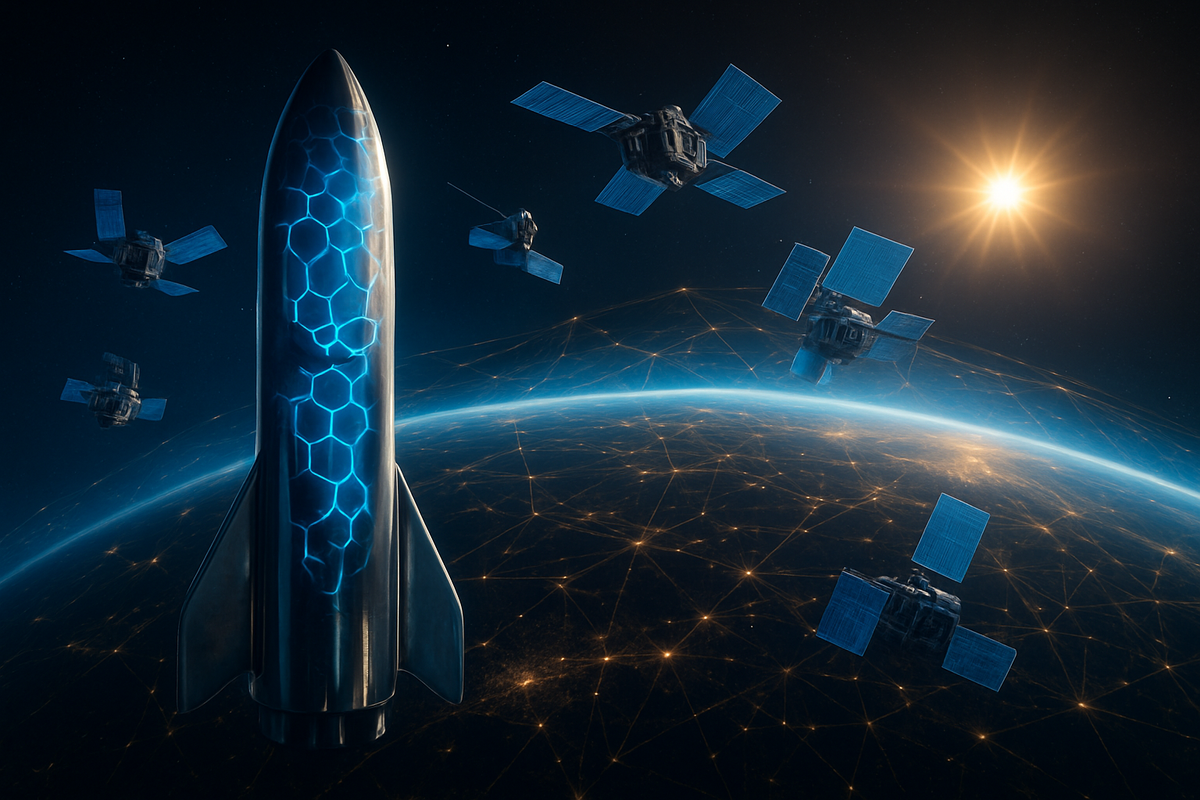
The immediate implications of this merger are staggering. By combining the orbital reach of Starlink and Starship with the cognitive power of xAI’s Grok models, Musk aims to bypass terrestrial bottlenecks such as power grid constraints and cooling limitations by launching "Grok-Sats"—autonomous, orbital AI data centers. As of April 10, 2026, the deal has not only redefined the valuation of private equity but has served as the primary engine for a record-breaking Q1 in Mergers and Acquisitions (M&A) volume, which surged to an unprecedented $1.2 trillion globally.
The Architecture of 'K2': Building the Orbital Intelligence Engine
The merger, internally code-named "Project K2," was the culmination of a series of strategic maneuvers that began in late 2025. Following a massive capital injection into xAI that valued the startup at $250 billion, SpaceX shareholders approved a stock-for-stock acquisition of the AI firm. This move effectively brought the $1 trillion aerospace leader together with the AI developer, creating a unified entity capable of managing its own compute, connectivity, and launch logistics. Key stakeholders in the deal included a consortium of venture capital heavyweights and early SpaceX investors like Alphabet (NASDAQ: GOOGL), whose estimated 7% stake in the aerospace giant has now transformed into a pivotal piece of the new AI-conglomerate's cap table.
The timeline leading to this moment was accelerated by the successful maiden flights of Starship V3 in January 2026. This newest iteration of Musk’s rocket allows for hourly launches and a massive 200-ton payload capacity, making the dream of "Orbital Intelligence" economically viable for the first time. Market reaction has been polarized but intense. Tech-focused hedge funds have flooded into the secondary markets to grab any remaining shares of the combined private entity, while legacy aerospace firms have seen their market caps shudder at the prospect of a competitor that can now automate the entire lifecycle of a satellite using proprietary AI.
Musk’s vision centers on the "AI Energy Wall." On Earth, data centers are increasingly competing with residential neighborhoods for electricity and water. By moving heavy compute workloads into space, the new SpaceX-xAI entity can utilize near-constant solar energy and the vacuum of space for radiative cooling. Initial tests of "Grok-Sat" prototypes conducted in March 2026 confirmed that processing large-scale AI queries in low Earth orbit (LEO) could eventually be 40% more cost-effective than terrestrial cooling, provided the hardware can survive the harsh radiation of the van Allen belts.
The Galactic Ledger: Winners and Losers in the Musk Wake
The primary beneficiary of this merger in the public markets has been NVIDIA (NASDAQ: NVDA). As the sole provider of the radiation-hardened "Blackwell-S" chips required for the Grok-Sat architecture, NVIDIA’s stock has seen a 12% jump in the last month. The company has essentially secured a monopoly on the "Space-Silicon" market, a new niche that analysts believe will be worth $100 billion by 2030. Similarly, Tesla (NASDAQ: TSLA) investors have cheered the news. Having invested $2 billion into xAI during its early stages, Tesla now holds a preferred stake in the new conglomerate, creating a synergy where Tesla’s Optimus robots can eventually be trained using the orbital compute power provided by its sister company.
Conversely, the "Old Guard" of cloud computing is facing a crisis of identity. Microsoft (NASDAQ: MSFT) and Amazon (NASDAQ: AMZN) are both finding themselves in a defensive posture. Microsoft’s failed Project Natick—an attempt at underwater data centers—is being re-evaluated as a missed opportunity to think vertically. Amazon’s Project Kuiper is currently years behind Starlink in both launch frequency and AI integration, leading to rumors that Jeff Bezos may fast-track "Project Sunrise," a direct space-based compute competitor. Meanwhile, legacy aerospace giants like Boeing (NYSE: BA) and Lockheed Martin (NYSE: LMT) are seeing their government contracts for satellite maintenance and intelligence gathering come under threat as the SpaceX-xAI entity offers integrated, AI-driven surveillance and data processing at a fraction of the cost.
Financial analysts warn that the "SpaceX Effect" might lead to a brain drain in the tech sector. With the promise of a massive $75 billion SpaceX IPO targeted for late June 2026, top-tier engineers are flocking to the new conglomerate, leaving traditional software firms struggling to retain talent. The valuation gap between companies with physical infrastructure (hardware/launch) and those with "just an app" is widening to levels not seen since the industrial revolution.
A Paradigm Shift: Industry Trends and Regulatory Hurdles
This merger fits into a broader 2026 industry trend where AI is no longer viewed as a standalone product but as an operating system for physical infrastructure. We are moving away from the "SaaS Era" and into the "Hard-Tech AI Era." The historical precedent for this is often compared to the formation of U.S. Steel in 1901—a moment where a single entity controlled every aspect of production, from the raw materials (launch) to the final product (intelligence). Just as Carnegie and Morgan reshaped the 20th century, Musk is attempting to corner the 21st-century "commodities" of data and space.
However, the regulatory implications are profound. The Federal Trade Commission (FTC) and international space regulators are already raising concerns about "Orbital Monopolies." There are active debates in the UN regarding the "Sovereignty of Compute"—whether a private company should be allowed to process sensitive global data on satellites that orbit outside the jurisdiction of any single nation. The ripple effects are also being felt in national security circles. With SpaceX-xAI effectively controlling the world’s most advanced "eyes and brains" in the sky, the Pentagon is reportedly reviewing its reliance on Musk’s infrastructure for military communications.
Comparisons to past mergers like AOL-Time Warner serve as a cautionary tale for those who fear the conglomerate may become too unwieldy. Critics argue that the thermal management issues of space-based data centers are being downplayed and that a single "solar flare event" could wipe out billions of dollars in orbital hardware. Nevertheless, the momentum of the Q1 M&A volume suggests that the market has already voted in favor of Musk’s high-stakes gamble.
The Road to the 'Musk IPO' and Beyond
In the short term, the market is bracing for the anticipated SpaceX IPO in June. This event is expected to be the largest in history, potentially valuing the public entity at $1.75 trillion. To prepare, the combined company is expected to pivot its strategic focus toward "Starlink 3.0," which will integrate Grok-AI as a standard feature for all enterprise customers, offering real-time data analysis for shipping, agriculture, and defense. The strategic challenge will be the "Radiation Wall"—engineering chips that can withstand cosmic rays without frequent failures.
Looking further ahead, the long-term goal of this merger is clear: Mars. Musk has long stated that AI is the only way to manage the complex logistics of a multi-planetary colony. By 2028, the company aims to have an "Orbital Brain" circling Mars, coordinating the first wave of autonomous Starship landings. This requires a level of integration between aerospace and AI that only a unified company could achieve. The merger ensures that the massive profits from Starlink and xAI’s commercial licenses can be funneled directly into the Starship development program without the friction of inter-company billing.
For investors, the primary risk remains the "Single Point of Failure" problem. The entire $1.25 trillion empire is heavily dependent on Musk’s leadership and the continued success of the Starship platform. Any significant delay in the launch schedule or a high-profile failure of an orbital data center could lead to a massive correction in the broader tech markets.
Conclusion: A New Era of High-Stakes Finance
The SpaceX and xAI merger stands as a watershed moment in the history of capitalism. It represents the end of AI as a digital abstraction and its birth as a physical, orbital force. By driving the Q1 2026 M&A volume to record heights, this deal has revitalized the "animal spirits" of the market, forcing every major player from Silicon Valley to Wall Street to rethink their 10-year plans. The creation of a $1.25 trillion entity that controls both the "launch" and the "thought" process of modern data is a feat that was once considered science fiction.
Moving forward, the market will be defined by the "Space-AI" race. Investors should watch for NVIDIA’s upcoming quarterly earnings to see the scale of orbital chip demand and monitor the regulatory filings surrounding the SpaceX IPO in June. The transition of compute from the Earth to the stars is no longer a question of "if," but "how fast." As we navigate the remainder of 2026, the success or failure of Musk’s "Orbital Intelligence" will likely dictate the trajectory of the global economy for the next decade.
This content is intended for informational purposes only and is not financial advice.