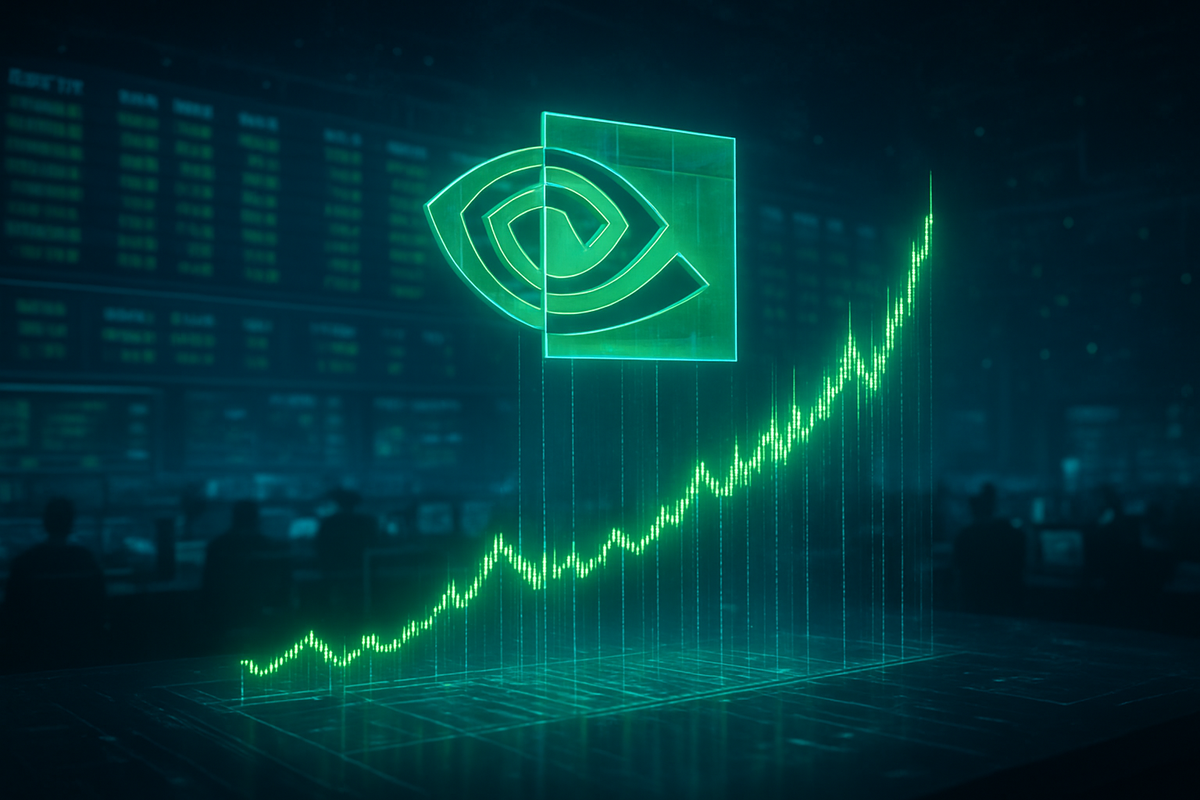
As of April 10, 2026, the financial markets are witnessing a dramatic reversal in the fortunes of the semiconductor sector, led by a powerful technical breakout in Nvidia (NASDAQ: NVDA). While retail sentiment reached a point of "extreme fear" in late March, institutional investors were quietly laying the groundwork for this rally. On March 30, 2026, data trackers recorded a staggering $2.69 billion spike in dark pool buy premium for Nvidia, a massive injection of "smart money" that has since served as a definitive liquidity floor during one of the most volatile opening quarters in recent years.
This institutional accumulation, hidden from the immediate view of the public exchanges, effectively neutralized the downward pressure from a retail-led selloff. The subsequent April breakout has seen Nvidia shares surge past critical resistance levels, validating the "bottom-fishing" strategy employed by major hedge funds and sovereign wealth funds. As the market transitions from the "Generative AI" hype of 2024–2025 to the "Agentic AI" era of 2026, this liquidity event on March 30 now appears to be the pivotal moment that saved the semiconductor bull run from a deeper correction.
Institutional Accumulation: The March 30 Pivot
The $2.69 billion dark pool accumulation on March 30 did not occur in a vacuum; it was the culmination of a brutal first quarter for growth stocks. Nvidia had entered 2026 coming off an all-time high of approximately $212.19, but by mid-March, a perfect storm of macro headwinds—including rising energy costs linked to the Iran conflict and an "ROI reckoning" for AI infrastructure—had dragged the stock down to a multi-month low of $164.27. During the week of March 23, the Fear & Greed Index plummeted to a reading of 12, signaling "Extreme Fear," while retail investors became net sellers for the first time in nearly a year, offloading $45 million in shares in a classic "surrender" event.
As retail traders exited, the Dark Index (DIX) for Nvidia shot above the 55% threshold on March 30. This metric indicates that market makers were aggressively shorting into massive private institutional purchase orders—essentially "dark" buying that doesn't immediately reflect in the public bid-ask spread. This $2.69 billion buy premium established a firm support zone between $165.90 and $171. The institutional conviction was bolstered by leaked reports of Nvidia’s $78 billion Q1 FY2027 revenue guidance, which significantly outperformed the consensus estimate of $72 billion, providing the fundamental fuel for the silent accumulation.
The technical confirmation of this move arrived on April 1, 2026, as Nvidia broke out of its three-month corrective channel. By April 8, the stock successfully tested the 0.618 Fibonacci resistance level at $185, turning it into support. This price action effectively invalidated a bearish head-and-shoulders pattern that had been haunting technical analysts throughout February. The "smart money" that entered at the $165 level on March 30 is now sitting on substantial gains as the stock eyes a return to its $212 historical peak.
Winners, Losers, and the "Memflation" Squeeze
Nvidia (NASDAQ: NVDA) stands as the primary beneficiary of this liquidity floor, having re-established its dominance as the market leader. The company’s pivot to the "Vera Rubin" architecture, unveiled shortly after the March accumulation, has solidified its position in the emerging "Agentic AI" market. However, the ripple effects extend to the broader ecosystem. Micron Technology (NASDAQ: MU) has seen a sympathetic recovery, despite the "memflation" crisis—a 125% year-over-year surge in DRAM prices—that initially scared off investors in Q1. Micron’s role in providing High-Bandwidth Memory (HBM4) for Nvidia's new platforms makes it an essential, albeit expensive, partner in the recovery.
On the losing side of this shift are traditional electronics manufacturers who are struggling to absorb the "inflation tax" on semiconductors. Companies focused on low-margin consumer hardware, such as PCs and mid-range smartphones, are finding themselves squeezed by the same "memflation" that is enriching memory makers. Furthermore, hyperscalers like Microsoft (NASDAQ: MSFT) and Alphabet (NASDAQ: GOOGL) are facing a double-edged sword. While their AI capabilities are expanding, their capital expenditure (capex) projections for 2026 have ballooned to nearly $650 billion combined. Microsoft’s guidance of $146 billion in capex has led to concerns over a "depreciation wall," even as their stock prices recover alongside Nvidia’s.
Meta Platforms (NASDAQ: META) has managed to navigate this period with more resilience, as its "Superintelligence Labs" initiatives have begun to show tangible ad-monetization returns. Meta’s ability to prove that its $135 billion capex is driving revenue—rather than just building infrastructure for infrastructure's sake—has allowed it to join Nvidia in the April breakout, while other hyperscalers face more skepticism regarding their "AI ROI."
Broader Significance: The Era of Agentic AI
The March 30 dark pool event is a case study in the evolving landscape of institutional trading and the shift toward "Agentic AI." By early 2026, the industry has moved beyond models that simply generate text or images to agents capable of autonomous action. This transition has sparked a secondary "inference boom," requiring a massive upgrade to global data center capacity. The $2.69 billion accumulation reflects institutional belief that this technological shift is not a bubble, but a foundational change in the global economy, comparable to the transition from the dial-up internet to the mobile era.
This event also highlights the growing significance of "dark pool" data as a leading indicator for retail traders. In an era where high-frequency trading and institutional algorithms dominate public exchanges, the real "discovery" of price often happens in these private venues. Historically, similar spikes in buy-side dark pool activity preceded major rallies in 2023 and late 2024; however, the scale of the March 30 event is unprecedented for a single ticker, signaling that Nvidia has become more than just a stock—it is a proxy for the entire AI economy.
Regulators at the SEC have taken note of this concentration of liquidity. The March 30 spike has reignited debates over dark pool transparency and whether such massive "hidden" moves provide an unfair advantage to institutional players. Meanwhile, the broader industry faces the "memflation" threat, where the rising cost of memory components acts as a bottleneck for non-AI sectors. This creates a fragmented market where AI-centric companies thrive, while the rest of the tech industry faces recessionary pressures, a dynamic that could invite antitrust scrutiny or calls for domestic supply chain interventions.
The Road Ahead: Short-Term Targets and Black Swans
Looking ahead, the short-term target for Nvidia remains the $212 level, with many Wall Street analysts from firms like Bank of America and JPMorgan raising their year-end price targets to $300. The primary challenge to this bullish thesis is geopolitical. The ongoing Iran conflict continues to pose a risk to energy prices, which could translate into higher operational costs for the massive data centers that power Agentic AI. Any escalation that disrupts the semiconductor supply chain in Taiwan or South Korea remains the "black swan" that could shatter the $165 liquidity floor.
In the long term, Nvidia and its peers must successfully navigate the transition to the "Vera Rubin" architecture. If the Agentic AI era delivers on its promise of autonomous productivity, the $2.69 billion "dip-buy" of March 2026 will be remembered as one of the greatest institutional trades of the decade. However, if the hyperscalers fail to monetize their $650 billion investments, a secondary correction could occur when the next set of earnings reports are released in late 2026. Investors should watch for the "invalidation level" at $197.72; if Nvidia holds above this mark through May, the technical structure for a sustained rally to $300 remains intact.
Market Wrap-Up: Watch the Smart Money
The $2.69 billion dark pool buy premium on March 30, 2026, served as a masterclass in institutional timing. By identifying the "retail surrender" and stepping in to provide a liquidity floor at $165, large-scale investors successfully front-ran the April technical breakout. This event not only saved Nvidia from a deeper technical breakdown but also signaled a fundamental shift in market focus toward Agentic AI and the next generation of hardware architectures.
Moving forward, the market remains bifurcated. While Nvidia and its core partners are riding a wave of institutional confidence, the broader economy is grappling with the "memflation" tax and the high costs of the AI transition. Investors should closely monitor the DIX levels and institutional flows in the coming months, as they have proven to be far more reliable than retail sentiment in this high-stakes environment. The $165 floor is now the "line in the sand" for the AI bull market; as long as it holds, the path of least resistance remains upward toward the $300 milestone.
This content is intended for informational purposes only and is not financial advice.