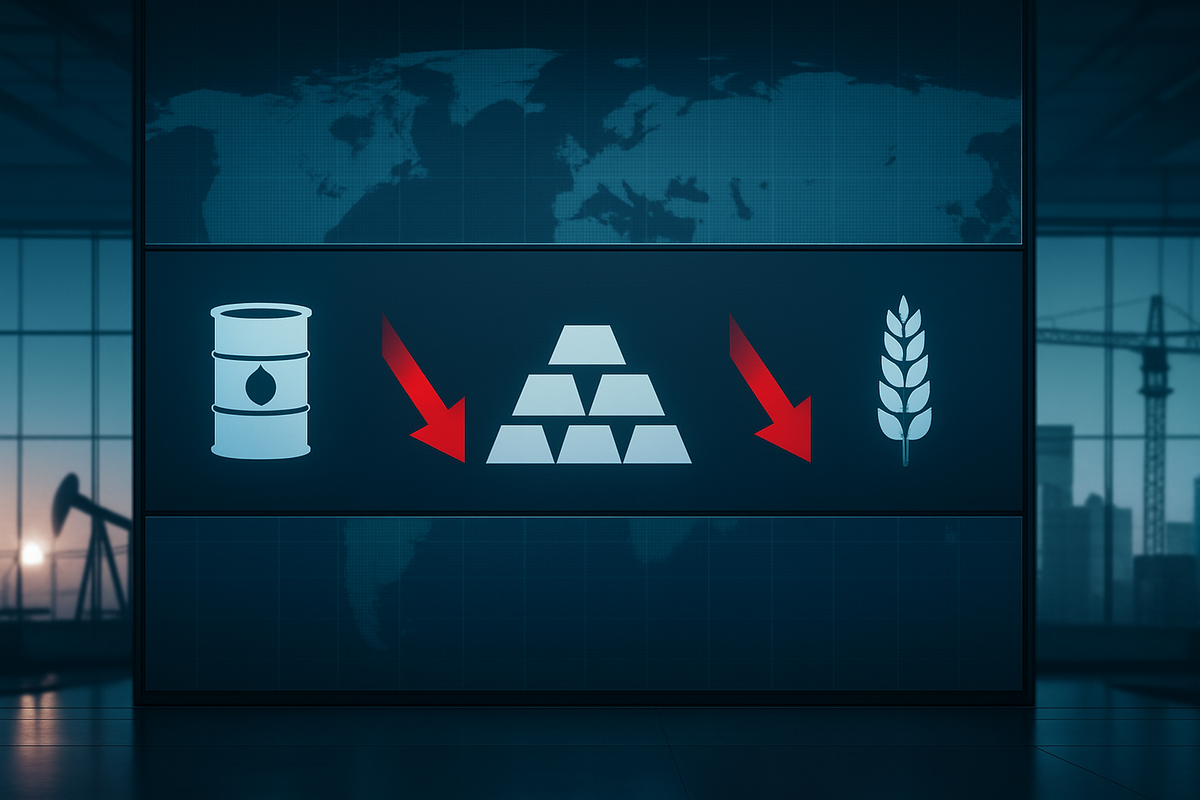
As of April 10, 2026, the global economy is standing at a critical juncture where the feverish commodity prices of the early 2020s have finally broken. The World Bank’s latest Commodity Markets Outlook report, released this week, paints a sobering picture for producers but offers a glimmer of hope for inflation-weary consumers. The report projects that aggregate global commodity prices will hit a six-year low by the end of 2026, following consecutive 7% annual drops in both 2025 and 2026.
This "Great Commodity Respite," as economists are calling it, marks the end of a decade defined by supply chain shocks and geopolitical volatility. While a cooling of prices typically suggests a easing of global inflation, the drivers behind this trend—a massive looming oil surplus, a structural slowdown in China, and persistent policy uncertainty—suggest that the road ahead for global markets and major industrial players will be fraught with margin compression and strategic retreats.
A "Perfect Storm" of Surplus and Stagnation
The World Bank's April 2026 report outlines a convergence of three primary forces that are aggressively pushing prices toward their lowest levels since the turn of the decade. First and foremost is a projected global oil surplus that is expected to reach between 1.2 and 3 million barrels per day (mb/d) by the end of the year. This level of oversupply has rarely been seen in modern history, with the only comparable periods being the 1998 Asian financial crisis and the 2020 pandemic lockdowns. This glut is largely the result of the "Americas Quintet"—the United States, Brazil, Canada, Guyana, and Argentina—which have ramped up production to record levels just as global demand growth has begun to plateau.
On the demand side, the primary headwind is the structural cooling of the Chinese economy. The World Bank has revised China’s 2026 GDP growth projection down to 4.4%, a reflection of the nation’s pivot away from property-led, infrastructure-heavy growth toward high-tech manufacturing and electric vehicles (EVs). This transition has fundamentally altered the demand curve for fossil fuels and industrial metals like iron ore. Furthermore, "policy traps" are exacerbating the downward pressure. Trade tensions, unresolved tariffs, and delays in U.S. biofuel mandates—specifically the Renewable Volume Obligations (RVO)—have created a cloud of uncertainty that has deterred capital investment and kept market sentiment bearish despite localized geopolitical flare-ups.
Winners and Losers in a Deflationary Commodity Environment
The transition to a low-price environment is creating a sharp divide among public companies, favoring those with extreme operational efficiency while punishing those exposed to high-cost production. In the energy sector, ExxonMobil (NYSE: XOM) and Chevron (NYSE: CVX) are navigating the downturn by leveraging their low-cost portfolios. ExxonMobil has successfully lowered its breakeven point to roughly $40–$42 per barrel by high-grading assets in Guyana and the Permian Basin. While a Brent crude average of $60 in 2026 will undoubtedly squeeze margins, these "Supermajors" are positioned to survive through sheer scale, though investors are closely watching for potential earnings revisions if prices slide toward the $40 mark.
The mining sector is witnessing a "schism" between traditional and future-facing commodities. BHP Group (NYSE: BHP) and Rio Tinto (NYSE: RIO) are facing a significant 20% drop in iron ore prices as the Chinese construction boom fades into history. For BHP, the strategy has been an aggressive shift toward copper and potash to offset the iron ore slump. Rio Tinto is following a similar path, redirecting capital expenditure toward lithium and copper, betting that the green energy transition will provide a floor for prices that industrial commodities no longer enjoy.
The agricultural and equipment sectors are perhaps the most vulnerable to the current cycle. Archer Daniels Midland (NYSE: ADM) has seen its 2026 profit outlook dampened by "crush margin" depression and uncertainty surrounding U.S. 45Z tax credits for biofuels. Meanwhile, Deere & Co (NYSE: DE) has characterized 2026 as the "bottom of the large ag cycle." The company is forecasting a 15% to 20% decline in demand for large agricultural machinery and expects to absorb nearly $1.2 billion in pre-tax tariff costs, illustrating how trade policy can exacerbate the pain of a commodity downturn.
Shifting Paradigms: From Scarcity to Surplus
The significance of the 2026 outlook extends beyond simple price charts; it represents a fundamental shift in the global industrial order. For the better part of five years, the market narrative was one of "scarcity" driven by post-pandemic demand and the war in Ukraine. The current projection of a 6-year price low suggests that the supply side has finally over-corrected. This event mirrors the historical precedents of the late 1990s, where massive capital investments eventually led to a decade-ending glut that required years of consolidation to clear.
Furthermore, the World Bank’s report highlights a decoupling of commodity prices from geopolitical risk. Traditionally, conflict in the Middle East or Eastern Europe would send oil and grain prices skyrocketing. However, the current "war premium" is being neutralized by the sheer volume of spare capacity held by non-OPEC+ nations. This shifts the balance of power in global energy markets, reducing the leverage of traditional oil-exporting cartels and forcing a rethink of energy security policies in the West.
The Road to 2027: Strategic Pivots and Scenarios
In the short term, the market should prepare for heightened volatility as companies adjust their 2026 guidance to reflect the $60 Brent crude and lower grain price environment. We are likely to see a wave of consolidation in the mid-cap mining and energy sectors, as smaller players with higher breakeven costs become acquisition targets for the cashed-up giants like Exxon or BHP. The long-term challenge will be the "Green Transition Paradox": while low commodity prices are good for the immediate economy, they can discourage the massive capital investments needed for long-cycle minerals like copper, potentially setting the stage for a supply squeeze in the late 2020s.
Strategic pivots are already underway. Companies are moving away from "growth at all costs" to "margin over volume." We expect to see more public companies focusing on share buybacks and dividend maintenance to keep investors engaged while they wait out the bottom of this cycle. For equipment manufacturers like Deere, the focus is shifting toward "precision ag" technology—selling efficiency to farmers who can no longer rely on high crop prices to cover their overhead.
Summary: What Investors Should Watch
The World Bank’s latest outlook confirms that the commodity super-cycle has entered a deep cooling phase. The 7% price drops forecasted for both 2025 and 2026 suggest that the "Great Commodity Respite" is not a temporary dip, but a multi-year structural adjustment. Investors should keep a close eye on Brent crude prices relative to the $60 support level and monitor the progress of U.S. biofuel policy and Chinese GDP data, as these will be the primary signals for any early recovery or further decline.
Moving forward, the focus will be on "breakeven resilience." Companies that can remain profitable in a $60 oil and $100 iron ore environment will be the winners of 2026. While the broader market may enjoy the deflationary benefits of lower raw material costs, the industrial and energy sectors are in for a period of disciplined survival. The "Great Respite" is here, and for the world’s largest commodity players, the margin for error has never been thinner.
This content is intended for informational purposes only and is not financial advice.