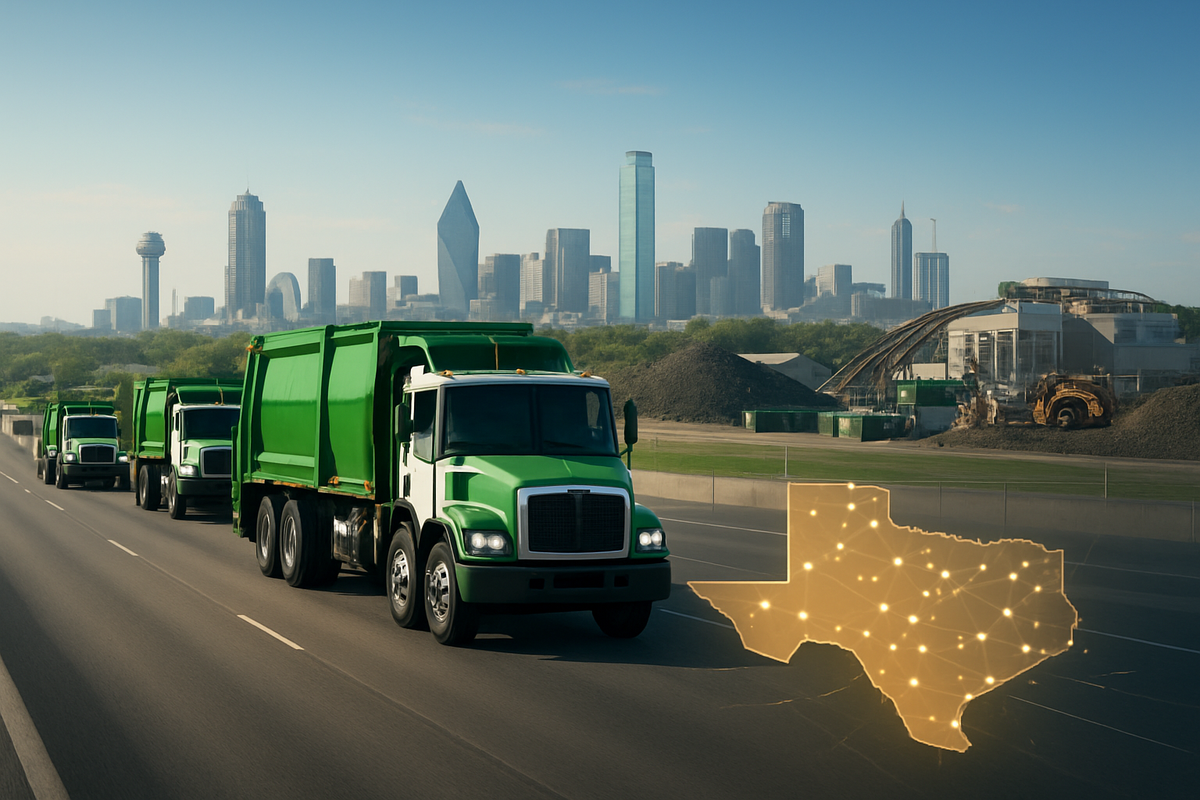
VAUGHAN, Ontario — GFL Environmental Inc. (NYSE: GFL) has officially closed its high-stakes acquisition of Frontier Waste Solutions, a premier solid waste service provider in the southern United States. Valued at approximately $900 million, the deal represents one of the most significant consolidations in the waste management sector this year. By integrating Frontier's extensive operations, GFL significantly densifies its footprint in the "Texas Triangle"—the booming economic powerhouse formed by the Dallas-Fort Worth, Houston, and San Antonio/Austin metropolitan areas.
The transaction marks a definitive pivot for GFL as it doubles down on high-growth municipal and commercial markets in the Sunbelt. Beyond the heavy machinery and landfill assets, the acquisition is being hailed for its strategic "buy-in" from Frontier’s leadership. John Gustafson, the founder and CEO of Frontier Waste Solutions, has signaled his long-term conviction in the merger by rolling over $100 million of his transaction proceeds into GFL subordinate voting shares. This move aligns the interests of Frontier’s founding team with GFL’s broader corporate mission, ensuring that the local expertise that built Frontier remains a driving force within the GFL ecosystem.
Operational Scale and the Strategic Roadmap
The acquisition, which finalized on April 1, 2026, brings a massive influx of operational capacity to GFL’s U.S. division. The deal includes 24 operational sites scattered across Texas and a fleet of over 650 specialized vehicles. Approximately 1,000 employees from Frontier will transition to GFL, bringing with them a wealth of local knowledge and established service relationships. Frontier has long been recognized for its rapid growth under Gustafson’s leadership, specifically its ability to secure lucrative municipal contracts in markets like Austin and Corpus Christi, as well as its strategic acquisition of the 380 McKinney C&D Landfill.
GFL Founder and CEO Patrick Dovigi described the acquisition as a "landmark moment" for the company’s expansion strategy. The timeline leading up to this closing involved months of due diligence and a shift in GFL’s capital allocation strategy. After a period of focusing on deleveraging and "tuck-in" acquisitions throughout 2024 and 2025, the Frontier deal signals a return to large-scale, transformative M&A. The transaction was financed through a combination of GFL’s existing credit facility, cash on hand, and the issuance of over 2.5 million shares to the sellers, showcasing a balanced approach to funding major growth.
Market reaction has been largely positive, with analysts noting that the Texas Triangle is perhaps the most sought-after geography in the waste industry due to its population density and pro-business environment. The addition of Frontier is expected to contribute a significant portion of the $425 million to $450 million in aggregate annualized revenue that GFL anticipates from its early 2026 acquisition cohort. By folding Frontier into its existing Texas infrastructure—which includes assets from previous buys like WCA Waste and Sprint Waste Services—GFL is positioning itself as a vertically integrated powerhouse capable of internalizing waste streams across the state.
Winners, Losers, and Competitive Shifts
The immediate winners of this deal include GFL’s shareholders, who stand to benefit from the increased density and operational synergies that come with "route clustering" in Texas. By owning both the collection routes and the disposal sites (like the McKinney landfill), GFL can avoid paying "tipping fees" to competitors, a process known as disposal internalization. This typically leads to significant margin expansion. Frontier’s previous owners, including private equity backers Summer Street Capital and Tailwater Capital, also see a successful exit, while CEO John Gustafson’s $100 million reinvestment suggests that he expects the combined entity to outperform the broader market in the coming years.
However, the move puts increased pressure on industry titans such as Waste Management (NYSE: WM) and Republic Services (NYSE: RSG). For decades, these companies have enjoyed a comfortable dominance in the Texas market. GFL’s aggressive expansion turns a former "challenger" into a "Tier 1" peer in the region. Specifically, Waste Management, which is headquartered in Houston, now faces a much more formidable rival for large municipal contracts. Similarly, Waste Connections (NYSE: WCN), also based in Texas, will find the bidding landscape for commercial and industrial waste services much more competitive as GFL leverages its newly expanded fleet and workforce.
On the losing end of the spectrum are smaller, independent waste haulers in the Texas Triangle who may find it increasingly difficult to compete with GFL’s economies of scale. As GFL and its peers continue to consolidate the market, these smaller operators often face a choice: sell to the larger players or risk being priced out of the market due to rising costs for labor, equipment, and landfill access. For municipal customers, the consolidation could be a double-edged sword, offering more robust service capabilities but potentially reducing the number of competitive bidders for long-term city contracts.
Broader Industry Implications
This event fits into a broader industry trend of "regional densification." In the waste sector, growth is no longer just about owning more trucks; it is about owning the entire value chain in high-growth corridors. The Texas Triangle expansion mirrors similar moves made by major players in the Southeast and the Mountain West. As the U.S. population continues to migrate toward the Sunbelt, waste companies are racing to lock up infrastructure in regions where housing starts and commercial activity are highest. GFL’s move is a clear signal that the company views Texas as the primary engine for its U.S. growth over the next decade.
The deal also highlights the continuing importance of "human capital" in M&A. In many large-scale acquisitions, the departure of founding leadership can lead to integration friction and the loss of local contracts. By securing a $100 million share rollover from Gustafson, GFL is employing a "partnership model" that has become a hallmark of its growth strategy. This approach contrasts with more traditional "hostile" or purely corporate takeovers, emphasizing the value of maintaining local brand equity and operational continuity.
From a regulatory standpoint, the deal appears to have cleared the necessary hurdles without major divestiture requirements, suggesting that while GFL is growing rapidly, the Texas market remains fragmented enough to satisfy antitrust concerns. However, as the "Big Four" (WM, RSG, WCN, and GFL) continue to acquire mid-sized players like Frontier, the industry may eventually reach a saturation point that triggers closer scrutiny from the Department of Justice. For now, the precedent set by this deal suggests that there is still significant runway for consolidation in the North American waste landscape.
Looking Ahead: The Post-Acquisition Horizon
In the short term, the market will be watching GFL’s integration process closely. The company must successfully merge Frontier’s 1,000 employees and 650 vehicles into its existing operations without disrupting service or losing key municipal accounts. Investors will look for evidence of margin improvement in GFL’s quarterly earnings throughout the remainder of 2026, specifically checking if the "disposal internalization" promised by the McKinney landfill acquisition begins to lower operational costs.
Long-term, GFL is expected to continue its path toward becoming a "pure-play" solid waste compounder. With a debt-to-equity ratio holding steady around 1.05 and a goal to keep net leverage in the low-to-mid 3s, the company has room for further strategic pivots. We may see GFL focus more on sustainability and renewable energy, potentially converting Frontier’s landfill assets into "renewable natural gas" (RNG) facilities—a trend that has gained massive traction among its competitors. The success of the Frontier integration will likely determine if GFL pursues another nearly $1 billion deal in 2027 or shifts toward returning capital to shareholders through dividends and buybacks.
Conclusion and Market Assessment
The acquisition of Frontier Waste Solutions for $900 million is more than just a line item on GFL’s balance sheet; it is a calculated bet on the economic future of Texas. By securing 24 sites and a workforce of 1,000, GFL has effectively built a "fortress" in one of the world's fastest-growing economies. The $100 million reinvestment by John Gustafson serves as a powerful endorsement of GFL’s platform, providing a level of leadership stability that is rare in such large-scale transactions.
Moving forward, the waste management industry remains a resilient "utility-like" sector that thrives on scale and efficiency. For investors, GFL’s ability to execute this integration will be the primary metric of success. If the company can deliver on its revenue projections of $450 million from its recent acquisitions while maintaining its leverage targets, it will solidify its position as the premier growth stock in the environmental services space. Watch for GFL’s Q3 and Q4 reports in late 2026 for the first real look at how the Frontier assets are performing under the "Green for Life" banner.
This content is intended for informational purposes only and is not financial advice