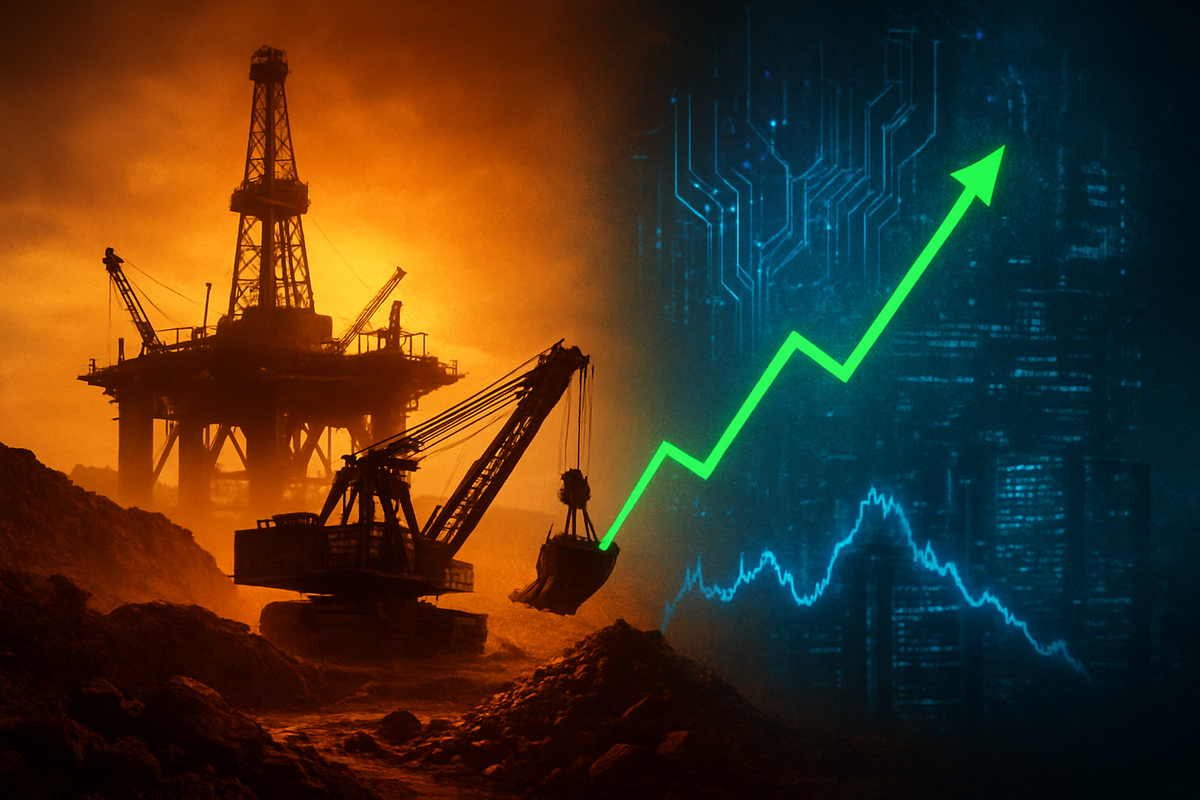
The financial landscape on March 9, 2026, has reached a critical tipping point, marking one of the most aggressive sector rotations in modern market history. As technology-heavy indices struggle to find their footing under the weight of "AI fatigue" and new trade pressures, investors have staged a massive exodus into the "real economy." This "Physical Reality" trade has propelled the Energy sector to a staggering 25% year-to-date (YTD) gain, while Materials have surged 17.8%, leaving the digital darlings of the previous decade in the dust.
This shift represents more than just a momentary dip; it is a fundamental re-rating of what constitutes value in a world increasingly defined by physical constraints and geopolitical volatility. As the S&P 500 struggles with its high concentration in technology, the underlying breadth of the market tells a different story: a renaissance for cyclicals and value-oriented stocks that are benefiting from a confluence of high energy prices, infrastructure demands, and a new era of global protectionism.
The Convergence of Conflict and Commodities
The dramatic outperformance of the Energy and Materials sectors has been catalyzed by a perfect storm of macroeconomic and geopolitical events. Central to today’s market action is the escalating conflict in the Middle East, which has entered its tenth day. With the Strait of Hormuz effectively closed, nearly 20% of the world’s oil supply is offline, sending Brent Crude prices soaring past the $100-per-barrel mark and touching $120 during intraday trading. This supply shock has provided a massive tailwind for "pure-play" energy producers who are seeing record-breaking cash flow projections.
Simultaneously, the Materials sector has been buoyed by the realization that the artificial intelligence revolution is a physical endeavor as much as a digital one. The massive buildout of data centers required to house advanced AI models has triggered an insatiable demand for copper, aluminum, and rare earth metals. This demand is further amplified by the U.S. government’s "OBBBA" infrastructure program, which has front-loaded fiscal stimulus into domestic manufacturing and construction, creating a structural shortage in core industrial materials.
The timeline leading to this March 9 divergence began in early February when the administration introduced a 15% global tariff policy. This move immediately pressured global supply chains, specifically targeting the high-margin hardware components essential for the tech sector. While tech firms scrambled to absorb these costs, domestic materials and energy providers found themselves shielded by their local assets and rising global commodity prices, cementing their lead in the 2026 market hierarchy.
Winners of the "Real Economy" and the Tech Retreat
The primary beneficiaries of this rotation are the titans of the old guard. ExxonMobil (NYSE: XOM) and Chevron (NYSE: CVX) have led the charge, with both companies up over 25% YTD as they capitalize on the energy supply vacuum. In the materials space, Freeport-McMoRan (NYSE: FCX) has become a market favorite, surging on the back of copper’s multi-year highs. Industrial stalwarts like Caterpillar (NYSE: CAT) and Deere (NYSE: DE) are also outperforming, as the demand for heavy machinery in the mining and infrastructure sectors remains relentless.
Conversely, the "Magnificent Seven" and other growth-oriented tech firms are facing a harsh reality. Apple (NASDAQ: AAPL) and Microsoft (NASDAQ: MSFT) have seen their valuations compressed as the 15% global tariff eats into hardware margins and global demand cools. The struggle is even more pronounced in the Software-as-a-Service (SaaS) space; firms like Salesforce (NYSE: CRM) and ServiceNow (NYSE: NOW) are grappling with what analysts are calling "Software Armageddon," where advanced AI agents are beginning to replace the very subscription models these companies pioneered.
Transportation and consumer discretionary stocks are also among the hardest hit. United Airlines (NASDAQ: UAL) and other major carriers have seen sharp declines as rising jet fuel costs threaten to erase quarterly profits. Even a few outliers, such as Hims & Hers (NYSE: HIMS), which has surged 47% YTD due to a unique weight-loss drug partnership, cannot mask the broader pain being felt across the growth and tech landscape as capital flows toward more defensive, tangible assets.
A Structural Shift in Global Trade and Technology
The significance of the March 9 rotation lies in its departure from the "digital-first" mindset that dominated the markets for the past fifteen years. This event highlights a broader industry trend toward deglobalization and the prioritization of supply chain security over pure efficiency. The imposition of global tariffs has forced a re-evaluation of the "just-in-time" manufacturing model that tech giants like Apple once mastered, favoring companies with domestic resource bases or shorter, more resilient supply chains.
Historically, this rotation mirrors the stagflationary periods of the 1970s or the post-dot-com bubble correction of the early 2000s, where value and commodities outperformed growth for extended periods. However, the 2026 twist is the role of AI. Unlike previous cycles where tech was purely speculative, the current demand for physical infrastructure—the power and the cooling systems for AI—is the very thing driving the Materials and Energy rally. In this sense, the AI boom has become a victim of its own physical requirements, creating a ripple effect that benefits the "picks and shovels" of the energy and mining industries at the expense of software developers.
Regulators and policymakers are now facing a "stagflationary" dilemma. With unemployment ticking up to 4.4% in the February jobs report and inflation remaining "sticky" due to energy costs, the Federal Reserve is caught between a rock and a hard place. The market is currently pricing in a "higher for longer" interest rate environment, as the Fed has signaled it cannot ease rates while energy-driven inflation remains a threat, further penalizing high-multiple tech stocks.
Navigating the Volatile Road Ahead
In the short term, the market is likely to remain highly volatile as it adjusts to the reality of $100+ oil and a fractured global trade system. Strategic pivots will be required for companies that have relied on cheap international labor and low energy costs. We may see tech giants aggressively investing in their own energy production—such as small modular nuclear reactors—to bypass the traditional grid and insulate themselves from future energy shocks. This would represent a further merging of the "digital" and "physical" economies.
Looking further ahead, the outcome of the current Middle East conflict will be the primary lever for market direction. If diplomatic channels can reopen the Strait of Hormuz, we could see a rapid "relief rally" in tech and a cooling of the energy surge. However, if the blockade persists, the current rotation could harden into a long-term trend, potentially leading to a multi-year period where value stocks and tangible assets consistently outperform. Investors should prepare for scenarios where growth is scarce and dividend-paying cyclicals become the bedrock of the average portfolio.
Summary and Investor Takeaways
The events of March 9, 2026, serve as a stark reminder that the "real economy" still dictates the terms of market survival. The 25% YTD rally in Energy and the 17.8% jump in Materials are not mere anomalies but signs of a deep-seated rotation toward value and cyclicals. As the tech-heavy indices struggle with overvaluation, AI fatigue, and the weight of global tariffs, the market has clearly stated its preference for companies that produce the fuel, metals, and machinery the world needs to function.
Moving forward, this is a "stock picker’s market" where broad index investing may no longer yield the outsized returns of the early 2020s. Investors should keep a close watch on three key factors in the coming months: the status of energy supply routes in the Middle East, the Federal Reserve’s response to "sticky" inflation, and the first-quarter earnings reports of tech giants to see how they are managing the new tariff environment. For now, the "Physical Reality" trade reigns supreme, and the march toward tangible value shows no signs of slowing.
This content is intended for informational purposes only and is not financial advice.