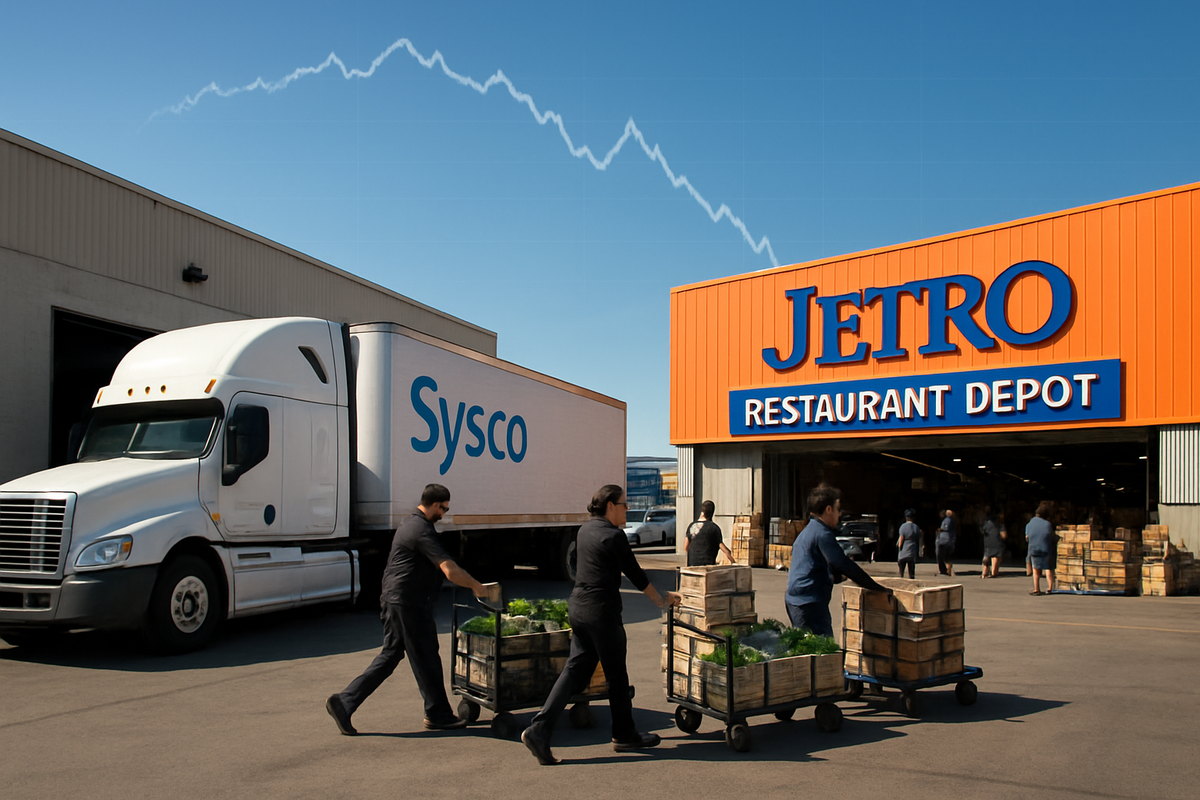
HOUSTON – In a move that has sent shockwaves through the global food distribution industry, Sysco Corporation (NYSE: SYY) announced on March 30, 2026, a definitive agreement to acquire the premier cash-and-carry wholesaler Jetro Restaurant Depot for a staggering $29.1 billion. The acquisition, the largest in Sysco’s history, marks a aggressive strategic pivot designed to capture the high-margin "independent restaurant" segment that has traditionally eluded broadline delivery giants. Under the terms of the deal, Sysco will pay $21.6 billion in cash and issue approximately 91.5 million shares to Jetro’s private owners, giving them a roughly 16% stake in the combined entity.
Despite the ambitious nature of the deal, Wall Street greeted the news with significant skepticism. Shares of Sysco (NYSE: SYY) tumbled 5.7% by the closing bell on the day of the announcement, as investors voiced concerns over the massive debt load required to fund the cash portion of the transaction and the potential for a prolonged and difficult integration process. Analysts noted that while the strategic logic is sound, the "execution risk" in merging a delivery-centric logistics machine with a retail-style warehouse operation is substantial.
A Massive Expansion into the "Cash-and-Carry" Realm
The acquisition of Jetro Restaurant Depot brings 166 large-format warehouse stores into the Sysco ecosystem. Unlike Sysco’s traditional model, which relies on a massive fleet of refrigerated trucks delivering to pre-ordered accounts, Jetro operates on a self-service basis. Independent restaurant owners, caterers, and non-profits visit Jetro depots to hand-select produce, meats, and supplies, paying upfront and transporting the goods themselves. This "cash-and-carry" model effectively eliminates the high logistics and delivery costs that have squeezed margins for broadline distributors in recent years.
The deal follows a period of quiet but intense negotiations led by Sysco CEO Kevin Hourican and Jetro Executive Chairman Stanley Fleishman. Hourican, the architect of Sysco’s "Recipe for Growth" strategy, framed the merger as a "multi-channel" evolution. "By bringing Jetro into the Sysco family, we are creating a seamless ecosystem for our customers," Hourican stated during a morning investor call. "Whether a chef needs a full truckload of staples delivered to their back door or a single case of fresh herbs for tonight’s special, Sysco will be there. We are no longer just a delivery company; we are an omnichannel partner for the entire foodservice industry."
The combined company is projected to generate nearly $100 billion in annual revenue, commanding an estimated 25% to 27% of the U.S. foodservice distribution market. Sysco plans to leverage its supply chain expertise to open more than 125 new Jetro locations over the next five years, targeting smaller urban markets where the cash-and-carry model is currently underserved.
Winners and Losers in the New Foodservice Landscape
While Sysco (NYSE: SYY) investors are currently nursing losses, the long-term competitive landscape of the $400 billion foodservice market has been fundamentally redrawn. The clearest "losers" in the immediate term appear to be pure-play broadline competitors like US Foods (NYSE: USFD). Without a warehouse arm to compete for the "street business" (small, independent accounts), US Foods risks being squeezed between Sysco’s massive scale and the nimble, tech-forward warehouse clubs. Performance Food Group (NYSE: PFGC) also faces intensified pressure, although its dominance in the convenience store and theater segments through its Vistar and Core-Mark divisions provides a partial moat against Sysco’s expansion.
On the other side of the ledger, traditional warehouse giants like Costco (NASDAQ: COST) and Sam’s Club, owned by Walmart (NYSE: WMT), may find themselves in a direct turf war with the new Sysco-Jetro entity. Costco has been aggressively expanding its "Business Center" format, which mirrors much of Jetro’s appeal. However, Sysco’s ability to offer "hybrid" contracts—allowing a restaurant to combine delivery for bulk items with member-only access to Jetro warehouses for "fill-in" shopping—presents a unique threat that general-interest warehouse clubs may struggle to match.
For the nation’s 725,000 independent restaurants, the merger is a double-edged sword. While Sysco’s procurement power could lead to more stable supply chains and broader product availability, many "mom-and-pop" operators fear that the loss of Jetro as an independent, low-cost alternative will eventually lead to higher prices. The "cash-and-carry" model was often the last refuge for small businesses looking to avoid the delivery fees and minimum order requirements of the major distributors.
Wider Significance and Regulatory Clouds
The Sysco-Jetro deal is more than just a corporate merger; it is a signal that the foodservice industry is moving toward a "hybrid" future. As labor costs for delivery drivers continue to rise and urban congestion makes last-mile delivery increasingly difficult, the "pull" model of cash-and-carry is becoming more attractive. This trend reflects broader retail shifts seen in the consumer space, where "buy online, pick up in store" (BOPIS) has become a standard offering.
However, the sheer size of the merger has already attracted the attention of regulators. The Federal Trade Commission (FTC), which in late 2025 established new "Food Supply Chain Security Task Forces," is expected to subject the deal to intense scrutiny. Regulators are particularly concerned with whether the merger will create a "vertical" monopoly that harms competition in the "food-away-from-home" sector. Given the current administration’s aggressive stance on food inflation and supply chain transparency, a "Second Request" for information is almost certain, potentially delaying the deal’s close until late 2026 or early 2027.
Furthermore, the integration must navigate a complex new regulatory environment. As of January 2026, the FDA’s Food Traceability Rule 204 is in full effect, requiring detailed electronic records for high-risk foods. Integrating Jetro’s "no-frills" warehouse systems into Sysco’s sophisticated digital compliance infrastructure will be a Herculean task, with any failure risking heavy federal fines or supply chain disruptions.
What Comes Next: Deleveraging and Deployment
In the short term, Sysco management is focused on one thing: deleveraging. The $21.6 billion in cash required for the deal will spike Sysco’s leverage ratio to approximately 5.0x, prompting a "Negative" outlook revision from S&P Global. To appease credit markets, Sysco has already announced a temporary suspension of its share repurchase program and a focus on capturing $250 million in annual cost synergies within the first three years of the merger.
Strategically, the market will be watching to see how quickly Sysco can deploy its "AI360" digital platform across the Jetro footprint. If Sysco can successfully use data analytics to predict what independent chefs need before they even walk into a Jetro warehouse, it could revolutionize the "shopping" experience and drive higher foot traffic. Conversely, if the integration is botched, the resulting debt burden could handicap Sysco’s ability to invest in other growth areas, such as international expansion or its specialty "Fresh" divisions.
A New Era for Foodservice Distribution
The acquisition of Jetro Restaurant Depot by Sysco (NYSE: SYY) marks the end of an era for independent wholesale and the beginning of a high-stakes experiment in "hybrid" distribution. By bridging the gap between delivery and cash-and-carry, Sysco is betting that it can become the indispensable backbone of the American restaurant industry.
For investors, the coming months will be a test of patience. The market's initial 5.7% sell-off reflects a "show-me" attitude toward the deal's ambitious synergy targets and the looming regulatory hurdles. Watch for Sysco’s quarterly updates on its debt-reduction progress and any preliminary feedback from the FTC. While the $29.1 billion price tag is eye-watering, the prize—a near-monopoly on the supply chain of the American dining experience—is even larger. Whether Sysco can digest this massive acquisition without significant indigestion remains the most important question in the financial markets of 2026.
This content is intended for informational purposes only and is not financial advice.