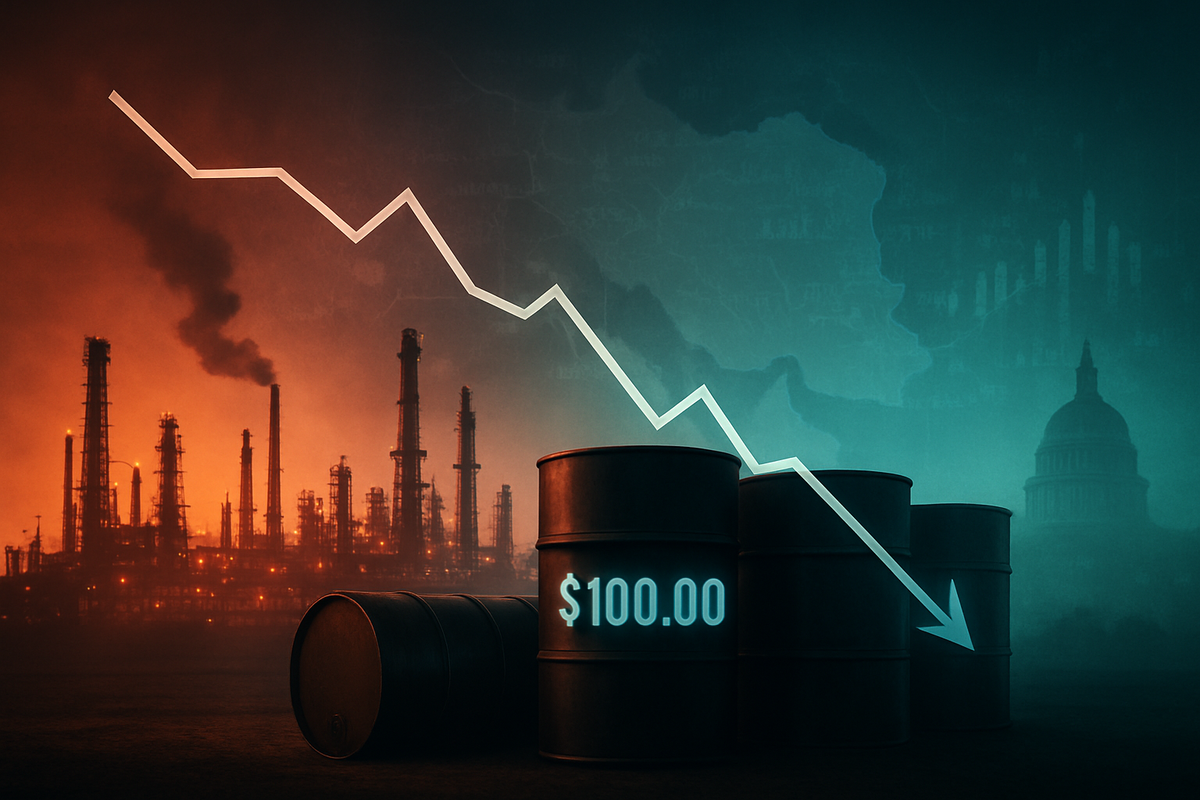
The global energy market experienced a seismic shift today, March 23, 2026, as oil prices plummeted by more than 11%, providing much-needed relief to a world teetering on the edge of a stagflationary crisis. Brent crude, the international benchmark, tumbled to approximately $100 a barrel, while West Texas Intermediate (WTI) saw a sharp decline of over 10%, settling near $88.85. The massive sell-off was triggered by an early-morning announcement from the White House confirming a five-day postponement of scheduled military strikes against Iranian nuclear and military infrastructure.
This unexpected de-escalation has sent a wave of optimism through global equity markets, which had been pricing in a "war premium" that briefly drove crude toward $120 earlier this month. The temporary stay on kinetic action offers a critical window for diplomatic backchannels, centered around the rumored "Muscat Protocol," to potentially avert a full-scale regional conflict. For consumers and central bankers alike, the double-digit drop in energy costs serves as a significant deflationary pulse, potentially altering the trajectory of interest rate hikes as inflation expectations are recalibrated in real-time.
Diplomatic Breathing Room: The Five-Day Window
The collapse in prices followed a tense weekend where military analysts across the globe expected "Operation Epic Fury"—the coalition's plan for targeted strikes—to commence. However, the five-day postponement announced today has effectively drained the geopolitical risk premium from the barrel. This pause comes in the wake of intense secret negotiations in Oman, where Iranian officials reportedly signaled a willingness to freeze uranium enrichment in exchange for the release of billions in frozen assets. While the Pentagon maintains that all military options remain "locked and loaded," the market has interpreted the delay as a sign that a diplomatic "off-ramp" is finally being paved.
The timeline leading to this moment has been one of extreme volatility. Following the collapse of the 2025 nuclear ultimatum, tensions in the Strait of Hormuz reached a breaking point in February 2026, leading to a 40% "war premium" on shipping and energy. The announcement of the strike postponement acted as a pressure-release valve for a market that was heavily overbought. Traders who had been hedging against $150 oil were forced into a massive liquidation of long positions, accelerating the downward momentum throughout the morning session.
Key stakeholders, including the International Energy Agency (IEA) and OPEC+ leadership, have remained largely silent as they assess the stability of this new baseline. However, initial reactions from the trading floors in London and New York suggest a "wait-and-see" approach, with high-frequency trading algorithms reacting violently to the news. The immediate market reaction has been one of relief, though the underlying fear remains that if the five-day window passes without a formal treaty, the rebound in prices could be even more aggressive than the current decline.
Winners and Losers: A Great Reallocation of Capital
The primary beneficiaries of today’s oil crash are the transportation and logistics sectors, which have been hammered by soaring fuel costs over the last quarter. Delta Air Lines (NYSE: DAL) saw its shares surge by over 8%, while United Airlines Holdings (NASDAQ: UAL) jumped nearly 10% in midday trading. For these carriers, fuel typically accounts for nearly a third of operating expenses. The sudden drop in jet fuel spot prices provides an immediate boost to their margins, especially as they enter the busy spring travel season with ticket prices still reflecting the higher energy costs of previous weeks.
In the logistics space, giants like FedEx Corp (NYSE: FDX) and United Parcel Service (NYSE: UPS) also posted significant gains. These companies utilize fuel surcharges that often lag behind real-time price movements, meaning they will benefit from a "margin window" where they continue to collect high surcharges while their actual operational costs for air and ground fleets plummet. Similarly, consumer discretionary stocks like Amazon.com Inc (NASDAQ: AMZN) have seen a lift, as lower gas prices are historically equivalent to a massive tax cut for the American consumer, freeing up more disposable income for retail spending.
Conversely, the "Big Oil" sector is facing a sharp correction. Exxon Mobil Corp (NYSE: XOM) and Chevron Corp (NYSE: CVX) both saw their stock prices dip by approximately 4-5% as the windfall profits from $120 oil began to evaporate. While these companies remain highly profitable at $100 a barrel, the loss of the "war premium" removes the speculative tailwind that had driven energy stocks to record highs earlier this year. Furthermore, independent shale producers in the Permian Basin may face renewed pressure if prices continue to slide toward the $80 mark, where the break-even math for new drilling becomes significantly tighter.
Wider Significance and the Inflation Narrative
Today’s 11% plunge is more than just a fluctuation in commodity prices; it represents a potential pivot point for the global economy. For much of 2025 and the beginning of 2026, the Federal Reserve and other central banks have been trapped in a "higher-for-longer" interest rate regime, largely driven by the "energy-led" inflation spike. A sustained drop in oil prices is the most potent deflationary force available to the market. Economists suggest that if Brent remains near $100, headline CPI could cool by as much as 0.4 percentage points over the next two quarters, potentially giving the Fed the "green light" to begin cutting rates as early as June.
This event mirrors the historical precedents of the 1970s oil shocks and the 2022 energy crisis, where geopolitical de-escalation often led to rapid "mean reversion" in prices. The difference in 2026, however, is the increased sensitivity of the global supply chain. The "logistics tax" added by the threat of conflict in the Middle East has been a hidden anchor on global GDP growth. By postponing the strikes, the U.S. has effectively removed a major regulatory and insurance burden from international shipping, which could lead to a broader recovery in global trade volumes.
However, the ripple effects are not entirely positive. For renewable energy firms and EV manufacturers, high oil prices act as a natural catalyst for transition. A return to lower energy costs could potentially slow the adoption of green technologies, as the economic incentive to move away from fossil fuels weakens. This creates a complex policy environment for the administration, which must balance the immediate need for inflation relief with long-term climate goals and the strategic necessity of energy independence.
What Comes Next: The Five-Day Countdown
All eyes are now on the five-day deadline. Short-term market dynamics will be dominated by technical "noise" and speculation regarding the Muscat Protocol. If a formal ceasefire or "freeze-for-freeze" agreement is signed before the weekend, oil could find a new floor in the $85–$95 range. However, if the postponement is viewed merely as a tactical reset for military operations, the ensuing price spike could be catastrophic, potentially breaching $130 as the market loses faith in a diplomatic resolution.
Strategic pivots are already underway in corporate boardrooms. Airlines and shipping firms are expected to use this dip to lock in hedges at lower rates, protecting themselves against a potential failure of diplomacy. Meanwhile, the Federal Reserve’s upcoming meeting will be scrutinized for any change in rhetoric. The "war-induced" inflation that seemed inevitable only last Friday is now a question mark, and the market may begin pricing in a "soft landing" scenario that seemed impossible just 72 hours ago.
The coming days will also test the unity of the OPEC+ alliance. While lower prices are a boon for the West, many producing nations require oil above $90 to balance their national budgets. We may see a strategic move from the Saudi-led cartel to tighten supply in the coming weeks to prevent a further slide, which could create a "floor" for prices that complicates the central banks' inflation-fighting efforts.
Final Assessment and Investor Outlook
The March 23 oil crash will likely be remembered as the moment the "War Premium of 2026" finally broke. The 11% drop has provided a vital lifeline to the global economy, reducing the immediate threat of a stagflationary spiral and offering a rare opportunity for diplomatic resolution. While the geopolitical situation remains incredibly fluid, the immediate relief for companies like Delta (NYSE: DAL) and FedEx (NYSE: FDX) is tangible and will likely be reflected in their upcoming quarterly earnings.
For investors, the key takeaway is that volatility is the new normal. The market is now a "headline-driven" environment where a single diplomatic dispatch can wipe out billions in market cap or create massive rallies. Moving forward, the focus should shift from purely energy-based inflation to the underlying health of the consumer and the potential for a mid-year interest rate cut.
In the coming months, watch for two primary signals: the official status of the Muscat Protocol and the upcoming CPI data releases. If the diplomatic window leads to a lasting peace, we could be entering a period of renewed economic expansion. If it fails, today’s plunge will be viewed as the "eye of the storm" before a even more turbulent second half of 2026.
This content is intended for informational purposes only and is not financial advice.