
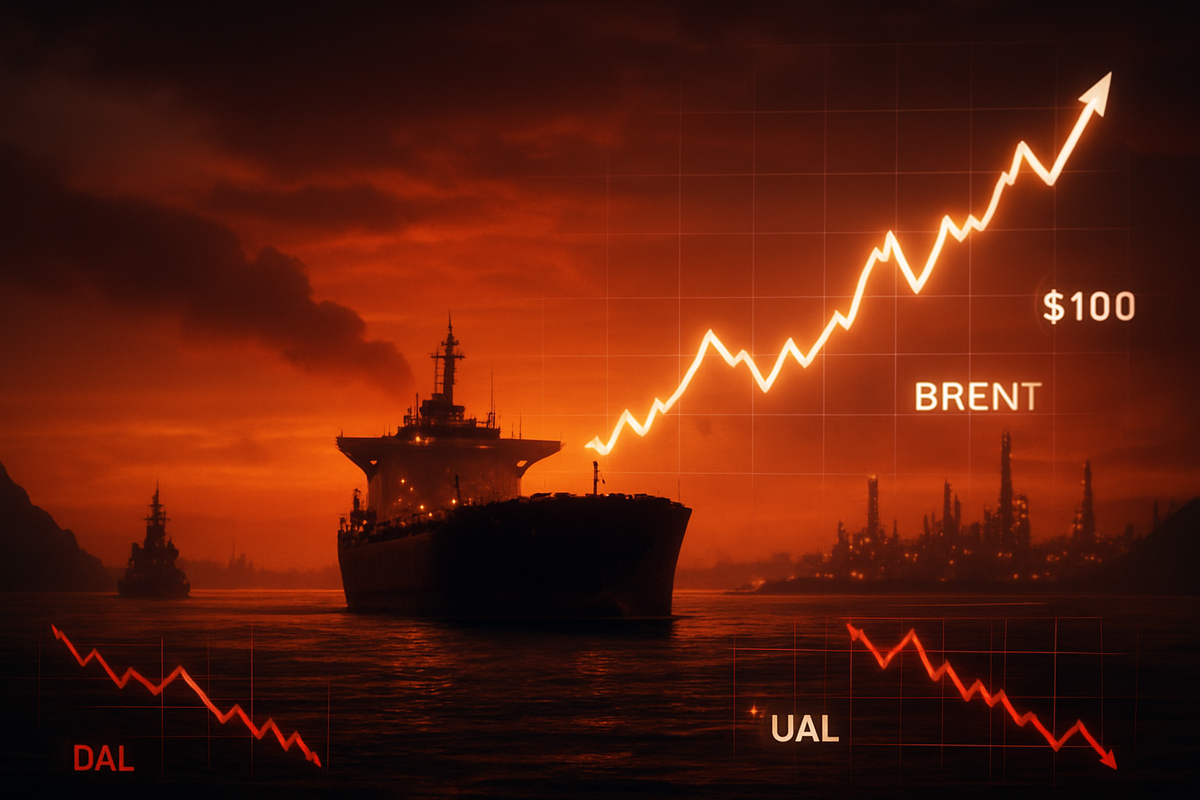
The global energy landscape shifted violently this month as Brent crude oil prices shattered the $100-per-barrel ceiling, driven by a dramatic military escalation between Iran and Israel that has effectively choked one of the world’s most vital maritime arteries. As of March 18, 2026, the energy markets remain in a state of high-octane volatility, with prices peaking at an intraday high of $119.50 before settling into a precarious range between $95 and $105. This sudden "energy tax" on the global economy has sent shockwaves through Wall Street, testing the resilience of a market that had, until recently, been buoyed by the rapid expansion of artificial intelligence and high-tech manufacturing.
The immediate implications of this price spike are being felt most acutely at the gas pump and in the boardrooms of major transportation firms. With the Strait of Hormuz currently contested and nearly 20 million barrels of daily supply hanging in the balance, the threat of a prolonged stagflationary cycle has re-emerged. While the broader stock indices have managed to avoid a total capitulation, the divergence between energy-producing giants and energy-consuming giants has reached its widest point in over a decade, forcing investors to rapidly recalibrate their portfolios for a "higher-for-longer" energy environment.
The Road to $100: A Timeline of Conflict and Contagion
The current crisis traces its immediate roots to February 28, 2026, when a series of coordinated strikes targeted Iranian nuclear and energy infrastructure, including the critical South Pars gas field. This move followed months of heightening shadow warfare and cyber-attacks between the two regional powers. In retaliation, Tehran moved to disrupt shipping in the Strait of Hormuz, the narrow waterway through which approximately one-fifth of the world’s oil and liquefied natural gas (LNG) flows. The resulting "geopolitical risk premium" added nearly $30 to the price of oil in a matter of days, catching many commodity traders off-guard after a two-year period of relative price stability where Brent crude averaged $70 per barrel.
Key players in this geopolitical drama include the Israeli government, the Iranian Revolutionary Guard, and a coalition of Western powers led by the United States, which has scrambled to coordinate a massive release from the International Energy Agency (IEA) strategic reserves. Despite a pledged release of 400 million barrels to stabilize the market, the physical reality of disrupted supply chains has kept prices elevated. Initial market reactions were swift and severe; during the first week of March, Brent crude saw its largest single-day percentage gain since the early 2020s, momentarily paralyzing the energy futures market as clearinghouses struggled with margin calls.
The crisis has also drawn in major OPEC+ members, specifically Saudi Arabia and the UAE, who find themselves in a delicate balancing act. While the higher prices provide a windfall for their national treasuries, the risk of a global recession—and the potential for the conflict to spill over into their own production facilities—has led to frantic diplomatic back-channeling. For now, the "Energy War" of 2026 has become the defining event for global markets, overshadowing even the most bullish technology narratives of the early year.
Winners and Losers: The Great Energy Divergence
In the equity markets, the surge has created a stark divide between those who extract energy and those who burn it. ExxonMobil (NYSE: XOM) and Chevron (NYSE: CVX) have emerged as the primary beneficiaries, with their share prices reaching all-time highs this week as investors flock to unhedged producers capable of capturing the full upside of the $100+ environment. These companies have seen their margins expand overnight, and analysts expect a massive wave of stock buybacks and dividend increases in the coming quarter, assuming prices remain in this elevated channel.
Conversely, the airline and logistics sectors are bearing the brunt of the volatility. Delta Air Lines (NYSE: DAL) and United Airlines (NASDAQ: UAL) have seen their stocks tumble between 15% and 25% over the past 30 days. Jet fuel costs, which typically account for a third of airline operating expenses, have spiked by nearly 50% in some regions, threatening to erase the profitability gains made during the 2025 travel boom. While travel demand remains relatively robust for now, the specter of fuel surcharges and rising ticket prices looms large, potentially grounding the post-pandemic recovery for good.
The retail sector presents a more nuanced picture. While Walmart (NYSE: WMT) recently achieved the historic milestone of a $1 trillion market capitalization, it is facing significant headwinds from rising shipping and last-mile delivery costs. High-end discretionary retailers, such as Target (NYSE: TGT), are seeing even greater pressure as the "energy tax" eats into the disposable income of the American middle class. Interestingly, consumer staples have become a preferred haven; companies like The Kroger Co. (NYSE: KR) have outperformed the broader market as investors pivot toward defensive stocks that offer essential goods regardless of the price of gasoline.
Broader Significance: AI as a Productivity Buffer
The 2026 oil shock is unfolding in a vastly different economic environment than previous crises. Historically, a $100 oil price would have signaled an immediate 10% to 15% correction for the S&P 500. However, the index has shown remarkable resilience, falling only 4% from its February peaks. Analysts attribute this "AI Hedge" to the pervasive role of artificial intelligence in the modern economy. With AI cloud services and automated logistics accounting for nearly 40% of corporate earnings growth in 2026, companies are more efficient and less energy-intensive on a per-dollar-of-GDP basis than they were during the oil shocks of the 1970s or early 2000s.
Despite this corporate resilience, the impact on US consumer sentiment has been devastating. The University of Michigan Consumer Sentiment Index plummeted to 55.5 in mid-March, reflecting a deep anxiety over the return of inflation. Year-ahead inflation expectations have stalled at 3.4%, ending a six-month trend of cooling prices. This divergence—where the stock market stays afloat while the consumer feels the pinch—suggests a growing disconnect in the "K-shaped" economy of 2026, where high-income households and tech-centric firms are shielded, while lower-income families face the brunt of rising energy costs.
From a regulatory standpoint, the crisis is likely to accelerate the transition toward domestic renewable energy and nuclear power. Policy makers in Washington and Brussels are already discussing new "energy security" subsidies to reduce reliance on the Strait of Hormuz. This event echoes the 1973 oil embargo, but with a modern twist: instead of just building more pipelines, the response involves a frantic build-out of "Agentic Commerce" networks—AI-driven supply chains designed to optimize routes and minimize fuel consumption in real-time.
What Comes Next: Strategic Pivots and Potential Scenarios
Looking ahead, the market is bracing for two primary scenarios. The first involves a successful diplomatic de-escalation that re-opens the Strait of Hormuz, which could see oil prices crater back to the $75 range as the geopolitical risk premium evaporates. However, the more likely short-term scenario is a "congealed conflict," where low-level hostilities keep the Strait contested for months. In this environment, companies will be forced to undergo a strategic pivot, prioritizing "near-shoring" and energy-efficient logistics to maintain their margins.
Market opportunities may emerge in the specialized shipping and defense sectors. Companies that provide maritime security or alternative energy transport are seeing a surge in inquiry. Additionally, the shift toward "Agentic Commerce" will likely benefit the tech giants that provide the underlying infrastructure for these AI-driven logistics shifts. Investors should also keep a close eye on the Federal Reserve; while high energy prices are inflationary, they are also "demand destructive," meaning the Fed may be forced to pause its current rate cycle to avoid tipping the economy into a deep recession.
The Bottom Line: What Investors Should Watch
The surge of crude oil past $100 per barrel is more than just a price spike; it is a stress test for the global economy's transition into the late 2020s. The key takeaway for investors is that while the energy sector is the clear immediate winner, the long-term impact will be determined by how quickly other industries can adapt to a more volatile energy regime. The resilience of the major stock indices, supported by AI-driven efficiencies, suggests that a systemic collapse is not yet on the horizon, but the "energy tax" on the consumer cannot be ignored indefinitely.
Moving forward, the primary metric to watch will be the "Strait of Hormuz Throughput." Any sign of a permanent blockage will necessitate a total re-evaluation of global inflation targets. For now, the market remains in a "wait and see" mode, balancing the record profits of energy titans against the cooling sentiment of the American consumer. As we navigate the remainder of 2026, the intersection of geopolitical stability and technological efficiency will remain the most critical frontier for global finance.
This content is intended for informational purposes only and is not financial advice