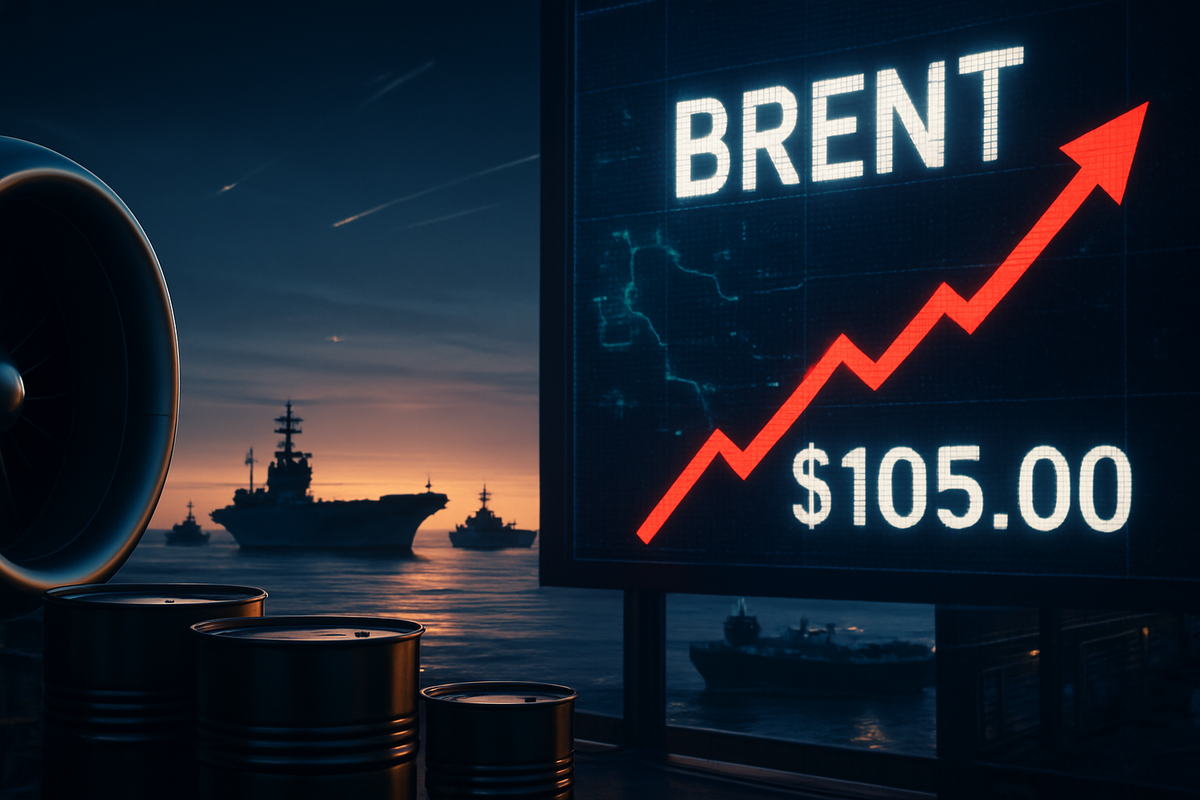
Global energy markets are grappling with a severe supply shock as Brent crude oil climbed past the $105 per barrel mark this morning, March 16, 2026. The price surge follows three weeks of escalating military hostilities between the United States and Iran, a conflict that has effectively paralyzed one of the world’s most critical maritime chokepoints, the Strait of Hormuz. As the blockade enters its twenty-first day, the immediate implications are reverberating through the global economy, sparking fears of a sustained stagflationary period reminiscent of the 1970s energy crises.
The surge in oil prices has triggered an immediate sell-off in transport and consumer-facing equities while providing a volatile lift to domestic energy producers. With approximately 20 million barrels of oil per day currently at risk—roughly one-fifth of global consumption—market analysts are warning that the $100 floor may become a permanent fixture for the duration of the military engagement. The U.S. government’s decision to tap into the Strategic Petroleum Reserve has so far failed to cool prices, as traders prioritize the physical reality of the Hormuz blockade over government interventions.
Operation Epic Fury and the Road to $105
The current crisis began in earnest on February 28, 2026, when the U.S. and allied forces launched "Operation Epic Fury," a targeted strike campaign against Iranian military infrastructure and nuclear facilities. This military action followed eighteen months of deteriorating diplomacy and the collapse of uranium enrichment restraints reported by the International Atomic Energy Agency (IAEA) in late 2024. The transition to the "Maximum Pressure 2.0" policy in early 2025 further tightened the noose on Iranian exports, leading to the current state of direct kinetic engagement.
Following the initial strikes, Tehran responded by deploying naval assets to obstruct the Strait of Hormuz, the narrow waterway through which the vast majority of Middle Eastern crude reaches global markets. Despite U.S. Navy efforts to maintain a "safe corridor," insurance premiums for commercial tankers have skyrocketed, effectively halting regular traffic. The timeline of this escalation has moved with startling speed; Brent crude sat at $78 in early February, meaning prices have appreciated by nearly 35% in just over two weeks as the risk premium is fully priced in.
Market reactions have been swift and decisive. The CBOE Crude Oil Volatility Index (OVX) reached a five-year high today, surpassing levels seen during the initial months of the 2022 Russia-Ukraine conflict. While the International Energy Agency (IEA) has authorized a record-breaking release of 400 million barrels from global reserves, the "paper oil" market remains dominated by fears of a prolonged "total blockade" scenario that could push prices toward the $130 range if a diplomatic off-ramp is not found by the end of the month.
Energy Giants Gain as Aviation Faces Turbulence
The divergent fortunes of public companies have become the central theme for Wall Street this quarter. Domestic energy majors like ExxonMobil (NYSE: XOM) and Chevron (NYSE: CVX) have seen their valuations soar as they benefit from higher price realizations and their relative insulation from Middle Eastern logistics. ExxonMobil (NYSE: XOM), in particular, has leveraged its expanding production in the Permian Basin and Guyana to offset broader market volatility, with its stock rising 37.8% year-over-year as of mid-March. Similarly, Chevron (NYSE: CVX) has found support through its diversified natural gas holdings in the Mediterranean, providing a hedge against pure crude volatility.
In contrast, the aviation and logistics sectors are facing an existential threat from surging fuel costs. The "crack spread"—the cost of refining crude into jet fuel—has hit a record $90 per barrel, nearly four times the historical average. United Airlines (NASDAQ: UAL) and American Airlines (NASDAQ: AAL) are among the most exposed, as both carriers have largely moved away from fuel hedging strategies in recent years. United Airlines (NASDAQ: UAL) CEO Scott Kirby recently warned that fare increases would be "meaningful and fast-acting" to combat the 140% surge in jet fuel prices observed since the conflict began.
Other major carriers are also feeling the pressure. Delta Air Lines (NYSE: DAL) has seen its margins compressed, while international competitors like Air France-KLM (OTC:AFLYY) and Wizz Air (LON:WIZZ) have fared slightly better due to more aggressive hedging programs initiated in 2025. Air France-KLM (OTC:AFLYY), which entered the year with nearly 87% of its fuel needs hedged, offers a stark contrast to the unhedged U.S. giants, though even these protections will eventually expire if the conflict persists into the summer travel season.
Historical Precedents and Global Economic Ripples
The 2026 oil shock is frequently being compared to the 2022 Russia-Ukraine war, but the scale of the current disruption is arguably more severe. While the 2022 crisis involved sanctions on Russian crude, the Strait of Hormuz carries roughly 17 times more oil than the volume disrupted during the early stages of the Ukraine conflict. Economists are now dusting off the "recessionary playbook" from the 1973 and 1979 oil shocks, warning that the global economy is facing a "double-whammy" of energy-led inflation and slowing industrial growth.
Beyond the energy sector, the ripple effects are impacting global manufacturing and consumer sentiment. Retailers are beginning to flag rising logistics costs, which are expected to be passed on to consumers by the second quarter. The regulatory environment is also shifting; the U.S. administration is facing renewed pressure to ease environmental restrictions on domestic drilling to maximize output, potentially reversing several "Green Transition" policies enacted over the last few years. This policy tension marks a significant pivot in the domestic political landscape as energy security takes precedence over climate goals.
The situation has also created a divide among international partners. The Eurozone and Japan, which are more dependent on Middle Eastern imports than the United States, are seeing their currencies weaken against the dollar as their trade balances deteriorate. This "petro-dollar" strength is further complicating the inflation fight for central banks globally, as the rising cost of oil is compounded by the rising cost of the currency used to purchase it.
The Horizon: Scenarios for De-escalation or Deepening Crisis
In the short term, market participants are watching for any signs of a "limited maritime truce" that would allow commercial shipping to resume under neutral flags. If such a deal is brokered, analysts at major investment banks suggest Brent could retreat to the $85–$90 range almost overnight. However, the military rhetoric from both Washington and Tehran suggests that a strategic pivot is unlikely in the next 14 days. Strategic planners at firms like ConocoPhillips (NYSE: COP) are reportedly preparing for a "high-for-longer" price environment that could last through the third quarter of 2026.
Potential scenarios range from a managed de-escalation to a full-scale regional conflict. A prolonged blockade would likely necessitate a massive shift in global logistics, including a surge in demand for long-haul trucking and rail as air freight becomes prohibitively expensive. This would create a secondary market opportunity for specialized logistics providers and alternative energy companies, though the transition period would be marked by significant economic pain.
The most critical factor to watch will be the stability of the Iranian domestic front. With the Iranian Rial losing half its value and nationwide protests continuing, the regime may either seek a "face-saving" exit from the conflict or double down on military aggression to distract from internal strife. For investors, the "known unknown" remains the duration of the Hormuz closure; every week the Strait remains blocked adds an estimated $3 to $5 to the long-term floor of oil prices.
Market Wrap-Up and Investor Outlook
As the US-Iran conflict enters its third week, the $105 Brent crude milestone serves as a sobering reminder of the global economy's continued vulnerability to geopolitical friction. The key takeaways for the market are clear: energy producers with domestic or non-Middle Eastern footprints are the primary beneficiaries, while transport and consumer discretionary sectors face a grueling period of margin erosion. The record jet fuel crack spreads have decoupled aviation costs from standard oil benchmarks, making traditional valuation models for airlines obsolete in the current environment.
Moving forward, the market will likely remain in a state of "high-alert volatility." Investors should keep a close eye on the weekly inventory reports from the Energy Information Administration (EIA) and any official communiqués regarding the status of the Strait of Hormuz. The efficacy of the IEA’s reserve release will also be a critical metric; if prices continue to rise despite massive injections of supply, it will signal that the market is pricing in a total and permanent loss of Iranian-controlled transit.
Ultimately, the lasting impact of this event may be a fundamental re-evaluation of global supply chain security. Much as the 2022 conflict accelerated Europe's pivot away from Russian gas, the 2026 crisis is likely to trigger a permanent shift in how the West views its energy dependence on the Middle East. For the coming months, the mantra for investors is "defense and diversification," as the world waits to see if diplomacy can catch up with the pace of military escalation.
This content is intended for informational purposes only and is not financial advice