

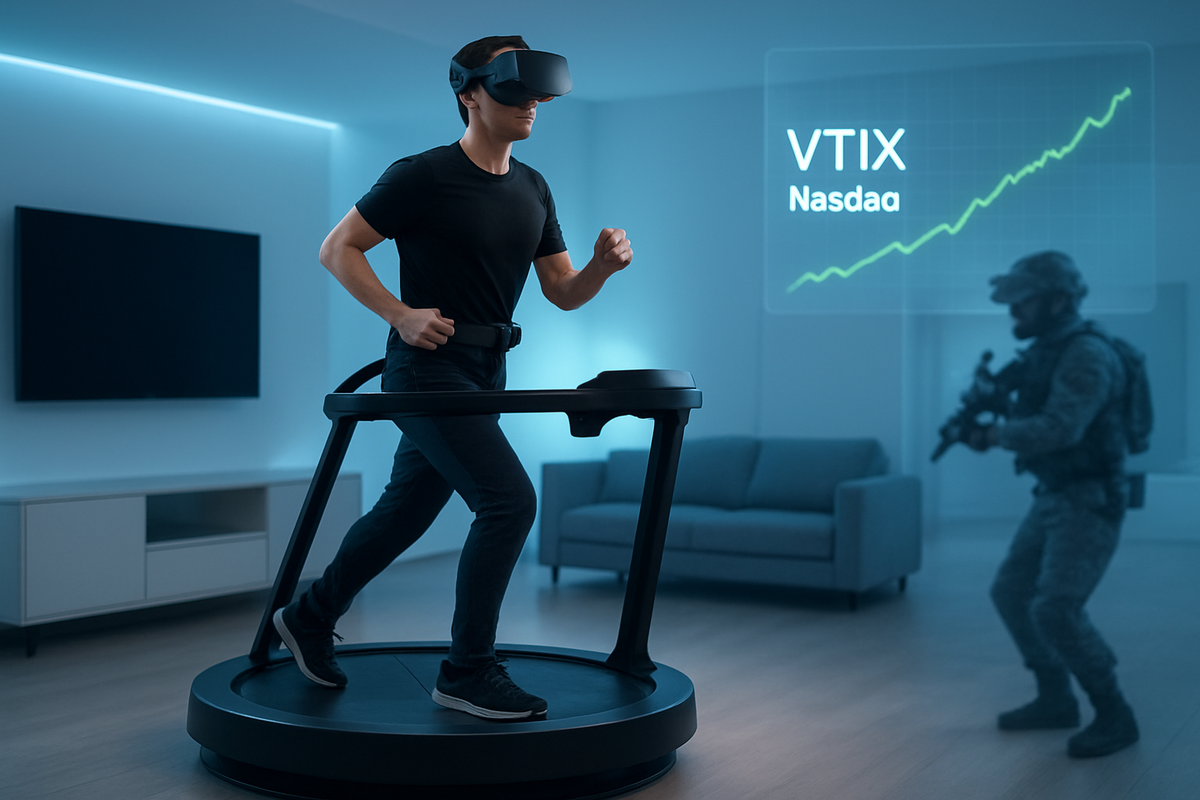
AUSTIN, TX — Virtuix (Nasdaq: VTIX), the pioneer in active virtual reality (VR) technology, has officially cemented its status as a major player in the spatial computing landscape. Following its successful listing on the Nasdaq Global Market earlier this year, the company announced today the appointment of veteran technology executive Brett Moyer to its Board of Directors. This leadership move comes at a pivotal moment as the company pivots from a niche hardware manufacturer into a diversified technology firm with significant footprints in consumer gaming, defense training, and the official Meta Platforms, Inc. (Nasdaq: META) ecosystem.
The transition to a public entity on January 27, 2026, marks the culmination of a decade-long journey for Virtuix, which originally rose to prominence through one of the most successful equity crowdfunding campaigns in history. By listing directly on the Nasdaq, Virtuix has provided a liquidity path for its 10,000+ retail investors while securing the institutional capital necessary to scale its "Omni One" treadmill platform globally. With shares currently stabilizing around the $6.80 mark after a high-energy ringing of the Nasdaq Closing Bell on March 5, the market is signaling cautious optimism for a company that is successfully bridging the gap between immersive entertainment and mission-critical government applications.
A Public Debut Bolstered by Veteran Leadership
The March 10, 2026, appointment of Brett Moyer to the Virtuix Board of Directors adds a layer of seasoned public-market expertise to the company’s leadership. Moyer, who currently serves as the Chief Financial Officer of Datavault AI (Nasdaq: DTLV) and was a founding member of WiSA Technologies, joins as an independent director and a member of the Audit Committee. His track record in navigating complex capital markets and executing mergers and acquisitions is expected to be vital as Virtuix manages its newly acquired $50 million equity line of credit and seeks to maintain the 41% year-over-year revenue growth reported in its latest fiscal cycle.
This board expansion follows a whirlwind two-month period that saw Virtuix transition from a private startup to a listed corporation under the leadership of founder Jan Goetgeluk. The listing was supported by an $11 million private placement, providing the runway needed to resolve long-standing supply chain constraints. Early market reactions have been largely positive, particularly as the company reported a swing to a 29% gross margin in late 2025, a significant recovery from the negative margins seen during the early phases of its "Omni One" preorder fulfillment.
The Ripple Effect: Winners and Losers in the VR Arms Race
The primary winner in Virtuix's public ascent is undoubtedly Meta Platforms, Inc. (Nasdaq: META). By bringing Virtuix into the "Made for Meta" program on February 17, 2026, Meta has effectively turned a potential peripheral competitor into a certified high-end accessory provider. This partnership allows the Omni One to be marketed as the premier "active" way to experience the Meta Quest 3 and Quest 3S, potentially boosting Quest hardware sales among fitness enthusiasts and hardcore gamers who previously found VR too sedentary.
Conversely, traditional high-end VR competitors like Sony Group Corp (NYSE: SONY) may feel the pressure. While the PlayStation VR2 offers haptic feedback, it lacks a dedicated, integrated locomotion solution comparable to the Omni One’s 360-degree treadmill. In the defense sector, legacy simulation firms may find themselves losing ground to Virtuix’s agile "Virtual Terrain Walk" (VTW) system. By using Gaussian splatting AI to create photorealistic digital twins from drone footage in a matter of hours, Virtuix is challenging the high-cost, long-lead-time simulation models traditionally offered by established defense contractors.
Defense and "Made for Meta": A Dual-Use Strategy
Virtuix's expansion into defense VR applications represents a broader trend of "dual-use" technology where consumer hardware is repurposed for national security. The deployment of Omni One units at the United States Military Academy at West Point and the Air Force Academy highlights a shift in how modern soldiers train for urban combat. By allowing troops to physically walk through a digital twin of a mission site before deployment, Virtuix is providing a level of muscle-memory training that seated VR simulations simply cannot replicate. This "human-in-the-loop" approach is also being tested for the teleoperation of humanoid robots, a field where Virtuix is collaborating with researchers at the University of Central Florida.
The "Made for Meta" designation is equally significant for the consumer market. It provides a "plug-and-play" guarantee that is often missing from third-party VR peripherals. This certification ensures that as Meta updates its operating system, the Omni One will remain compatible, reducing the technical friction that has historically plagued the VR industry. This move signals that the industry is moving away from fragmented, "hacker-only" setups toward a more unified, user-friendly ecosystem similar to the smartphone accessory market.
The Road Ahead: Global Scaling and Strategic Challenges
In the short term, Virtuix is focused on aggressive geographic expansion. With the Nasdaq listing providing the necessary visibility, the company is launching dedicated storefronts in the United Kingdom and the European Union this April. The goal is to leverage its current manufacturing capacity of 3,000 units per month to reach a $100 million annual revenue run rate by the end of 2026. However, challenges remain; the Omni One’s $3,495 price point remains a high barrier for the average consumer, making the expansion into commercial gyms and military training facilities even more critical for long-term sustainability.
Strategically, the market will be watching for potential pivots into the "Metaverse for Fitness." As healthcare costs rise, Virtuix could potentially partner with insurance providers to offer the Omni One as a preventative health tool. The primary risk factor remains the pace of VR adoption in the mainstream; if the "spatial computing" trend led by companies like Apple Inc. (Nasdaq: AAPL) loses momentum, Virtuix’s high-end hardware could see a cooling of demand.
Conclusion: A Milestone for the Spatial Computing Industry
The emergence of Virtuix as a public company on the Nasdaq (VTIX) is a landmark event for the virtual reality sector. It validates the long-term potential of immersive locomotion and proves that hardware-heavy startups can survive the "valley of death" between crowdfunding and institutional viability. The addition of Brett Moyer to the board provides the financial gravitas needed for this next chapter, while the "Made for Meta" partnership secures its place in the dominant consumer VR ecosystem.
Investors should closely monitor the company's Q1 2026 earnings report and any further announcements regarding defense contracts, as these high-margin agreements will likely dictate the stock's performance in the second half of the year. For the public, the message is clear: the era of sitting down to play or train in virtual reality is rapidly coming to an end.
This content is intended for informational purposes only and is not financial advice.