
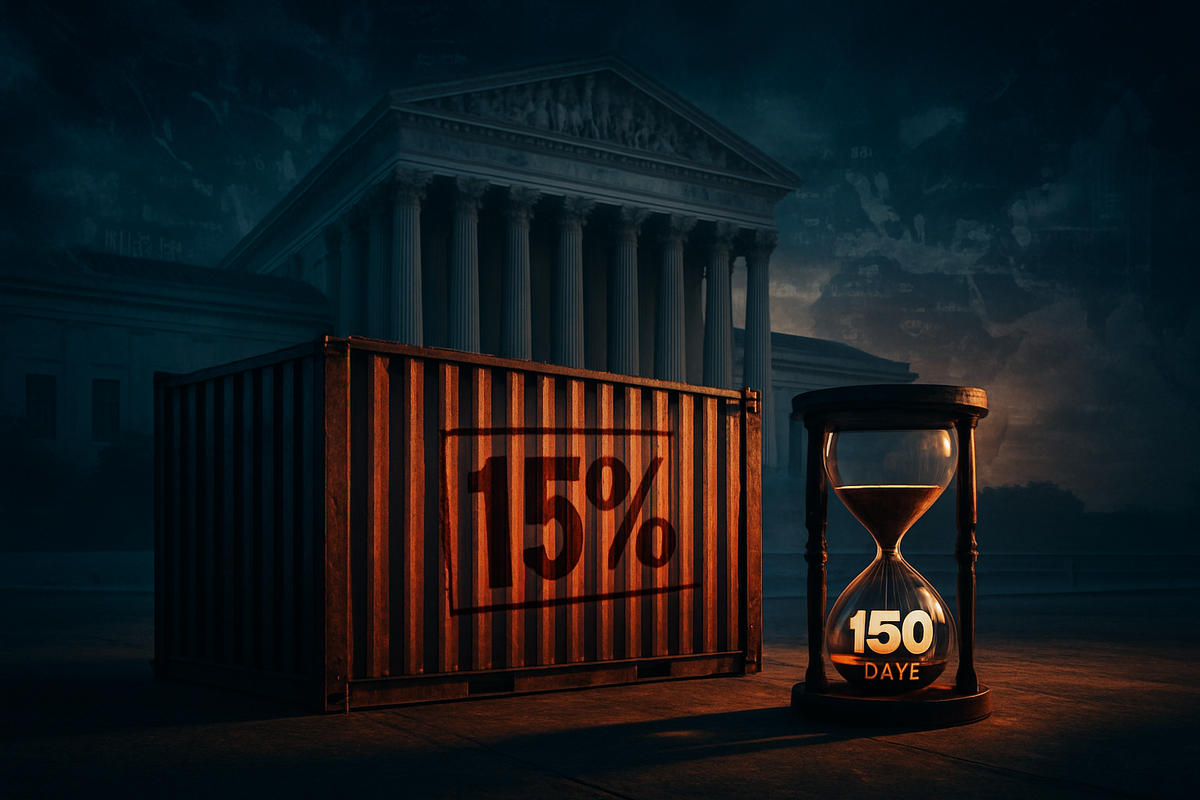
WASHINGTON, D.C. — In a whirlwind 72 hours that has fundamentally reshaped the American economic landscape, the U.S. Supreme Court struck down the administration’s previous tariff regime, only for President Trump to immediately pivot to a rarely used "balance-of-payments" emergency power. The resulting 15% across-the-board global tariff, enacted under Section 122 of the Trade Act of 1974, has plunged financial markets into a state of "maximum trade uncertainty" as corporations scramble to navigate a 150-day legal countdown.
The sudden shift from targeted, high-percentage levies to a broad, uniform surcharge has created a paradoxical environment for Wall Street. While some of the most punitive duties on Chinese imports have been lowered, the new 15% baseline now applies to virtually every product entering the United States, including those from traditional allies. For large-cap stocks and global supply chain managers, the primary challenge is no longer just the cost of goods, but the looming "July Cliff"—the July 24, 2026, expiration date of the President’s temporary authority.
The Verdict and the Pivot: A Timeline of Legal Volatility
The current crisis began on the morning of February 20, 2026, when the Supreme Court issued its landmark 6-3 decision in Learning Resources, Inc. v. Trump. The Court ruled that the International Emergency Economic Powers Act (IEEPA), which the administration had used since early 2025 to impose sweeping "Reciprocal Tariffs," does not grant the executive branch the authority to tax imports. Writing for the majority, Chief Justice John Roberts asserted that the power to lay and collect duties resides exclusively with Congress under Article I of the Constitution. The ruling immediately invalidated an estimated $130 billion to $170 billion in collected duties, triggering a brief relief rally in tech and retail sectors.
However, the relief was short-lived. Within hours of the ruling, the White House invoked Section 122 of the Trade Act of 1974, citing a "fundamental international payments problem" and a record-high balance-of-payments deficit. On February 21, the administration announced a 10% global surcharge, which was increased to the statutory maximum of 15% the following day. By February 24, 2026, the new tariffs were officially in effect at all U.S. ports of entry. Unlike previous measures, Section 122 requires broad and uniform application, meaning that products from the European Union, Canada, and Mexico are now subject to the same 15% surcharge as those from non-aligned nations.
The reaction from industry stakeholders has been swift and litigious. On March 9, 2026, a coalition of small importers led by the Liberty Justice Center filed Burlap and Barrel, Inc. v. Trump, challenging the administration’s definition of a "balance-of-payments emergency." Meanwhile, U.S. Customs and Border Protection (CBP) remains mired in a logistical nightmare, attempting to process billions of dollars in court-ordered refunds for the invalidated IEEPA tariffs while simultaneously implementing the new Section 122 collection protocols.
Corporate Winners and Losers in the "Broad-Brush" Era
The transition to a 15% flat tariff has created a fragmented performance across U.S. large-cap stocks. For hardware giants like Apple (NASDAQ: AAPL), the new regime is a significant headwind. Analysts estimate Apple faces an annual tariff bill of approximately $3.3 billion, with a potential 9% compression in gross margins. While the company has moved nearly 25% of its production to India, the high-end component ecosystem remains heavily reliant on global logistics now caught in the 15% net.
In the automotive sector, Ford (NYSE: F) and Tesla (NASDAQ: TSLA) are facing renewed pressure. Ford has reported a nearly $900 million impact to its bottom line due to the loss of previous tariff-relief programs that were invalidated by the Court. The manufacturing cost of a standard F-150 is expected to rise by as much as $6,000, potentially cooling consumer demand. Tesla, despite its high level of domestic manufacturing, remains vulnerable to the 15% surcharge on imported specialized battery materials and high-grade steel.
Conversely, some companies have found a measure of insulation. NVIDIA (NASDAQ: NVDA) has remained relatively resilient, largely due to its dominant market position and specific "Agentic AI" exemptions granted by the administration to secure U.S. lead in artificial intelligence. Domestic material producers such as Nucor (NYSE: NUE) and United States Steel (NYSE: X) have seen mixed results; while protected by the 15% floor, the rate actually represents a decrease in protection compared to the previous 25% duties on specific metals, leading to a "cooling" of the domestic metals rally. Walmart (NYSE: WMT) presents a complex case; while it faces rising costs of goods sold, it is also a primary beneficiary of the massive court-ordered tariff refunds, which could provide a multi-billion-dollar liquidity injection in the short term.
The Ghost of 1971: Wider Significance and Historical Precedent
The invocation of Section 122 is not without historical precedent, drawing direct comparisons to the "Nixon Shock" of 1971. In that year, President Richard Nixon issued Proclamation 4074, imposing a 10% import surcharge to address the gold standard crisis. The legal fallout from Nixon’s move eventually led Congress to codify Section 122 in the Trade Act of 1974, specifically to provide a "safety valve" for the President while maintaining Congressional oversight.
This historical context is crucial because Section 122 is intentionally restrictive. It caps the surcharge at 15% and, most importantly, limits its duration to 150 days. This "stopgap" nature of the current policy is what is driving the "maximum trade uncertainty" cited by analysts. Because the tariffs expire on July 24, 2026, unless extended by an Act of Congress, businesses are unable to make long-term capital expenditure (CAPEX) decisions. The move has effectively frozen supply chain re-shoring projects, as companies wait to see if the 15% rate is a temporary negotiating tactic or the new permanent floor of American trade policy.
Furthermore, the "uniform" requirement of Section 122 has damaged recently negotiated trade deals. Traditional allies in the UK and EU, who had previously secured exemptions under the "Turnberry Agreement," now find themselves back at the starting line, facing the same 15% barrier as their competitors. This has led to retaliatory threats from Brussels and London, further complicating the global macroeconomic outlook for the second half of 2026.
Navigating the July Cliff: What Comes Next
As the 150-day clock ticks toward the July 24 deadline, market participants are watching for three potential scenarios. The first is a "Legislative Extension," where the administration successfully lobbies Congress to turn the Section 122 surcharge into a permanent tariff through a new Trade Act. This would provide the "certainty" markets crave, albeit at a higher cost of business. The second scenario involves the administration using the 150-day window to launch more targeted Section 301 (unfair trade) or Section 232 (national security) investigations, which were not directly affected by the Supreme Court’s ruling on IEEPA.
In the short term, supply chain managers are engaging in massive "front-loading" of inventory. Shippers are rushing to get goods into U.S. ports before the July 24 expiration, fearing that what comes next could be even more restrictive. This has led to a spike in freight rates and port congestion reminiscent of the 2021 supply chain crisis. For retailers, this means the full inflationary impact of the 15% tariff likely won't hit store shelves until Q3 2026, as they work through existing "pre-tariff" inventory buffers.
Strategic pivots are already underway. Many multinational firms are delaying price hikes in hopes of a "Plan B" trade deal. However, if no legislative solution is found by mid-summer, a massive wave of price adjustments is expected across the electronics, apparel, and automotive industries.
Market Outlook and Final Assessment
The Supreme Court’s intervention has restored the Constitutional balance of power, but in doing so, it has inadvertently triggered a period of extreme tactical volatility. The pivot to Section 122 is a brilliant, if disruptive, legal maneuver by the administration to maintain its trade agenda within the bounds of the law. However, the temporary nature of this authority is a double-edged sword: it provides a legal shield for the President but creates an expiration date for economic stability.
For investors, the coming months will be defined by "cliff-watching." The key metrics to monitor are not just corporate earnings, but the progress of trade negotiations in the halls of Congress and the status of the Burlap and Barrel lawsuit. If the courts or Congress move to further restrict the President's Section 122 powers, the resulting vacuum in trade policy could lead to even greater market swings.
Ultimately, the "maximum trade uncertainty" of early 2026 serves as a stark reminder of the friction between executive trade ambitions and the rule of law. While the 15% tariff is a significant cost, the true price for the market is the lack of a long-term roadmap. Until the July Cliff is resolved, the U.S. large-cap market is likely to remain in a defensive, high-volatility holding pattern.
This content is intended for informational purposes only and is not financial advice.