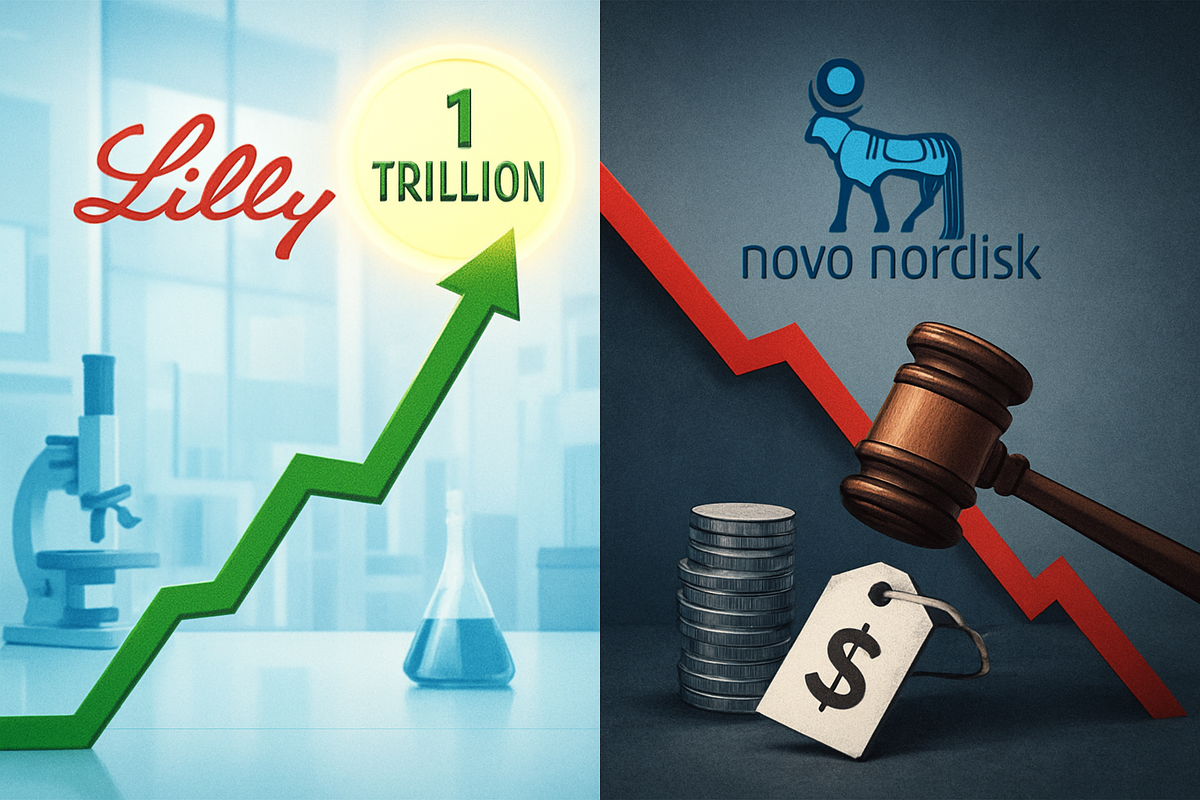
In a dramatic week for the pharmaceutical sector, a stark rift has opened between the two undisputed titans of the weight-loss drug market. On February 4, 2026, Eli Lilly (NYSE: LLY) reported a staggering 45% surge in full-year 2025 revenue, propelled by the insatiable global demand for its blockbuster treatments, Mounjaro and Zepbound. The results catapulted Lilly’s market capitalization back above the $1 trillion mark, cementing its status as the world’s most valuable healthcare company and a juggernaut of the "incretin era."
Conversely, the market’s response to Novo Nordisk (NYSE: NVO) has been nothing short of a "brutal reset." Despite years of pioneering the GLP-1 space, the Danish drugmaker stunned investors by issuing a "shock" 2026 guidance, predicting its first sales decline in a decade. The divergence highlights a shifting landscape where manufacturing scale and domestic political maneuvering in the United States have become just as critical as clinical efficacy. As Eli Lilly accelerates, Novo Nordisk is finding itself increasingly squeezed by aggressive U.S. pricing pressures and a rapidly evolving regulatory environment.
The financial data released this week provides a granular look at Eli Lilly’s historic 2025 performance. The company posted a fourth-quarter revenue of $19.3 billion, a 43% year-over-year increase, bringing its total annual revenue to $65.2 billion. This growth was almost entirely fueled by its "tirzepatide duo"—the diabetes drug Mounjaro and the obesity treatment Zepbound. Together, these two products generated over $36 billion in 2025, accounting for more than half of the company’s total sales. Lilly’s ability to finally resolve the chronic supply shortages that plagued the industry in 2024 proved to be the decisive factor, with U.S. prescription volumes for Zepbound soaring by 50% in the final quarter alone.
Meanwhile, Novo Nordisk’s earnings call painted a far more somber picture. While the company reported 2025 sales of approximately $48.9 billion—a respectable 6% to 10% growth—it was the 2026 forecast that sent shockwaves through the Copenhagen and New York exchanges. Novo projected a sales decline of 5% to 13% for the coming year, a sharp reversal from its previous double-digit growth trajectory. The company’s leadership, led by new CEO Maziar "Mike" Doustdar, cited a "painful transition" as the primary reason for the downgrade, acknowledging that the era of $1,000-per-month GLP-1 prices in the U.S. has effectively ended.
The timeline of this divergence can be traced back to mid-2025, when Eli Lilly aggressively expanded its manufacturing footprint in North Carolina and Ireland, while simultaneously launching its "LillyDirect" platform. This move allowed Lilly to bypass traditional pharmacy benefit managers (PBMs) and capture a larger share of the self-pay market. At the same time, Novo Nordisk faced intensifying political pressure, culminating in a series of landmark negotiations with the U.S. government late last year. By the time the 2025 year-end results were tallied, Zepbound had captured a commanding 60.5% share of the U.S. obesity market, leaving Novo's Wegovy to defend a shrinking piece of a more competitive pie.
Market reaction was swift and polarized. Eli Lilly shares surged nearly 10% in a single session, closing at an all-time high of $1,082. In contrast, Novo Nordisk saw its stock plummet by 18% in Copenhagen, erasing over $30 billion in market value in hours. Analysts have described this as a "de-coupling" of the two stocks, which for years had traded in lockstep as the dual winners of the obesity gold rush.
Eli Lilly emerges as the undisputed winner of this new market phase. By diversifying its portfolio into Alzheimer’s with Kisunla and maintaining a lead in the breast cancer space with Verzenio (NYSE: LLY), the company has built a multi-pillared growth engine that is less reliant on a single drug class than its Danish rival. Furthermore, Lilly’s aggressive entry into the "self-pay" market with vials of Zepbound has effectively neutralized the threat from compounded "knockoff" drugs, securing its grip on new patient starts.
Novo Nordisk, on the other hand, is the primary "loser" in terms of near-term valuation and growth sentiment. The company is now caught in a margin squeeze; while volume remains high, the net price it receives for Ozempic and Wegovy has been slashed by government-mandated caps. Novo is betting heavily on its "Wegovy Pill," launched in early 2026, but the aggressive $149-per-month introductory price—designed to maintain market share—is further compressing the margins that investors had grown accustomed to.
The fallout extends to secondary players and the "compounding" industry. Companies like Hims & Hers (NYSE: HIMS), which thrived during the 2024-2025 drug shortages by offering compounded semaglutide, are now facing an existential threat. As Lilly and Novo have resolved their supply issues, the FDA has moved to restrict the production of these "copycat" versions. Moreover, with branded drug prices falling toward $350 for cash-paying patients, the price advantage once held by compounders has largely evaporated.
Looking ahead, "next-gen" challengers like Amgen (NASDAQ: AMGN) and Viking Therapeutics (NASDAQ: VKTX) are positioned as potential winners if they can offer better dosing convenience. Amgen’s MariTide, currently in Phase 3 trials, is being watched closely for its potential once-monthly or even once-quarterly dosing. If MariTide can match the efficacy of Lilly’s Zepbound with a fraction of the injections, it could disrupt the market again by 2028. Viking Therapeutics remains the high-efficacy "dark horse," with its oral candidate VK2735 showing promise as a more tolerable alternative to the current market leaders.
The divergence between Lilly and Novo is a direct consequence of the broader "TrumpRx" policy shift. In late 2025, the U.S. administration implemented a "Most-Favored-Nation" policy and launched TrumpRx.gov, a government-run platform that forced drugmakers to cap prices for cash-paying patients. Novo Nordisk’s decision to cut the monthly price of Wegovy from $1,350 to $350 was a watershed moment for the industry, signaling the end of the U.S. market as a high-margin "haven" for global pharmaceutical profits.
This event also marks the first time Medicare has begun covering obesity drugs for standalone weight loss, a policy that went into effect on January 1, 2026. While this expands the potential patient pool by tens of millions, it has also introduced a "Medicare floor" for pricing. Under the new negotiations, Novo and Lilly have agreed to copays of just $50 per month for seniors, which, while beneficial for the public, significantly lowers the average net price per prescription across the board.
The ripple effects are being felt across the healthcare ecosystem. Insurance companies and PBMs are now under intense scrutiny for their role in the pricing chain, with new federal transparency laws taking effect in 2026. This has forced a pivot from "rebate-driven" models to "volume-driven" models. Historically, pharmaceutical companies could offset price cuts with volume, but the scale of the 2026 price caps is so significant that even a doubling of volume may not be enough to sustain the revenue growth seen in previous years.
Comparisons are being drawn to the insulin pricing crisis of the early 2020s, but with a key difference: the weight-loss market is far larger and more integrated into the broader economy. The shift in 2026 represents a fundamental recalibration of how breakthrough drugs are priced in America, moving away from a "value-based" model toward a "utility-based" model where mass access is prioritized over maximum per-unit profit.
In the short term, all eyes will be on the FDA’s mid-2026 decision regarding Eli Lilly’s oral obesity pill, Orforglipron. If approved, it would mark the first daily pill in the "triple agonist" class, potentially rendering injectables obsolete for many patients. Lilly is already preparing a massive marketing push, intending to leverage its existing LillyDirect infrastructure to deliver the pill directly to consumers, bypassing the "pricing pressure" that has hampered Novo’s traditional distribution model.
Strategic pivots are already underway at Novo Nordisk. To compensate for the 2026 revenue dip, the company is pivoting toward "beyond-obesity" indications. They are accelerating trials for semaglutide in treating MASH (liver disease) and chronic kidney disease, markets where they hope to maintain higher pricing power due to the critical nature of the conditions. Additionally, Novo’s recent acquisition of a manufacturing facility from Catalent is expected to come fully online by late 2026, which could help lower their cost-of-goods-sold and partially restore margins.
For the wider market, the emergence of Pfizer (NYSE: PFE) as a "second-wave" player will be a key storyline for late 2026. After a series of setbacks, Pfizer is entering Phase 3 trials with a new long-acting injectable, MET-097i. While they are late to the party, Pfizer is betting that the "third or fourth" generation of users will value their drug's safety profile and the company’s massive distribution network. The "arms race" is shifting from who has the best drug to who can deliver the most convenient, affordable, and accessible treatment to a global population of over one billion people with obesity.
The events of early 2026 represent a "coming of age" for the GLP-1 market. The 45% revenue surge at Eli Lilly proves that there is still massive growth to be captured by those who can master manufacturing and adapt to a changing U.S. political climate. Conversely, Novo Nordisk’s guidance cut serves as a cautionary tale: no level of clinical success can fully insulate a company from the gravity of pricing reform and intensifying competition.
Moving forward, the market will transition from a speculative "growth at any cost" phase to a "valuation based on execution" phase. Investors should closely monitor the uptake of oral formulations and the progress of Medicare negotiations for 2027. The most critical metric will no longer be "prescriptions written," but "net price per dose," as the industry adjusts to a lower-margin, higher-volume reality.
For investors, the key takeaway is that the "duopoly" is evolving. While Lilly currently holds the upper hand, the entrance of new competitors like Amgen and the pivot of Novo Nordisk toward specialized medical indications mean the landscape remains fluid. The $1 trillion milestone for Eli Lilly is a testament to the power of the obesity market, but the "shock" at Novo Nordisk is a reminder that in the world of high-stakes pharmaceuticals, the regulatory pen can be just as powerful as the lab-grown molecule.
This content is intended for informational purposes only and is not financial advice.