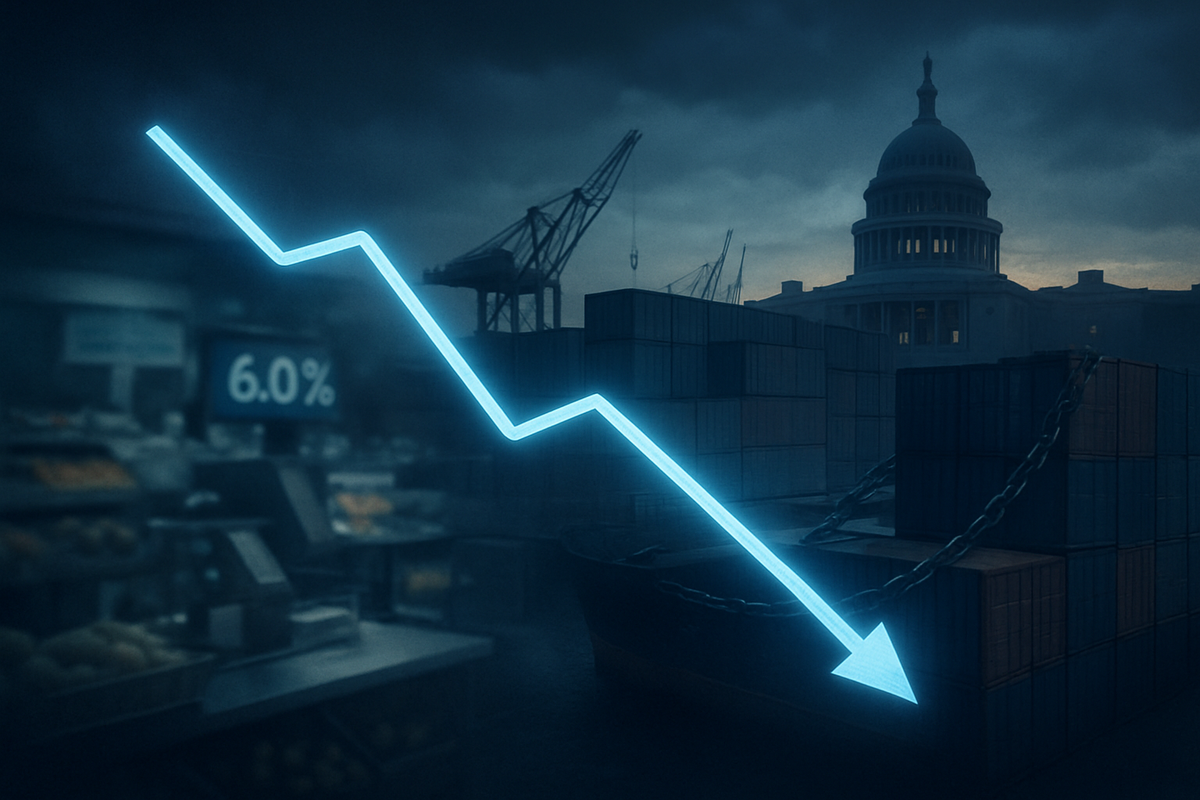
In a sharp reversal of the optimistic momentum seen at the end of last year, U.S. consumer confidence has tumbled to an eight-month low, with the Conference Board’s Consumer Confidence Index falling to 98.3 in January 2026. This decline marks a significant psychological shift among American households, who are now grappling with the dual pressures of aggressive new trade tariffs and a historic restructuring of the federal workforce. The sudden drop from December’s reading of 104.1 has reignited fears of a consumer-led slowdown, as the "Expectations Index"—a critical forward-looking metric—plunged to 72.9, well below the threshold that historically signals an impending recession.
The immediate implications of this sentiment shift are already being felt across the retail and manufacturing sectors. As inflation expectations for the year ahead surged to 6.0%, driven by anticipated price hikes on imported goods, families have begun a "consumption freeze," prioritizing essential savings over discretionary spending. Market analysts warn that the confluence of higher costs at the register and job insecurity within the public sector is creating a "perfect storm" for the U.S. economy, forcing both consumers and corporations to radically recalibrate their financial strategies for 2026.
The Convergence of Protectionism and Public Sector Reform
The January 2026 sentiment crash is the culmination of a series of rapid-fire policy shifts that began in the final months of 2025. Central to this volatility is the implementation of the "Liberation Day" trade policies, which introduced a 10% universal baseline tariff on all imports, coupled with "Reciprocal Tariffs" that have seen rates on Chinese goods soar to a staggering 54%. The timeline of these events has been relentless: following the announcement of these duties in late 2025, the New Year began with a second wave of tariffs targeting key partners, including a 26% levy on goods from India and a 20% tax on European luxury items.
Simultaneously, the administration’s "Operation Absolute Resolve" has drastically reshaped the domestic labor market. By February 5, 2026, the federal government had already finalized the removal of over 300,000 employees through a mix of layoffs and buyouts. Furthermore, a new ruling from the Office of Personnel Management (OPM) has reclassified 50,000 career civil servants into "policy-career" roles, effectively stripping them of civil service protections. This move has not only unsettled the Washington D.C. metro area economy but has sent a ripple of job insecurity across the nation, as private-sector contractors who rely on federal partnerships face their own waves of "low-hire" mandates and project cancellations.
Initial market reactions have been stark. Major indices fluctuated wildly as the Conference Board report was released, with investors rotating out of consumer-facing stocks and into defensive havens. The surge in inflation expectations has also complicated the Federal Reserve’s path, as the central bank must now weigh the risks of stagnant growth against the inflationary pressure of tariff-induced price spikes.
Corporate Impact: Assessing the Winners and Losers
The "tariff wall" of 2026 has created a sharp divide between companies dependent on global supply chains and those with a predominantly domestic footprint. Apple (NASDAQ: AAPL) has emerged as one of the most high-profile victims of the new trade regime. Facing a 34% tariff on components from China and 26% from India, the tech giant reported a $900 million quarterly hit to its bottom line. Analysts suggest that if Apple passes these costs to the consumer, the price of a high-end iPhone could reach $2,500, potentially eroding its massive user base. Similarly, Caterpillar (NYSE: CAT) has projected annual tariff-related costs of up to $2.6 billion, as the price of imported steel and specialized components used in its machinery continues to rise.
Retailers are also in the crosshairs. Walmart (NYSE: WMT) and Target (NYSE: TGT) both "front-loaded" inventory in late 2025 to delay the inevitable price hikes, but those buffers are now thinning. By early 2026, price increases of nearly 40% were reported on categories such as electronics and toys. While Walmart’s scale allows it to absorb some of the shocks, Target has struggled to maintain its margins, leading to a "trading down" effect where consumers are migrating toward deep-discount retailers like Dollar General (NYSE: DG) and Five Below (NASDAQ: FIVE).
Conversely, domestic manufacturers are finding a rare competitive advantage. Nucor (NYSE: NUE) and Steel Dynamics (NYSE: STLD) have seen order backlogs swell as 50% import duties on foreign steel make their American-made products more attractive. Whirlpool (NYSE: WHR), which manufactures 80% of its products in the U.S. and sources nearly all its steel locally, has been able to undercut rivals like Samsung and LG, who are burdened by tariff penalties on imported components. Additionally, Palantir (NYSE: PLTR) has seen its government revenue projections climb as federal agencies, stripped of human headcount, turn to its Artificial Intelligence Platform (AIP) to maintain operational efficiency.
Broader Significance: A New Economic Paradigm
The current decline in consumer confidence fits into a broader trend of "economic nationalism" that is redefining global trade. This event is not merely a temporary dip but may represent a structural shift toward a more protectionist and lean-government model. Historically, the U.S. has not seen such a drastic combination of trade barriers and public sector contraction since the post-war era. The 98.3 reading on the Confidence Index is a clarion call that the "low-inflation, high-globalization" era of the previous three decades is effectively over.
The ripple effects are extending far beyond the U.S. borders. Trading partners in the European Union and Asia are already considering retaliatory measures, raising the specter of a full-scale global trade war. For domestic policy, the reclassification of the federal workforce signals a move toward a "unitarian executive" model, which could lead to more rapid—but also more volatile—policy changes. From a historical perspective, the current environment draws comparisons to the stagflation of the 1970s, where high prices were coupled with sluggish growth, though the modern reliance on AI and domestic energy production offers a different set of tools to combat these pressures.
Navigating the Road Ahead
In the short term, markets will be hypersensitive to any signs of a "thaw" in trade negotiations or a stabilization of the federal labor force. However, the long-term reality suggests that companies must undergo a "strategic pivot" toward domestic sourcing. Reshoring is no longer a luxury but a survival requirement. We are likely to see a surge in investment in automated manufacturing as companies seek to mitigate the loss of cheap foreign labor and the rising cost of imported goods.
The potential scenarios for the remainder of 2026 range from a "soft landing" managed by aggressive AI-driven productivity gains to a "hard recession" if consumer spending continues to crater. Market opportunities may emerge in "efficiency tech" and domestic infrastructure, but the challenge will remain the squeeze on the American middle class. Investors should prepare for a period of sustained volatility as the economy digests these monumental shifts in how the U.S. trades and governs itself.
Conclusion and Investor Takeaways
The drop in U.S. consumer confidence to 98.3 is a sobering reminder that policy changes have real-world psychological and financial consequences. The combined weight of tariffs and federal job cuts has introduced a level of uncertainty that hasn't been seen in years, fundamentally altering consumer behavior and corporate strategy. While domestic steel and tech-efficiency firms may find silver linings, the broader market is facing a significant headwind as the cost of living climbs and job security wavers.
Moving forward, the market is likely to remain in a defensive posture. The key takeaway for investors is to monitor the "Expectations Index" closely; if it remains below the 80-point mark for several consecutive months, the probability of a formal recession will become nearly certain. Investors should watch for upcoming earnings reports from major retailers in the spring to see how much of the tariff cost is truly being passed to the consumer and whether the "trade-down" trend to discount stores like Dollar General continues to accelerate. For now, caution and a focus on domestic resilience seem to be the order of the day.
This content is intended for informational purposes only and is not financial advice.