
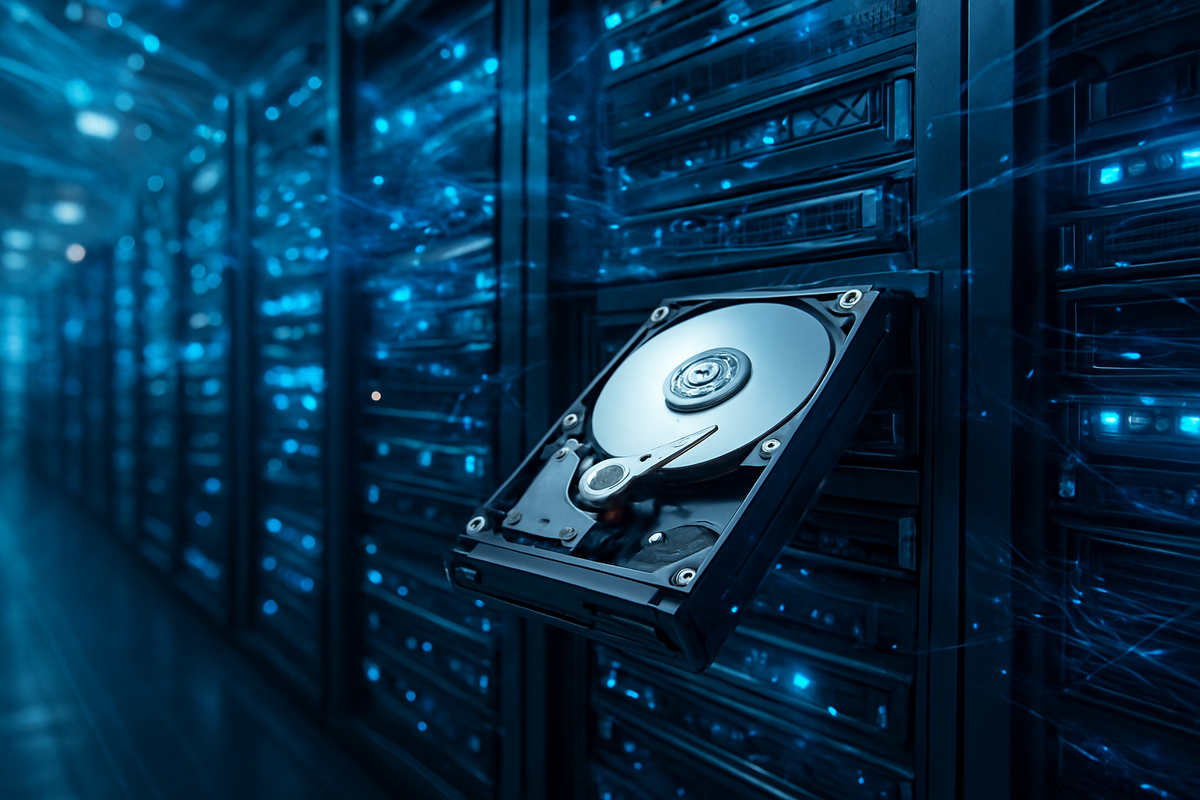
The financial markets witnessed a historic shift in the technology landscape this week as Seagate Technology Holdings plc (NASDAQ: STX) saw its stock price skyrocket by 19%, following a fiscal second-quarter earnings report that shattered Wall Street’s most optimistic projections. The surge, which propelled the storage giant to an all-time high, serves as a definitive signal that the artificial intelligence revolution has moved beyond the "compute" phase and into a massive, multi-year infrastructure build-out for data storage.
Seagate’s results have effectively debunked the long-standing narrative that hard-disk drives (HDDs) were a fading legacy technology destined to be replaced by flash storage. Instead, the "AI Supercycle" of 2026 has transformed the humble hard drive into a critical strategic asset. As generative AI models transition from training to massive-scale inference, the resulting "tsunami" of unstructured data is driving demand for mass-capacity storage at a scale never before seen in the enterprise sector.
The "Big Beat": Breaking Records in the AI Era
On January 27, 2026, Seagate reported fiscal second-quarter results that stunned analysts across the board. The company posted revenue of $2.83 billion, a 22% increase year-over-year, comfortably beating the consensus estimate of $2.71 billion. Even more impressive was the profitability; Seagate reported a non-GAAP earnings per share (EPS) of $3.11, nearly 10% higher than the most bullish analyst forecasts. Gross margins reached a record-breaking 42.2%, driven by a lucrative shift toward high-capacity "nearline" drives that now account for the vast majority of the company's shipments.
The stock’s 19% jump on January 28 was not merely a reaction to current numbers but to the company’s forward-looking guidance and supply commentary. Seagate management revealed that its nearline manufacturing capacity for the remainder of 2026 is already fully allocated, with several major cloud service providers (CSPs) currently negotiating supply guarantees reaching into 2028. This level of visibility is unprecedented in the historically cyclical storage industry, suggesting a structural shift in how data centers plan their capacity.
At the heart of this performance is the successful commercial ramp-up of Seagate’s Mozaic 3+ platform, which utilizes Heat-Assisted Magnetic Recording (HAMR) technology. By the end of the quarter, Seagate had shipped over 1.5 million HAMR units, allowing it to provide 30TB+ drives that offer superior storage density without a corresponding increase in power consumption—a critical factor for power-constrained AI data centers.
Sector Winners and the SSD Rivalry
The ripple effects of Seagate’s earnings were felt throughout the storage and memory sectors. Western Digital Corp. (NASDAQ: WDC) saw its shares rally 12% in sympathy, as investors bet that the industry-wide supply crunch would benefit all major players. Western Digital confirmed this trend just days later, reporting its own record gross margins of 46.1% and noting that its UltraSMR (Shingled Magnetic Recording) drives were seeing massive adoption among hyperscalers who cannot get enough capacity from Seagate alone.
Even memory specialists like Micron Technology, Inc. (NASDAQ: MU) benefited from the news, with shares rising 6%. While Micron primarily focuses on High-Bandwidth Memory (HBM) and enterprise SSDs, Seagate’s commentary reinforced the broader thesis that the AI infrastructure build-out is entering a second, more intensive phase. Interestingly, the traditional rivalry between HDDs and Solid State Drives (SSDs) has evolved into a "co-opetition" model. By early 2026, a severe shortage of NAND flash pushed enterprise SSD prices to nearly 16 times the cost per terabyte of HDDs, forcing data center architects to return to hard drives for the "data lake" layer of AI infrastructure.
The clear "losers" in this environment are smaller data center operators and legacy enterprise firms that did not secure long-term agreements (LTAs). These players are now facing 35-45% price increases for bulk storage on the spot market, as the three major HDD manufacturers—Seagate, Western Digital, and Toshiba—prioritize their largest "hyperscale" customers who have moved to multi-year contracts to protect their AI pipelines.
The AI Data Lake Explosion: A Structural Shift
This resurgence is fundamentally tied to the changing nature of data in 2026. While the initial AI boom in 2023 and 2024 focused on the GPUs needed to train models, the current phase focuses on the "unstructured data" those models generate and consume. A single minute of AI-generated high-definition video can require up to 20,000 times more storage space than a text-based document, and the industry is currently seeing an explosion in AI-driven video, 3D modeling, and real-time sensor data.
Historically, the storage market was defined by boom-and-bust cycles. However, the current environment mirrors the early days of the cloud migration, but with significantly higher stakes. Data is no longer just being stored; it is being used as the "fuel" for continuous AI model refinement. This has led to the rise of the "Hybrid Storage Architecture," where high-performance SSDs handle the immediate processing (inference), while high-capacity HDDs provide the massive, cost-effective reservoir for the raw data.
Furthermore, the environmental and regulatory pressure on data centers has played into Seagate’s hands. The Mozaic HAMR technology allows for a 40% increase in storage capacity within the same physical footprint and power envelope as previous generations. In a world where power availability is the primary bottleneck for data center expansion, the ability to store more data with less electricity has turned Seagate’s technological lead into a formidable competitive moat.
The Road Ahead: From Scarcity to Sustained Growth
Looking toward the latter half of 2026 and into 2027, the primary challenge for Seagate will not be finding customers, but managing its supply chain to meet insatiable demand. The company is already preparing to transition to its Mozaic 4 platform, which aims for 40TB+ capacities. If Seagate can maintain its execution on these density gains, it could potentially widen its margin lead over competitors who are still relying on older energy-assisted recording methods.
Investors should also keep a close eye on the potential for strategic pivots within the industry. With nearline capacity fully booked, there is speculation that Seagate may increase its capital expenditure to expand production lines—a move that carries risk if the AI "hype" were to cool. However, given that storage is a "late-cycle" beneficiary of AI, most analysts believe the risk of oversupply is low for at least the next 24 months.
Market participants should also watch for any regulatory shifts regarding data sovereignty. As more nations mandate that AI data be stored locally, the demand for regional data centers is expected to increase, potentially creating a secondary wave of demand for Seagate’s enterprise-grade hardware beyond the major U.S. and Chinese cloud giants.
A New Golden Age for Storage
Seagate’s 19% jump is more than just a successful earnings report; it is a validation of the company's long-term bet on HAMR technology and a signal that the hard drive is once again the backbone of the digital economy. The transition from a commodity hardware business to a high-margin, critical infrastructure provider is now largely complete.
As we move through 2026, the key takeaways for the market are clear: storage capacity is the new bottleneck in the AI value chain, and pricing power has shifted decisively back to the manufacturers. The "sold out" status of Seagate's 2026 inventory suggests that the earnings beats may continue for several quarters to come.
For investors, the months ahead will require a focus on execution and supply chain stability. While the demand is guaranteed, the ability to deliver these highly complex, high-density drives at scale will determine if Seagate can maintain its current valuation. For now, the "death of the disk" has been officially postponed—permanently.
This content is intended for informational purposes only and is not financial advice.