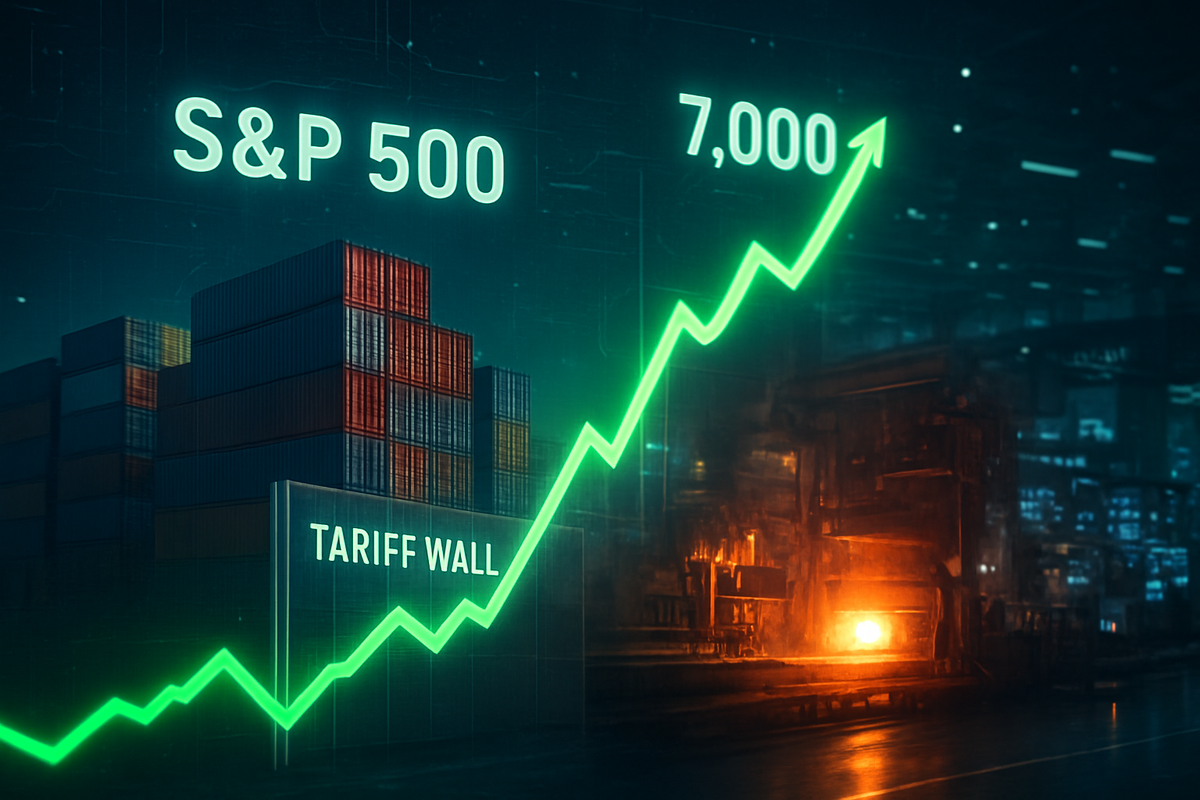
As the final closing bell of 2025 rings across the floor of the New York Stock Exchange, investors are looking back at a year that defied every traditional economic playbook. What began as a period of profound "tariff chaos" and geopolitical brinkmanship has ended with the S&P 500 (INDEXSP:.INX) hovering near the historic 7,000 mark, closing the year with a remarkable 18% gain. The resilience of the U.S. market in the face of a radical shift toward protectionism has become the defining story of the decade, proving that while trade barriers can disrupt supply chains, they have yet to dismantle the structural dominance of American innovation.
The immediate implications of 2025’s trade policy shifts were nothing short of seismic. The implementation of universal baseline tariffs and the aggressive decoupling from Chinese manufacturing forced a total re-evaluation of corporate valuations. For much of the spring, the "Tariff Wall" appeared to be an insurmountable obstacle for global growth, yet by December, a combination of Federal Reserve intervention, a breakthrough in geopolitical diplomacy, and the continued surge of Artificial Intelligence (AI) provided the tailwinds necessary for a year-end rally that few analysts saw coming in the dark days of April.
The Year of the Great Reset: From 'Liberation Day' to the Busan Summit
The narrative of 2025 was set in motion on April 2, a date now etched in financial history as "Liberation Day." Utilizing the International Emergency Economic Powers Act, the administration imposed a 10% universal baseline tariff on all imports, coupled with a staggering 145% duty on specific Chinese electronics and machinery. The immediate market reaction was a bloodbath; the S&P 500 plummeted 11% in just 48 hours, erasing $6.6 trillion in market value as the Nasdaq Composite (INDEXNASDAQ: .IXIC) suffered its largest single-day point loss in history.
The timeline of escalation was rapid. Following the April shock, the "Total Reset" period began in May, when U.S. and Chinese delegations met in Geneva to negotiate a 90-day truce. This temporary de-escalation saw China-specific duties pared back to 30%, providing the market its first "relief rally" of the summer. However, the true turning point arrived on October 30 at the Busan Summit in South Korea. A high-stakes meeting between U.S. and Chinese leadership delivered a decisive stabilization of trade relations and a commitment to secure rare earth supply chains. This "Busan Breakthrough" acted as the catalyst for the fourth-quarter surge, as the VIX (INDEXCBOE:VIX) volatility index, which had spiked above 40 in the spring, finally retreated to pre-crisis levels.
Winners and Losers: The New Map of Corporate Value
The 2025 trade environment created a sharp bifurcation between "domestic-first" winners and "multinational-exposed" losers. In the technology sector, hardware giants faced the brunt of the initial storm. Nvidia (NASDAQ: NVDA) and Apple (NASDAQ: AAPL) were forced to navigate multi-billion dollar tariff charges—estimated at $5.5 billion and $1.1 billion respectively—leading to significant price volatility in the first half of the year. Conversely, software and cybersecurity firms like Palantir (NYSE: PLTR) and CrowdStrike (NASDAQ: CRWD) emerged as safe havens, their lack of physical supply chain exposure making them the preferred vehicles for investors seeking growth without the "tariff tax."
The retail sector saw perhaps the most dramatic upheaval. The elimination of the de minimis loophole, which previously allowed low-value shipments to enter the U.S. duty-free, decimated the business models of "fast-fashion" importers. Retailers with high Asian supply chain exposure, such as VF Corporation (NYSE: VFC) and Wayfair (NYSE: W), saw their margins squeezed and share prices languish. However, the "Big Box" titans proved their mettle. Walmart (NYSE: WMT) and Costco (NASDAQ: COST) leveraged their massive private-label ecosystems to absorb costs and gain market share from smaller competitors. Interestingly, the year also saw a boom in the resale market, with platforms like ThredUp (NASDAQ: TDUP) and TheRealReal (NASDAQ: REAL) reporting record growth as consumers turned to second-hand goods to circumvent tariff-driven inflation on new imports.
A Fundamental Shift in Global Trade Dynamics
The events of 2025 signify a broader industry trend away from the "just-in-time" globalism of the last thirty years toward a "just-in-case" model centered on national security and domestic resilience. Investors have shifted their primary valuation metrics from simple earnings per share (EPS) to "geographic cost exposure" and "supply chain elasticity." This shift has accelerated "friend-shoring" initiatives, with companies moving production from China to allies like Vietnam, India, and Mexico—though even Mexico faced pressure this year under threats of "reciprocal" duties.
This era of protectionism bears some historical resemblance to the trade tensions of the late 1970s and early 1980s, but with a modern twist: the weaponization of high-tech exports. The policy implications are profound, as the U.S. government has effectively traded lower consumer prices for a revitalized industrial base. While the "labor gap" remains a hurdle—with nearly 500,000 manufacturing jobs still unfilled—the capital expenditure into domestic facilities by firms like Samsung (OTC:SSNLF) and LG (OTC:LGEAF) suggests that the "reshoring" trend is no longer just political rhetoric, but a structural market reality.
The Road to 2026: Strategic Pivots and New Opportunities
Looking ahead to 2026, the market faces a "new normal" where trade policy is the primary driver of volatility. In the short term, the focus will remain on whether the Busan Summit's "truce" can be converted into a long-term treaty. Strategic pivots are already underway; many multinational corporations are adopting a "China Plus One" strategy, diversifying their manufacturing footprints to ensure that no single geopolitical event can paralyze their entire operation.
Market opportunities are emerging in the sectors that facilitate this transition. Logistics automation, domestic energy production, and AI-driven supply chain management are expected to be the high-growth themes of the coming year. However, the challenge of persistent inflation—a natural byproduct of higher tariffs—will likely keep the Federal Reserve on high alert. Investors should prepare for a scenario where interest rates remain "higher for longer" to counteract the inflationary pressures of a less efficient, but more secure, global trade network.
Final Thoughts: A Year of Hard-Won Resilience
As we close the books on 2025, the key takeaway for investors is the sheer adaptability of the American corporate sector. Despite the "Tariff Wall" and the geopolitical tremors that shook the foundations of global trade, the U.S. stock market proved that it could find a path to growth. The move toward S&P 7,000 was not a smooth ascent, but a hard-won victory for companies that prioritized agility and domestic strength over the fragile efficiencies of the past.
Moving forward, the market will likely remain sensitive to every headline regarding trade negotiations and "reciprocal" duties. The era of predictable, low-tariff global trade is over, replaced by a more complex, fragmented, and volatile landscape. Investors should watch closely for developments in domestic labor markets and the continued integration of AI in manufacturing, as these will be the engines that determine if the resilience of 2025 can be sustained into 2026 and beyond.
This content is intended for informational purposes only and is not financial advice.