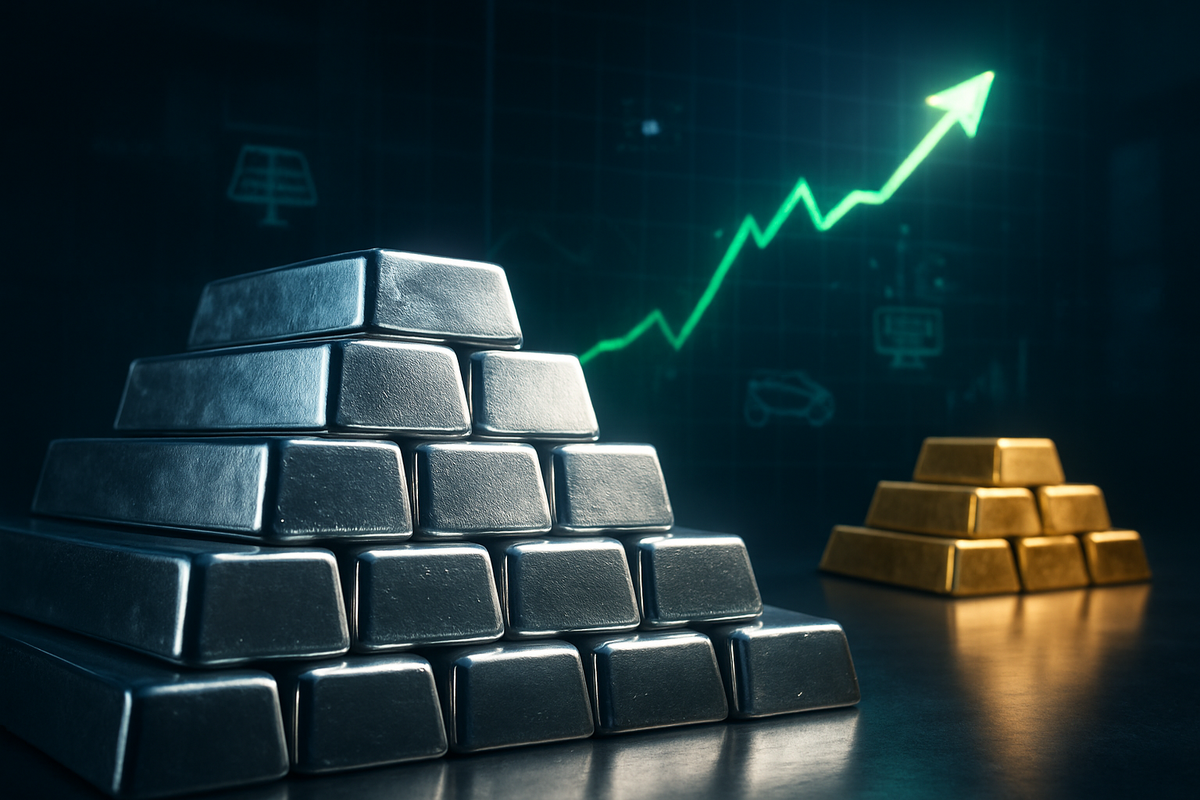
As 2025 draws to a close, the financial world is witnessing a historic realignment of the precious metals market. While gold has traditionally been the primary beneficiary of geopolitical instability, it is silver that has stolen the spotlight this year, undergoing a parabolic rally that has left even the most optimistic analysts stunned. Trading at approximately $79.70 per ounce as of December 29, 2025, silver has surged more than 160% since the beginning of the year, far outstripping gold’s respectable 75% gain. This dramatic outperformance marks a fundamental shift in how the market perceives the "poor man’s gold," transitioning it from a speculative commodity to a strategic, critical asset in a world defined by trade wars and technological revolution.
The immediate implications of this surge are being felt across the global economy. From the solar farms of the Sun Belt to the high-tech corridors of Silicon Valley, the soaring cost of silver is forcing a radical reassessment of supply chains. The rally has been fueled by a "perfect storm" of the second Trump administration’s unorthodox economic policies, a persistent structural supply deficit, and a landmark decision by the U.S. government to designate silver as a "Critical Mineral." As investors and central banks scramble to secure physical positions, the gold-to-silver ratio—a key metric of relative value—has plummeted from over 80:1 to below 60:1, signaling that the silver bull market may still have run room.
A Year of "Tariff Madness" and the Debasement Trade
The catalyst for silver’s 2025 ascent can be traced back to the early days of the second Trump administration. Upon taking office in January, President Trump moved swiftly to implement a "Tariff Madness" agenda, including a 25% levy on all imports from Canada and Mexico and a 10% universal baseline tariff. These moves, intended to bolster domestic manufacturing, instead ignited fears of a global trade war and sparked a resurgence of inflation. As the U.S. Dollar (DXY) weakened by nearly 10% over the course of the year due to concerns over sovereign debt sustainability and the extension of the 2017 tax cuts, investors flocked to "the debasement trade." Silver, with its lower entry price and higher volatility, became the vehicle of choice for those seeking protection against a devaluing currency.
The timeline of the rally reached a fever pitch in August 2025, when the U.S. Department of the Interior officially designated silver as a "Critical Mineral." This designation followed years of warnings from the Silver Institute regarding a deepening structural deficit. By the third quarter of 2025, it became clear that the world was facing its fifth consecutive year of supply shortfall, estimated at 148 million ounces. Physical inventories at the COMEX and LBMA warehouses plummeted to levels not seen in decades, leading to a "physical squeeze" where industrial users were forced to pay massive premiums to secure delivery. The tension between the administration’s "America First" industrial policy and the reality of a global silver shortage created a feedback loop that drove prices through one resistance level after another.
Key players in this drama included not only the Trump administration’s trade architects but also a new cohort of institutional buyers. While central banks have historically focused on gold, 2025 saw a historic shift. Russia became the first major nation in the modern era to explicitly include silver in its state reserves, allocating over $500 million for purchases through 2027. This move, aimed at diversifying away from the dollar and building a "sanction-resistant" reserve, was mirrored by increased retail demand in India and China, where silver is increasingly viewed as a necessary hedge against local currency volatility.
Winners and Losers in the New Silver Era
The primary beneficiaries of this price explosion have been the primary silver miners and streaming companies, which have seen their valuations reach all-time highs. First Majestic Silver (NYSE: AG) has been one of the standout performers of 2025, with its stock price surging nearly 197% to trade around $17.42. The company’s strategic acquisition of the Cerro Los Gatos mine earlier in the year proved prescient, doubling its production capacity just as prices began their vertical climb. Similarly, Pan American Silver (NYSE: PAAS) has leveraged its massive reserve base across the Americas to report record free cash flow, with its stock price more than doubling to $55.39.
Streaming and royalty companies have also thrived in this high-price environment. Wheaton Precious Metals (NYSE: WPM) reached an all-time high of $124.50 in December, benefiting from a business model that keeps operating costs fixed while allowing the company to capture the full upside of metal price increases. With gross profit margins exceeding 80%, WPM has become a favorite for institutional investors looking for low-risk exposure to the silver rally. These companies are now sitting on massive cash piles, which they are expected to use for aggressive exploration and potential M&A activity in 2026 as they scramble to bring new supply online.
Conversely, the "losers" of this rally are the industrial sectors that rely heavily on silver’s unique conductive properties. The solar energy industry, in particular, is facing a crisis. The rapid adoption of high-efficiency TOPCon and HJT solar cells, which require significantly more silver than older models, has made the metal a major cost driver for renewable energy projects. Major solar manufacturers and electric vehicle (EV) producers are now facing margin compression, leading to a frantic search for "thrifting" technologies—methods to reduce or replace silver with cheaper materials like copper. However, given silver’s unmatched electrical conductivity, these technological pivots are proving difficult and expensive to implement in the short term.
The Broader Significance: De-Dollarization and the Industrial Shift
The 2025 silver rally is more than just a commodity price spike; it is a symptom of a broader shift in the global financial and industrial order. The "unorthodox" economic policies of the Trump administration have accelerated the trend of de-dollarization, as nations seek to insulate themselves from the weaponization of the U.S. financial system. Silver’s inclusion in state reserves by nations like Russia suggests that the metal is regaining its status as a monetary asset, a role it had largely lost in the late 20th century. This "remonetization" of silver, combined with gold's climb toward $4,500 per ounce, indicates a profound lack of confidence in fiat currencies and traditional bond markets.
Furthermore, the designation of silver as a critical mineral highlights the growing intersection between national security and the green energy transition. As the world moves toward AI-driven infrastructure and a fully electrified transport sector, the demand for silver is becoming inelastic. The AI "hyperscaler" boom of 2025 has required massive investments in power generation and grid infrastructure, all of which rely on silver-coated components. This dual-demand profile—monetary safe-haven on one hand and indispensable industrial metal on the other—distinguishes the current rally from historical precedents like the Hunt brothers’ attempt to corner the market in 1980. Unlike that speculative bubble, the 2025 surge is grounded in a physical shortage that cannot be easily resolved by high interest rates or regulatory changes.
From a policy perspective, the Trump administration now faces a dilemma. While high silver prices benefit domestic miners, they act as a "tax" on the very industrial and energy sectors the administration seeks to promote. There is growing talk in Washington of potential export controls on silver or federally funded incentives for domestic recycling programs. However, such measures could further distort the market and exacerbate the global shortage, leading to even higher prices on the international stage.
Looking Ahead: Can the Momentum Hold?
As we move into 2026, the primary question for investors is whether silver can maintain its $80 handle or if a correction is imminent. In the short term, the market remains extremely tight. With physical inventories at historic lows, any further geopolitical shock—such as an escalation of trade tensions with the European Union or further instability in the Middle East—could easily push silver toward the psychological $100 mark. The "short squeeze" dynamics that characterized much of 2025 are still in play, as many institutional players who bet against the rally are still looking for an exit.
In the longer term, the high price of silver will inevitably trigger a supply response. Mining companies are already increasing their exploration budgets, and projects that were previously uneconomical at $25 silver are now being fast-tracked. However, the lead time for bringing a new mine into production is often five to ten years, meaning that any significant increase in primary supply is unlikely to hit the market before the end of the decade. This suggests that the structural deficit will persist for the foreseeable future, providing a solid floor for prices even if the initial "mania" cools down.
The potential for a strategic pivot by the Federal Reserve also looms large. If the Fed is forced to raise interest rates aggressively to combat the inflation sparked by tariffs, the "opportunity cost" of holding silver could rise, leading to some profit-taking. However, if the administration continues to pressure the Fed for lower rates to support manufacturing, the real yield environment will remain deeply negative, providing a continuous tailwind for precious metals.
A New Paradigm for the White Metal
The silver rally of 2025 has rewritten the rulebook for precious metals investing. What began as a speculative trade has transformed into a fundamental realignment driven by a unique combination of populist economic policy and the inescapable reality of resource scarcity. The key takeaway for the market is that silver is no longer just "gold's volatile cousin"; it is a strategic asset at the heart of the 21st-century economy. The compression of the gold-to-silver ratio and the metal’s new status as a critical mineral suggest that we have entered a "new paradigm" where silver’s industrial utility and monetary value are finally being priced in tandem.
Moving forward, the market will remain highly sensitive to every tweet and policy announcement coming out of the White House. Investors should watch for signs of "demand destruction" in the industrial sector and any shifts in central bank buying patterns. While the volatility of 2025 has been breathtaking, the underlying drivers—inflationary fiscal policy, trade protectionism, and a green energy revolution—show no signs of abating. For now, the "Silver Squeeze" remains the defining financial story of the decade, and the white metal's journey to $80 may just be the beginning of a much longer ascent.
This content is intended for informational purposes only and is not financial advice.