The global foreign exchange market is the largest and most liquid financial market in the world. According to the Bank for International Settlements (BIS) Triennial Central Bank Survey, global FX turnover reached approximately $7.5 trillion per day in April 2022, with the most recent data from April 2025 confirming that trading activity remains heavily concentrated in a small group of currency pairs. Just a handful of pairs account for the majority of total global FX volume, with the top five pairs alone representing more than 60% of all daily trading activity. Understanding where this volume is concentrated — and why — is essential for any trader looking to navigate the currency markets effectively.
Whether you are new to currency trading or looking to refine your strategy, knowing which pairs attract the most liquidity, the tightest spreads, and the most consistent price action is a critical starting point. The best forex pairs to trade are not simply the most popular ones — they are the pairs that offer the right combination of volatility, liquidity, and tradeable price drivers for your specific approach. This article ranks the most traded currency pairs by average daily volume, explains what drives each pair's price, and covers the key concepts every forex trader should understand before entering the market.
A Ranking Table of the Most Traded Forex Pairs by Average Daily Volume
The table below ranks the 15 most traded currency pairs by total average daily volume and their share of total global FX turnover. Data is sourced from the BIS and reflects daily averages recorded in April 2025, expressed in billions of US dollars.
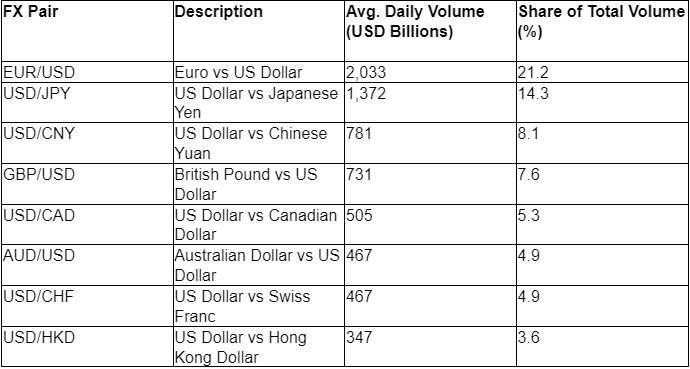
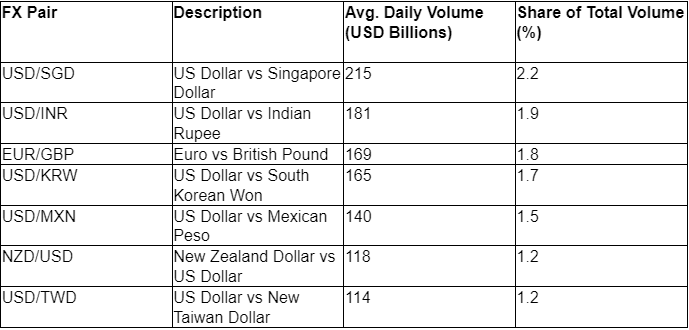
Source: Bank for International Settlements (BIS). Daily averages in April 2025, in billions of US dollars.
Types of Forex Pairs: Majors, Minors, and Exotics
Every currency pair in the forex market falls into one of three broad categories, and understanding these categories helps traders assess liquidity, spread costs, and price behavior before placing a trade.
Major Pairs
Major pairs always include the US dollar on one side and are paired with another widely traded currency from a large, developed economy. EUR/USD, USD/JPY, GBP/USD, AUD/USD, USD/CAD, USD/CHF, and NZD/USD are the classic major pairs. They carry the highest daily volumes, the tightest bid-ask spreads, and the most consistent liquidity throughout the trading day. Because of this, they are the most accessible pairs for both institutional and retail traders.
Minor or Cross Pairs
Minor pairs, also called cross pairs, do not include the US dollar. They are formed by pairing two major currencies against each other. EUR/GBP is a good example from the table above. Cross pairs tend to have slightly wider spreads than majors and can sometimes move in ways that reflect the relative strength of two regional economies rather than global risk sentiment alone. They are popular among traders who want to express a view on a specific regional economic relationship without taking a direct position on the US dollar.
Exotic Pairs
Exotic pairs combine the US dollar or another major currency with the currency of an emerging or smaller economy. USD/INR, USD/KRW, USD/MXN, USD/TWD, USD/CNY, USD/HKD, and USD/SGD all fall into this category to varying degrees. Exotic pairs typically carry wider spreads, lower liquidity, and higher volatility. Some, like USD/HKD and USD/SGD, are managed by their central banks, which limits their price movement significantly.
Base and Quote Currency: What a Pair's Price Actually Means
Every forex pair has two components: the base currency and the quote currency. The base currency is listed first, and the quote currency is listed second. The price of a pair tells you how many units of the quote currency are needed to buy one unit of the base currency. For example, if EUR/USD is trading at 1.0850, it means one euro costs 1.0850 US dollars. If USD/JPY is trading at 149.50, it means one US dollar costs 149.50 Japanese yen. This distinction matters because it determines how profits and losses are calculated and how the pair responds to economic events in each country.
Timing also plays a role in how actively a pair is traded. For instance, EUR/USD and GBP/USD see their highest volume during the London and New York sessions, when both regional markets are open simultaneously. If you want to know what time does london session open and how it overlaps with other sessions, understanding the forex market hours schedule is an important part of planning your trading activity around peak liquidity windows.
Pair Nicknames Every Forex Trader Should Know
Currency pairs have widely used nicknames in the trading community. These names are used by traders, analysts, and financial media, so knowing them helps you follow market commentary more easily.
- Fiber — EUR/USD, named after the fiber-optic cables that carry transatlantic financial data
- Gopher — USD/JPY, a long-standing nickname in the trading community
- Cable — GBP/USD, named after the telegraph cable that once connected London and New York for exchange rate transmission
- Loonie — USD/CAD, named after the loon bird on the Canadian one-dollar coin
- Aussie — AUD/USD, simply named after Australia
- Swissie — USD/CHF, named after Switzerland
- Kiwi — NZD/USD, named after New Zealand's national bird
Commodity Currencies: CAD, AUD, and NZD
Three of the most traded pairs involve currencies that are closely tied to commodity exports. These are often called commodity currencies because their exchange rates tend to move in line with the prices of the raw materials their countries export.
Canadian Dollar (CAD) and Oil
Canada is one of the world's largest oil exporters, and crude oil is its most significant export commodity. When global oil prices rise, Canadian export revenues increase, which tends to strengthen the Canadian dollar and push USD/CAD lower. When oil prices fall, the opposite typically occurs. Traders watching USD/CAD often monitor WTI crude oil prices as a leading indicator of near-term direction.
Australian Dollar (AUD) and Iron Ore
Australia is the world's largest exporter of iron ore, which is a key input in steel production. China is Australia's largest trading partner and the biggest buyer of Australian iron ore. When iron ore prices rise or Chinese industrial demand strengthens, the Australian dollar tends to appreciate, pushing AUD/USD higher. Weakness in Chinese economic data or a drop in iron ore prices often weighs on the Aussie.
New Zealand Dollar (NZD) and Dairy
New Zealand's economy is heavily dependent on agricultural exports, with dairy products being the most important. Whole milk powder prices, tracked through the Global Dairy Trade auction, are a key driver of NZD sentiment. When dairy prices are strong, New Zealand's export income rises, which supports the New Zealand dollar and tends to lift NZD/USD.
Safe-Haven Currencies: JPY and CHF
Two currencies in the most-traded list are widely regarded as safe havens: the Japanese yen and the Swiss franc. During periods of global financial stress, geopolitical uncertainty, or sharp equity market selloffs, investors tend to move capital into these currencies because of the stability and credibility associated with their economies and financial systems.
The Japanese yen benefits from Japan's status as the world's largest net creditor nation. When risk sentiment deteriorates, Japanese investors tend to repatriate capital from overseas, which increases demand for yen and causes USD/JPY to fall. The Swiss franc benefits from Switzerland's political neutrality, strong banking system, and consistent current account surplus. In times of crisis, USD/CHF often falls as the franc strengthens against the dollar.
Managed and Pegged Currencies: CNY, HKD, and SGD
Not all currencies in the top 15 float freely. Three of them operate under managed or pegged exchange rate regimes, which significantly affects how they trade.
Chinese Yuan (CNY)
The People's Bank of China manages the yuan within a daily trading band set around a central reference rate. The CNY does not float freely, and the central bank intervenes regularly to keep the exchange rate within its target range. This makes USD/CNY less volatile than freely floating pairs, but it also means the pair's direction is heavily influenced by Chinese government policy rather than pure market forces.
Hong Kong Dollar (HKD)
The Hong Kong dollar has been pegged to the US dollar since 1983, with the exchange rate maintained in a narrow band of 7.75 to 7.85 HKD per USD. The Hong Kong Monetary Authority intervenes whenever the rate approaches either end of the band. As a result, USD/HKD has very limited price movement and is primarily traded for hedging and settlement purposes rather than speculative trading.
Singapore Dollar (SGD)
The Monetary Authority of Singapore manages the Singapore dollar against an undisclosed basket of currencies within a policy band. Unlike a fixed peg, the SGD is allowed to appreciate or depreciate gradually within the band, and the MAS adjusts the slope, width, and center of the band as part of its monetary policy. This makes USD/SGD more dynamic than USD/HKD but still more constrained than freely floating pairs.
What Moves Each Pair's Price
While each pair has its own specific drivers, several broad categories of factors influence currency prices across the board.
- Central bank policy and interest rate differentials: When one country's central bank raises interest rates relative to another, its currency tends to attract capital inflows seeking higher returns, which strengthens it against the other currency. The interest rate differential between the Federal Reserve and the European Central Bank, for example, is one of the most closely watched drivers of EUR/USD.
- Inflation and employment data: Inflation reports such as CPI and employment data such as non-farm payrolls in the US directly influence expectations for central bank policy. Stronger-than-expected inflation or employment figures often lead traders to price in rate hikes, which can move currency pairs sharply.
- Commodity prices: As discussed above, commodity prices are a primary driver for AUD/USD, NZD/USD, and USD/CAD. Changes in oil, iron ore, and dairy prices can shift these pairs significantly even without any change in monetary policy.
- Global risk sentiment: When investors are confident and willing to take on risk, they tend to sell safe-haven currencies like JPY and CHF and buy higher-yielding or commodity-linked currencies. When fear rises, the opposite happens. This risk-on/risk-off dynamic affects nearly every pair in the market.
- Export performance and trade balances: Countries with strong export sectors and trade surpluses tend to see sustained demand for their currencies. Japan's large trade surplus, for example, creates structural demand for yen over time.
- Capital flows: Foreign direct investment, portfolio investment, and cross-border capital movements all create demand for specific currencies. Large capital inflows into a country's equity or bond markets tend to strengthen its currency, while outflows weaken it.
Conclusion
The most traded forex pairs in the world are not chosen arbitrarily — they reflect the size of the underlying economies, the depth of their financial markets, and the global demand for their currencies in trade and investment. EUR/USD dominates with over 21% of total global FX volume, followed by USD/JPY, USD/CNY, and GBP/USD. Understanding the difference between major, minor, and exotic pairs, knowing what drives each pair's price, and recognizing the role of commodity links, safe-haven flows, and managed exchange rate regimes gives traders a much clearer picture of how the forex market actually works. Whether you are drawn to the liquidity of the majors or the volatility of the exotics, building your knowledge around these fundamentals is the foundation of any sound trading approach.