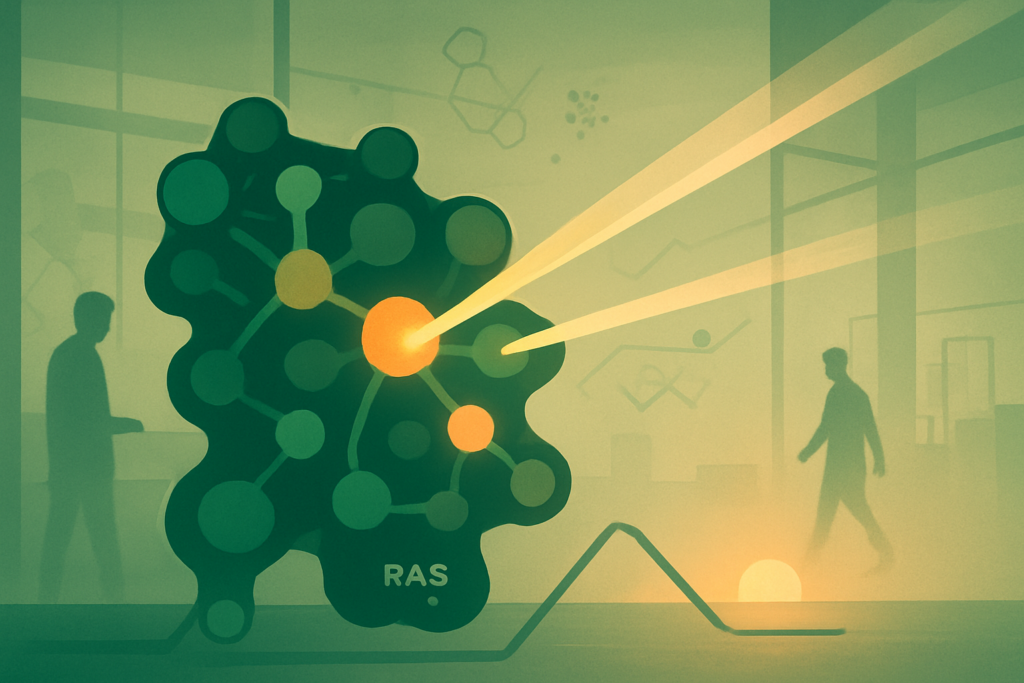
The biotechnology sector has always been a high-stakes arena where clinical success can create multi-billion-dollar empires overnight, and a failed negotiation can erase a fifth of a company’s market value in a single trading session. This volatility was on full display in late January 2026 as Revolution Medicines (Nasdaq: RVMD) experienced a dramatic 20% stock plunge following the collapse of acquisition talks with pharmaceutical giant Merck & Co. (NYSE: MRK).
For months, rumors of a mega-merger had fueled a speculative rally in RVMD shares, with reported valuations ranging as high as $32 billion. When the dust settled on January 26, 2026, the market was left to grapple with a stark reality: Revolution Medicines would remain independent—at least for now. This article provides a deep dive into the fallout of the Merck deal, the fundamental strength of RVMD’s "RAS(ON)" platform, and why the company remains one of the most significant stories in modern oncology.
Historical Background
Founded in 2014 by a team of industry veterans and academic leaders, including Dr. Mark Goldsmith, and backed by Third Rock Ventures, Revolution Medicines set out with a singular, audacious goal: to "undruggable" the RAS pathway. For decades, RAS mutations—found in approximately 30% of all human cancers—were considered the "Holy Grail" of oncology, notorious for their lack of viable binding pockets for small-molecule drugs.
RVMD transitioned from a research-heavy startup to a clinical powerhouse through strategic pivots and a relentless focus on the "ON" state of RAS proteins. Unlike the first generation of KRAS inhibitors that targeted the protein in its inactive (OFF) state, Revolution’s platform was designed to inhibit the protein when it is actively signaling for tumor growth. This distinction became the company's defining competitive edge, leading to its IPO in early 2020 and a steady ascent into the upper echelons of mid-cap biotech.
Business Model
Revolution Medicines operates as a clinical-stage precision oncology company. Its business model is centered on the discovery and development of "first-in-class" and "best-in-class" targeted therapies for RAS-addicted cancers.
The company does not yet have a commercial product on the market, meaning its revenue is currently derived from collaborations and the intermittent sale of equity to fund its massive R&D requirements. Its primary "customers" at this stage are not patients, but the clinical trial participants and the regulatory agencies overseeing its path to market. The ultimate value proposition lies in the high-margin, high-demand nature of oncology drugs, where a successful "Pan-RAS" inhibitor could potentially command a global market worth tens of billions of dollars.
Stock Performance Overview
The stock performance of RVMD has been a rollercoaster characterized by extreme technical sensitivity to clinical data.
- 1-Year Horizon: Prior to the Merck news, RVMD had been one of the top performers in the biotech index, gaining over 60% as its lead candidate, RMC-6236, showed stellar results in pancreatic cancer trials.
- 5-Year Horizon: Since its 2020 IPO, the stock has significantly outperformed the XBI (Biotech ETF), reflecting the market's growing confidence in the "RAS(ON)" hypothesis.
- Recent Plunge: The 20% drop on January 25-26, 2026, erased nearly $6 billion in market cap. While painful for short-term holders, the stock remains well above its late-2024 lows, suggesting that the "Merck premium" was merely a layer of froth on a fundamentally solid base.
Financial Performance
As of January 26, 2026, Revolution Medicines’ balance sheet remains its greatest defensive asset.
- Cash Position: The company holds approximately $2.0 billion in cash, cash equivalents, and marketable securities.
- Burn Rate: With eight registrational trials either active or planned for 2026, the burn rate is high, yet the current treasury provides a runway into the second half of 2027.
- Valuation: Despite the recent sell-off, RVMD maintains a market capitalization of roughly $24 billion. This is a high valuation for a pre-revenue company, reflecting massive expectations for its Phase 3 readouts in 2026.
Leadership and Management
The leadership team is led by CEO Mark Goldsmith, M.D., Ph.D., a figure widely respected in the venture and scientific communities for his disciplined approach to drug development. Goldsmith has been a vocal proponent of "staying the course," often emphasizing that the value of the company's multi-drug pipeline exceeds what many big pharma suitors are currently willing to pay.
The board of directors includes heavyweights from the life sciences sector, ensuring a high level of governance and strategic oversight. The decision to walk away from Merck’s reported $30 billion offer suggests a board that is confident in its internal projections and unwilling to sell the company at a "discount" to its long-term potential.
Products, Services, and Innovations
The crown jewel of the RVMD portfolio is the RAS(ON) platform. By targeting the active state of the RAS protein, these drugs can theoretically overcome the resistance mechanisms that plague first-generation inhibitors.
- RMC-6236 (Daraxonrasib): A pan-RAS(ON) multi-selective inhibitor currently in Phase 3 trials for pancreatic ductal adenocarcinoma (PDAC). It is the most watched drug in the RAS space.
- RMC-9805 (Zoldonrasib): An oral KRAS G12D(ON) inhibitor. It received FDA Breakthrough Therapy Designation in early 2026, marking a significant milestone for the treatment of non-small cell lung cancer (NSCLC).
- RMC-6291 (Elironrasib): A KRAS G12C(ON) inhibitor designed to treat patients who have failed therapy with earlier drugs like Lumakras or Krazati.
Competitive Landscape
RVMD is fighting a multi-front war against some of the largest names in healthcare:
- Amgen (Nasdaq: AMGN) & Bristol Myers Squibb (NYSE: BMY): These giants pioneered the G12C(OFF) inhibitors. However, their drugs have struggled with limited durability of response. RVMD’s RMC-6291 is positioned as the "fix" for patients who relapse on these therapies.
- Eli Lilly (NYSE: LLY): Lilly’s olomorasib is a potent G12C competitor, but it lacks the broad "pan-RAS" coverage of RVMD’s flagship candidates.
- Astellas (OTC: ALPMY): A major rival in the G12D mutation space.
The competitive advantage for Revolution Medicines lies in its breadth. While others target specific mutations (like G12C), RVMD is building a franchise that can treat the entire spectrum of RAS mutations.
Industry and Market Trends
The oncology market is shifting toward "precision medicine 2.0." After a decade of immunotherapy dominance (led by Merck’s Keytruda), the industry is returning to targeted small molecules that can be combined with other therapies.
Additionally, the "M&A winter" of 2023-2024 has thawed. Large pharmaceutical companies are facing "patent cliffs" (the loss of exclusivity on their best-selling drugs) and are desperate to acquire high-growth biotech companies to refill their pipelines. This macro trend made RVMD a natural target for Merck, and even though talks stalled, the pressure for Big Pharma to buy innovative biotech remains high.
Risks and Challenges
Despite the optimism, the risks for RVMD are substantial:
- Clinical Risk: The "RAS(ON)" platform is still largely unproven in Phase 3 trials. Any "miss" in the upcoming RASolute 302 data could cause a 50% or greater collapse in the stock.
- Financing Risk: If the company remains independent, it will eventually need more capital. If the market turns sour, raising another billion dollars could be highly dilutive to existing shareholders.
- Regulatory Risk: The FDA has become increasingly stringent regarding trial design and comparative efficacy for oncology drugs.
Opportunities and Catalysts
The recent stock drop may represent a "clearing event." With the Merck distractions gone, the focus shifts back to the science.
- H1 2026 Data: The Phase 3 results for RMC-6236 in second-line pancreatic cancer are expected within months. This is arguably the most significant clinical catalyst in the entire biotech sector for 2026.
- New Suitors: Just because Merck walked away does not mean AbbVie (NYSE: ABBV) or Pfizer (NYSE: PFE) won't step in, especially if the H1 data is strong.
Investor Sentiment and Analyst Coverage
Wall Street remains broadly bullish on RVMD. Following the 20% dip, Stifel reiterated a Buy rating with a $170 price target, suggesting the sell-off was an overreaction. Mizuho analysts have suggested that if the pan-RAS platform succeeds, the company could be looking at $10 billion in peak annual sales.
Institutional ownership remains high, with funds like Fidelity and Vanguard holding significant stakes. Retail sentiment is mixed, with many frustrated by the failed merger but others viewing the "independence" of the company as a sign that the best is yet to come.
Regulatory, Policy, and Geopolitical Factors
Revolution Medicines benefits from several government incentives:
- Breakthrough Therapy Designation: This provides "all hands on deck" support from the FDA, accelerating the development of RMC-9805 and RMC-6291.
- Orphan Drug Status: Many of the mutations RVMD targets are in rare or high-unmet-need populations, granting them extended market exclusivity.
Conversely, the Inflation Reduction Act (IRA) in the United States remains a concern. The law allows Medicare to negotiate prices on high-spending drugs, which could potentially impact the long-term profitability of a blockbuster oncology drug.
Conclusion
The 20% plunge in Revolution Medicines’ stock following the end of Merck acquisition talks is a classic "buy the rumor, sell the news" event, amplified by the high stakes of the biotech sector. However, the fundamentals of the company—a robust $2.0 billion cash pile, a pioneering RAS(ON) platform, and a roadmap to Phase 3 data in 2026—remain unchanged.
Investors should view the first half of 2026 as the ultimate "moment of truth." If Daraxonrasib (RMC-6236) delivers in the RASolute 302 trial, the $30 billion price tag Merck was reportedly considering might soon look like a bargain. For now, RVMD is a high-conviction, high-volatility play on the future of targeted cancer therapy.
This content is intended for informational purposes only and is not financial advice.