

Delhi has always been an important centre for business, government, consulting, financial services, and corporate activity. As companies become increasingly data-driven, the finance careers available to graduates are changing as well.
A finance degree alone may no longer be enough for someone who wants to build a career in investment banking, financial analysis, valuation, corporate finance, or equity research. Employers increasingly look for candidates who can work with financial statements, build models, interpret data, understand valuation, and communicate their findings clearly.
This is why choosing the best investment banking institute in Delhi is becoming less about simply finding a course with a familiar name and more about finding a learning environment that combines finance knowledge, practical projects, technology skills, and career preparation.
For students and working professionals considering an investment banking course in Delhi, one of the most important questions is simple: does the training actually prepare you for the work you will be expected to do?
Why Delhi Is Becoming an Important Destination for Finance Careers
Delhi and the wider National Capital Region have a diverse corporate ecosystem. Along with banks and financial institutions, the region has consulting companies, multinational corporations, fintech businesses, research firms, accounting and professional-services organisations, and corporate finance teams.
That diversity creates opportunities across several finance functions.
A graduate may begin with a role such as:
- Financial Analyst
- Investment Banking Analyst
- Equity Research Analyst
- Business Analyst
- Valuation Analyst
- Risk Analyst
- Corporate Finance Analyst
- Research Associate
- FP&A Analyst
The skills required for these positions overlap considerably.
Financial statement analysis, Excel, financial modeling, valuation, data analysis, Power BI, presentation skills, and an understanding of financial markets can all contribute to career readiness.
This is also why students should look beyond a course title when comparing finance institutes in Delhi.
Investment Banking Is More Than Knowing Finance Theory
Investment banking is often associated with mergers and acquisitions, IPOs, capital raising, and large financial transactions. But behind every major transaction is a significant amount of analysis.
An analyst may need to understand a company’s financial statements, project future revenue and expenses, calculate valuation, compare companies, analyse transaction structures, prepare presentations, and communicate findings to senior professionals.
Consider a hypothetical acquisition.
An analyst could be asked to:
- Collect historical financial information.
- Clean and organise the data.
- Build a financial model.
- Forecast future performance.
- Calculate valuation using methods such as DCF and comparable-company analysis.
- Examine the potential impact of an acquisition.
- Analyse synergies and risks.
- Prepare an investment presentation.
This is very different from simply memorising financial concepts.
A good investment banking course with placement support should therefore provide opportunities to practise these tasks rather than relying entirely on classroom theory.
Why Financial Modeling Has Become a Core Finance Skill
Financial modeling is one of the most practical skills for students targeting modern finance careers.
A financial model converts business assumptions into a structured numerical representation of a company’s future performance.
For example, an analyst might create assumptions for:
- Revenue growth
- Operating expenses
- Working capital
- Capital expenditure
- Debt
- Interest expenses
- Taxes
- Cash flow
- Valuation
The model can then be used to understand different scenarios and support business decisions.
This makes financial modeling useful far beyond traditional investment banking.
It can support careers in corporate finance, equity research, private equity, FP&A, consulting, valuation, transaction advisory, and financial analytics.
For students specifically looking for a financial modeling course with placement assistance, this practical component should be one of the first things they evaluate.
What Should You Look for in a Finance Course With Placement Support?
Placement assistance can sound attractive in a course brochure, but students should understand what actually sits behind the term.
A strong career-oriented finance program should ideally include several components.
- Practical Financial Modeling
Students should learn how to build models rather than simply study formulas.
This can include three-statement modeling, valuation models, forecasting, sensitivity analysis, and M&A modeling.
- Valuation
Understanding how businesses are valued is fundamental for investment banking and several other finance roles.
Students should get exposure to techniques such as discounted cash flow analysis and comparable-company analysis.
- Financial Statement Analysis
A candidate should be comfortable reading an income statement, balance sheet, and cash-flow statement.
More importantly, they should understand what those numbers say about the underlying business.
- Data and Analytics
Finance is increasingly connected with technology.
Power BI, Tableau, SQL, Python, and AI-enabled tools can help finance professionals analyse larger datasets and automate repetitive tasks.
- Real-World Projects
Projects give students something concrete to discuss during interviews.
Building a valuation model, analysing an M&A transaction, preparing an equity research report, or creating an investment pitch can demonstrate practical ability much better than a list of theoretical subjects.
- Interview Preparation
Technical knowledge is only one part of getting hired.
Students also need to understand how to explain their projects, answer financial questions, present themselves professionally, and handle HR interviews.
This is where structured career support can make a meaningful difference.
Boston Institute of Analytics: A Practical Finance Education Option in Delhi
For students comparing the best investment banking institute in Delhi, Boston Institute of Analytics (BIA) is one option worth considering because its finance programs combine investment banking, financial analytics, financial modeling, and technology-oriented skills.
BIA’s Delhi finance programs are offered through its Connaught Place centre.
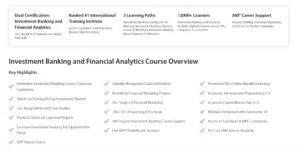
Its Investment Banking & Financial Analytics program covers areas including financial analysis, corporate finance, equity, fixed income, derivatives, wealth management, equity research, financial modeling, and M&A valuation. The curriculum also incorporates Python, prompt engineering, and business intelligence tools.
The program is structured around more than 200 hours of learning and practical exercises, along with 50+ assignments and case studies and hands-on capstone projects.
That practical orientation matters because students need to move from understanding financial concepts to actually applying them.
A Financial Modeling Course That Goes Beyond Excel
BIA’s Financial Modeling and Business Analytics program takes a broader approach to finance careers.
The program covers financial modeling, M&A modeling, advanced Excel, business analytics, Power BI, Tableau, SQL, Python for finance automation, and Generative AI and prompt engineering. The curriculum contains more than 200 hours of learning and practical work.
This combination is particularly relevant for students who do not want to limit themselves to traditional finance roles.
For example, someone who understands financial modeling as well as business intelligence tools can potentially explore roles across financial analysis, corporate finance, valuation, business analytics, and investment-related functions.
The program is also designed for students from different educational backgrounds, including Commerce, Arts, Engineering, and Science.
How BIA Approaches Placement and Career Preparation
One of the important differences between a standard academic course and a career-oriented program is what happens after the classroom training.

BIA describes its career support around resume building, interview preparation, career mentorship, and access to corporate opportunities. Its investment banking program also highlights an exclusive job opportunities portal and 360-degree career support.
The learning paths are designed around different levels of career preparation.
The Investment Banking & Financial Analytics program offers:
- 4-month Certification
- 6-month Diploma with a 2-month internship
- 10-month Master Diploma with extended on-job training
BIA’s own course information also makes an important distinction: career assistance and training do not mean that every student receives a guaranteed permanent job, since employment outcomes depend on individual performance, employer requirements, and market conditions.
That distinction is important when evaluating any investment banking course with job assistance in Delhi.
Students should look for transparent career support rather than judging a program solely by a placement claim.
What Kind of Projects Should Finance Students Build?
A strong finance portfolio can become an important advantage during interviews.
Instead of saying, “I have learned financial modeling,” a candidate can demonstrate what they have actually built.
For example, a student could work on:
Financial Modeling Project
Build a detailed financial model for a listed company, including historical financial statements, assumptions, projections, and sensitivity analysis.
Valuation Project
Value a publicly traded company using DCF and comparable-company approaches.
M&A Analysis
Analyse a recent acquisition and evaluate transaction rationale, valuation, financing structure, potential synergies, and risks.
Equity Research Project
Prepare an equity research report covering a company’s business model, financial performance, industry outlook, valuation, and investment thesis.
Investment Pitch
Develop a professional pitch book for a hypothetical investment opportunity.
These projects provide students with stories and examples they can use during technical interviews.
The Importance of Learning Financial Technology
Finance professionals are no longer working in isolation from technology.
A modern finance team may use spreadsheets, databases, dashboards, automation tools, Python, SQL, and AI-powered applications alongside traditional financial analysis.
This is particularly relevant in investment banking and financial analytics.
For someone searching for the best financial modeling course with placement in Delhi, therefore, it is worth checking whether the program teaches only Excel-based modeling or also explains how financial professionals use analytics and automation.
BIA’s Financial Modeling and Business Analytics curriculum reflects this broader approach by combining modeling with Power BI, Tableau, SQL, Python, and Generative AI.
BIA’s Broader Finance Learning Ecosystem
Another consideration when selecting a finance institute is the professional ecosystem around the program.
BIA currently reports a 50,000+ alumni network, 7,000+ industry mentors and advisors, and 350+ corporate partners across its broader learning ecosystem.
Its Delhi School of Finance also lists Investment Banking & Financial Analytics, Financial Modeling and Business Analytics, Equity Research and Valuation Analytics, and CFA-related training among its finance offerings.
For a student, the advantage of such an ecosystem is not simply the number itself. The more important question is whether the learning environment creates opportunities for mentorship, practical exposure, professional networking, and career preparation.
Who Should Consider an Investment Banking Course in Delhi?
An investment banking program can be relevant to several types of learners.
Recent Graduates
Commerce, finance, economics, business, engineering, and even other graduates can use practical finance training to transition towards finance-oriented roles.
Finance Students
Students who already understand accounting and finance can strengthen their practical capabilities through modeling, valuation, analytics, and projects.
Working Professionals
Professionals in accounting, operations, analytics, banking, or related fields may use investment banking and financial analytics skills to pursue a career transition.
Career Switchers
A structured program can help career switchers build foundational knowledge while creating a portfolio of practical finance projects.
The important factor is not simply the degree someone already holds. It is whether they can demonstrate relevant skills.
How to Choose the Best Investment Banking Institute in Delhi
Before enrolling, compare institutes using a practical checklist.
Ask:
Does the curriculum include financial modeling?
If investment banking is the goal, modeling should be a central part of the program.
Does the course teach valuation and M&A?
These are important areas for investment banking and transaction-focused roles.
Are there practical projects?
Look for actual models, valuation exercises, research reports, pitch books, and case studies.
Are analytics tools included?
Power BI, Tableau, SQL, Python, and AI tools can add significant value to a finance professional’s toolkit.
Who teaches the course?
Industry exposure can make complex finance concepts easier to connect with real workplace situations.
What does placement assistance actually include?
Check whether the institute provides resume support, interview preparation, mentorship, employer connections, internships, or job-search guidance.
Is the institute transparent about employment outcomes?
A credible institution should distinguish between career assistance, internships, job training, and permanent employment.
Why Practical Skills Can Make the Difference
The finance job market is competitive.
Two candidates may have similar degrees, but the candidate who can open an Excel workbook and build a financial model, explain a DCF valuation, analyse a company’s financial statements, create a Power BI dashboard, and confidently discuss a completed project may have a stronger interview story.
That is the real value of career-focused finance education.
A good course does not simply add another certificate to a resume. It should help turn theoretical knowledge into demonstrable skills.
For students evaluating an investment banking course in Delhi, that distinction can be crucial.
Final Thoughts
Delhi offers an attractive environment for students and professionals interested in finance, analytics, banking, consulting, and corporate careers. But entering these fields requires more than academic credentials.
Financial modeling, valuation, financial statement analysis, investment research, data analytics, communication, and interview skills are becoming increasingly important.
For anyone searching for the best investment banking institute in Delhi, the right choice should therefore be based on the quality of the curriculum, practical exposure, industry interaction, career support, and transparency around placements.
Boston Institute of Analytics stands out as a practical option for learners who want to combine investment banking and financial analytics with hands-on financial modeling, valuation, business intelligence, and technology skills. Its Delhi programs in Connaught Place offer multiple learning paths, practical projects, career support, and internship or job-training options depending on the program selected.
Ultimately, the strongest finance career preparation is not about finding a course that promises the easiest job. It is about finding a program that helps you become capable of doing the job.
For an aspiring analyst in Delhi, that can be the difference between simply completing a finance course and actually becoming industry-ready.
Frequently Asked Questions
- Which is the best investment banking institute in Delhi?
The best investment banking institute in Delhi should offer more than theoretical finance lessons. Look for a program covering financial modeling, valuation, M&A, financial statement analysis, investment research, analytics tools, practical projects, interview preparation, and career support. Boston Institute of Analytics is one option for students looking for a practical, industry-oriented investment banking program in Delhi.
- Is an investment banking course with placement support worth pursuing?
Yes. A career-focused investment banking course can be valuable when it combines technical finance training with practical projects, resume building, mock interviews, technical interview preparation, mentorship, and employer connections. However, students should distinguish between placement assistance and a guaranteed job, as employment ultimately depends on skills, performance, employer requirements, and market conditions.
- What does a financial modeling course with placement support teach?
A good financial modeling course typically covers advanced Excel, financial statement analysis, forecasting, three-statement modeling, valuation, DCF analysis, comparable-company analysis, sensitivity analysis, and M&A modeling. Programs that also include Power BI, SQL, Python, and AI tools can help learners prepare for the increasingly technology-driven finance industry.
- Can non-commerce graduates join an investment banking course in Delhi?
Yes. Investment banking and financial analytics programs can be suitable for graduates from Commerce, Economics, Business, Engineering, Science, Arts, and other backgrounds, depending on the institute’s eligibility requirements. Students without a finance background may need to spend additional time developing accounting, financial markets, and corporate finance fundamentals.
- What career opportunities are available after a financial modeling or investment banking course?
Depending on their skills, experience, and qualifications, graduates can explore roles such as Investment Banking Analyst, Financial Analyst, Valuation Analyst, Equity Research Analyst, Business Analyst, Corporate Finance Analyst, Risk Analyst, FP&A Analyst, and Research Associate. Practical modeling, valuation, analytics, and communication skills can strengthen a candidate’s profile for these roles.