Retirement planning can sound like three different jobs. You figure out how much you need, decide where to invest, and then worry about taxes later. Many people also turn to financial advisors for help with each part of the puzzle.
But there is a problem with treating them as separate pieces: they all affect the same money.
Imagine reaching retirement with a healthy investment account. On paper, you might think, “I’m set.” Then you start taking money out and discover that some of those withdrawals count as taxable income. Suddenly, the amount you saved and the amount you can actually spend are two different numbers.
So, what should you be planning for? Not just a retirement balance. You should be planning for the money you will have available to live on after taxes.
Retirement planning starts with the life you want
Before choosing investments or worrying about tax rules, start with a simple question: What do you want retirement to look like?
Your answer could mean traveling every year. It could mean staying close to home, paying off your mortgage, helping your family, or having enough money that an unexpected bill does not cause panic.
Your spending needs determine how much income your investments need to provide.
You should have an emergency, protection, and growth fund.
A good emergency fund should cover at least three to six months of your basic expenses. In your protection fund is the money you plan to use every day. And the rest can be invested more aggressively.
Only 35% of non-retirees thought they were on track with their retirement savings, according to the Federal Reserve’s 2026 report.
That does not mean you need one magical retirement number. It means your plan needs to connect today’s savings with tomorrow’s spending.

Your investments are part of the retirement plan
Once you know what you are saving for, your investments need to fit the plan.
Someone who is decades away from retirement usually has more time to ride out market ups and downs. Someone who expects to start using their savings soon has a different problem. A large market drop right before withdrawals begin can hurt much more than a similar drop many years earlier.
That is why investment choices should not be made by asking, “What investment could make me the most money?”
A better question is: What mix of investments makes sense for when I need this money?
That can include a mix of stocks, bonds, cash and other assets, depending on your goals, time frame, and comfort with risk.
Also, where you hold the investments can matter almost as much as what you own.
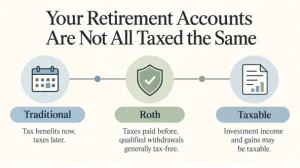
A traditional IRA, for example, can offer a tax deduction for eligible contributions, while taxes are generally deferred until money is withdrawn. A Roth IRA works differently. Contributions are made with after-tax money, but qualified withdrawals are generally tax-free.
Taxes are part of your retirement income
Suppose you have several sources of retirement money: a traditional 401(k), a Roth account, and investments in a taxable brokerage account. They do not all create the same tax result when you use them.
Money withdrawn from a traditional retirement account can generally be included in taxable income. Investments held in a regular taxable account can also create taxable income through things such as dividends or capital gains.
A Roth account can provide a different kind of flexibility because qualified withdrawals are not included in gross income.
That means the question is not simply, “How much do I have?”
It is also:
Which account should I use, when should I use it, and what could that withdrawal do to my tax bill?
For another perspective on this issue, see this FinancialContent article about growing retirement tax concerns.
A simple way to connect all three
You do not need a spreadsheet with 50 tabs to start. Begin with three questions:
- Retirement: How much will I realistically need to spend each year?
- Investments: How much do I need to save, and what mix of investments fits my time frame?
- Taxes: Which accounts will I draw from, and how might those withdrawals be taxed?
Then look at the three answers together.
Maybe saving a little more now gives you more flexibility later. Maybe having money in different types of accounts gives you more choices about where your income comes from. Maybe an investment that looks attractive on paper does not make sense when you consider when you will need the money.
The point is not to predict every detail of your financial future. Nobody can.
The point is to avoid building three plans that contradict each other.
A better retirement plan looks at the whole picture
Retirement is not a finish line where your savings suddenly become income. It is a change in how your money works.
During your working years, you are putting money into the system. During retirement, you are taking money out. Your investments need to support that change, while your tax strategy helps determine how much of the money you get to keep.
A strong plan does not just ask whether you are saving enough. It asks whether your investments match your timeline, whether your accounts give you useful choices, and whether your future income has been considered on an after-tax basis.
The earlier you connect those dots, the fewer surprises you will face later.