I concluded a February 5, 2026, Barchart article on platinum after the correction with the following:
Time will tell if the most recent correction is a golden buying opportunity for platinum, but buying on price weakness has been optimal over the past months, and I expect that trend to continue.
Nearby NYMEX platinum futures traded at $2,253.20 on February 4, 2026, after hitting a low of $1,882 per ounce on February 2. Platinum futures were higher than the February 2 low but lower than the February 4 price in May 2026, as they are hovering around the $2,000 level.
Platinum moves into a consolidation pattern with a bullish bias
The continuous NYMEX platinum futures price dropped 41.8% from the record high of $2,925.00 on January 26, 2026, to the low of $1,703.00 per ounce on March 23, 2026.
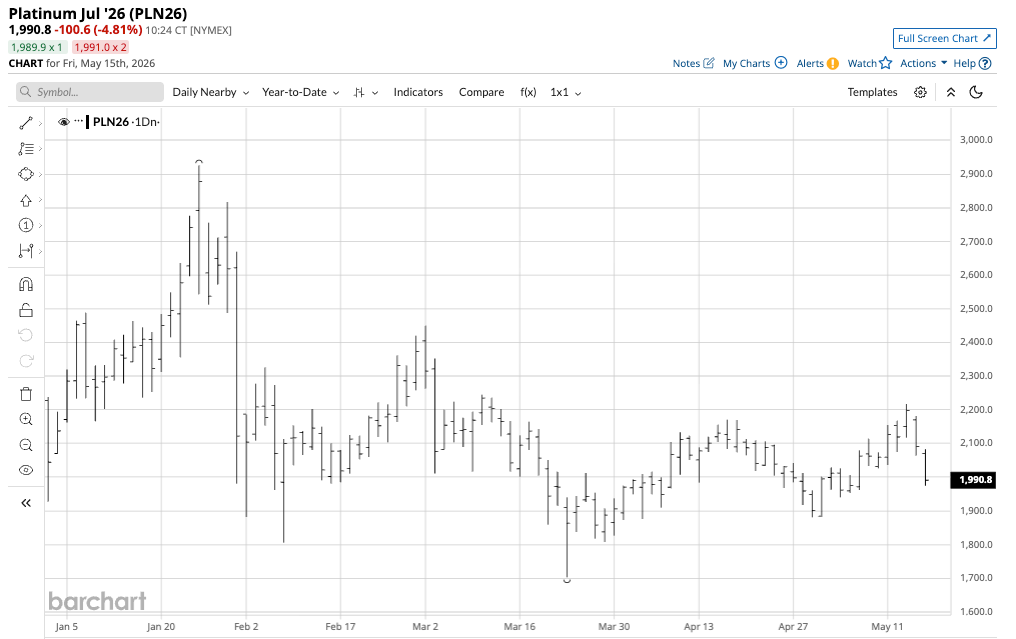
The chart shows that platinum futures moved into a consolidation pattern following the March 23 low. However, the sideways trading pattern has a bullish bias as platinum futures have made higher lows and were at just over $1,990 per ounce on May 15.
The case for owning platinum at around $2,000 per ounce
While platinum prices have doubled after a decade of trading around the $1,000 per ounce pivot point, platinum at near $2,000 could still be a bargain for the following reasons:
- Platinum remains at less than half the price of gold, making it historically inexpensive compared to the leading precious metal.
- Annual platinum production of around 225 metric tons in 2025 was over 16 times lower than gold production, which was 3,672 metric tons.
- Given its density and heat resistance properties, platinum has many industrial applications.
- Platinum broke out of a decade-long consolidation and remains in a bullish trend despite the correction from the late-January high to the late-March low.
If the price action in gold and silver is a model, platinum at around $2,000 per ounce is inexpensive.
Technical levels to watch in the platinum futures market
The quarterly NYMEX platinum futures chart highlights the critical long-term technical levels that could trigger substantial price moves.
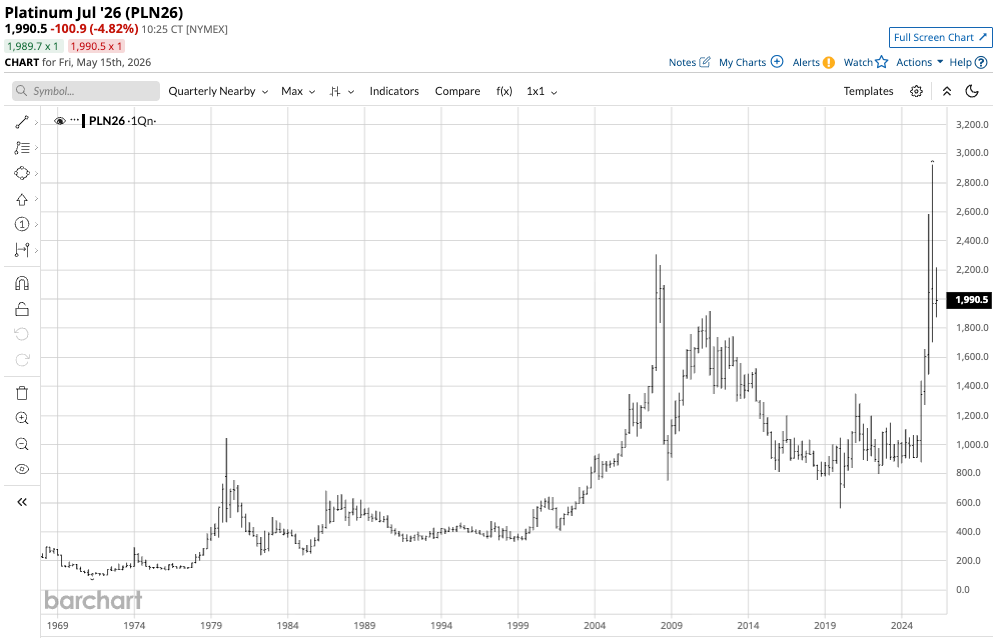
As the chart shows, long-term technical support remains clustered around the $1,000 per ounce level, with the downside targets below the Q2 2026 low of $1,875 and the March 2026 low of $1703. Below there, technical support is at the Q1 2023 high of $1,348.20 per ounce.
Technical resistance stands at the Q1 2008 previous record high of $2,308.80 per ounce and the Q1 2026 high of $2,925.
Liquidity could be the key to higher prices
The total open interest in the NYMEX platinum futures market on May 14, 2026, was 64,520 contracts. With each contract containing 50 troy ounces, the value of the platinum futures market at $1,990 per ounce was $6.420 billion. Gold’s open interest on May 14, 2026, was 384,401 contracts. With each contract containing 100 troy ounces, the value of the gold futures market at $4,550 per ounce was $174.9 billion, 27.24 times higher than the value of the platinum futures market.
Meanwhile, on May 14, 2026, total NYMEX platinum warehouse stocks were 456,086.27 ounces or 14.2 metric tons. Total COMEX gold warehouse stocks were over 63 times higher at 28,777,998.972 ounces or 895.1 metric tons.
Platinum is far less liquid than gold in the futures and over-the-counter markets. While gold has an active forward curve, enabling options, platinum’s forward curve is extremely limited, inhibiting put and call options.
Less liquid markets tend to be more volatile than liquid markets as bids to purchase can disappear during downside corrections and offers to sell can evaporate during rallies.
Therefore, the bullish trend in precious metals could drive platinum prices to higher rapidly if the market is preparing for another leg up.
Two ETF Choices for pure platinum exposure- PPLT and PLTM
The most direct investment or trading route for a risk position in platinum is the physical market for bars and coins. While NYMEX futures offer a delivery mechanism, they involve margin and unique accounts requiring significant compliance. The two ETFs that hold 100% of their assets in physical platinum bullion are the Aberdeen Physical Platinum ETF (PPLT) and the GraniteShares Platinum Shares ETF (PLTM).
At $179.50 per share, PPLT had around $2.6 billion in assets under management. PPLT trades an average of nearly 282,500 shares per day and charges a 0.60% management fee.
At $19.00 per share, PLTM had over $274 million in assets under management. PLTM trades an average of more than 278,000 shares per day and charges a 0.50% management fee.
PPLT and PLTM do an excellent job of tracking platinum prices, but there is one drawback. While platinum trades around the clock, the ETFs only trade during U.S. stock market hours. Therefore, they can miss highs or lows when the stock market is closed.
I remain bullish on platinum at the $2,000 per ounce level, and expect the precious metal to reach new all-time highs. However, any purchase should leave room for corrections, as even the most aggressive bull markets rarely move in straight lines.
On the date of publication, Andrew Hecht did not have (either directly or indirectly) positions in any of the securities mentioned in this article. All information and data in this article is solely for informational purposes. For more information please view the Barchart Disclosure Policy here.
More news from Barchart