Women's Intimate Care Product Market is expanding with rising hygiene awareness, demand for pH-balanced products, and growing online access enabling private, informed purchases.
NEWARK, DE / ACCESS Newswire / May 5, 2026 / According to the latest market analysis by Future Market Insights, the global women's intimate care product market, valued at USD 32.6 billion in 2026 and projected to reach USD 48.5 billion by 2036, is undergoing a structural shift-from a discreet, occasional-use category into a normalized component of daily personal care. What was once niche is now being integrated into routine hygiene habits, driven by rising awareness of pH balance, sensitive skin needs, and access to information through digital channels. For industry stakeholders, this evolution signals not just incremental growth, but a redefinition of how personal care portfolios are built, marketed, and trusted.
Quick Stats Snapshot
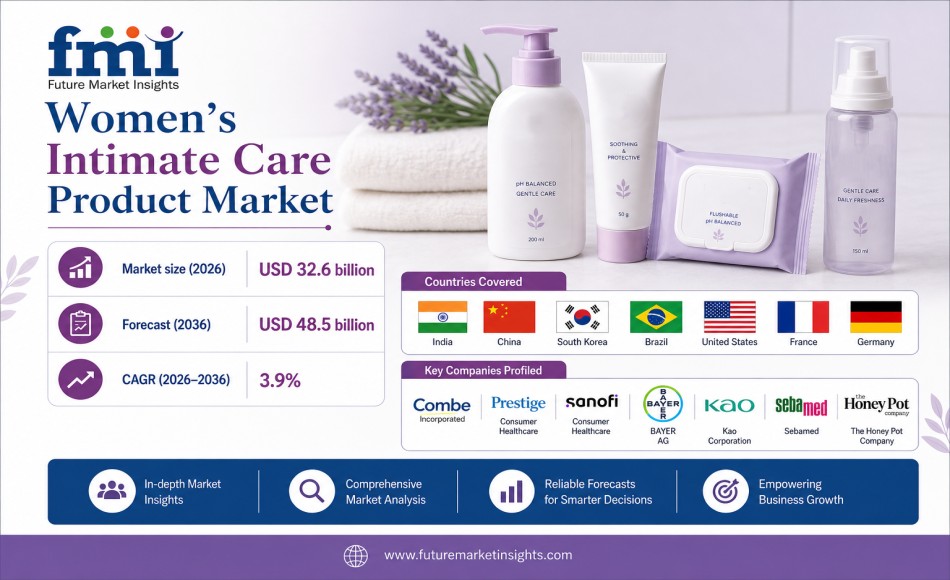
Market size (2026): USD 32.6 billion
Forecast (2036): USD 48.5 billion
CAGR (2026-2036): 3.9%
Top growth market: India (6.2% CAGR)
Leading product segment: Intimate wash (20% share by 2026)
Dominant sales channel: Online retail (32% share by 2026)
Key consumer group: Ages 26-40 (45% revenue share)
Get detailed market forecasts, competitive benchmarking, and pricing trends: https://www.futuremarketinsights.com/reports/sample/rep-gb-11016
Market Size and Growth Outlook
The global women's intimate care product market is projected to grow steadily from USD 32.6 billion in 2026 to USD 48.5 billion by 2036. While the overall CAGR of 3.9% suggests a mature category, underlying demand dynamics reveal a more nuanced story: growth is less about volume expansion and more about premiumization, product specialization, and consumer trust.
Emerging markets-particularly across South Asia and East Asia-are expected to outpace global averages, supported by expanding retail access, digital education, and shifting cultural attitudes toward women's health and hygiene.
Growth Drivers: Hygiene Awareness Meets Digital Empowerment
Three structural forces are shaping demand:
1. Daily Hygiene Normalization
Consumers are increasingly replacing general body wash products with specialized intimate care solutions designed for external use. pH-balanced formulations have become a baseline expectation rather than a premium differentiator.
2. Rise of Private, Digital Commerce
E-commerce is transforming category access. The ability to discreetly compare ingredients, read peer reviews, and purchase products privately has significantly reduced social barriers-particularly in conservative or emerging markets.
3. Ingredient Transparency and Skin Sensitivity
Demand is shifting toward mild, dermatologically tested, and clearly labeled formulations. Sensitive skin considerations now influence nearly half of purchasing decisions, pushing brands to simplify claims and avoid aggressive positioning.
Key Challenges: Trust, Education, and Claim Discipline
Despite steady growth, the category faces critical constraints:
Consumer skepticism around product safety-especially for fragranced or poorly explained formulations
Blurred lines between cosmetic hygiene and medical treatment, leading to confusion
Regulatory and communication risks tied to probiotic or "health" claims
Brands that fail to clearly communicate external-use positioning and safe ingredient profiles risk losing credibility in a trust-sensitive category.
Emerging Opportunities: Premiumization Through Simplicity
Opportunities lie less in product proliferation and more in clarity and consistency:
Pharmacy-led credibility: Products positioned with dermatological backing and pharmacy availability are gaining stronger repeat purchase rates
Mid-range affordability in emerging markets: Particularly in India and Southeast Asia, accessible pricing paired with "safe" positioning is driving scale
Education-led digital brands: Direct-to-consumer players are leveraging content, not just products, to build trust
Customize insights for your business strategy : https://www.futuremarketinsights.com/customization-available/rep-gb-11016
Segmentation Insights: Routine Drives Scale
By Product Type:
Intimate wash dominates with a projected 20% share by 2026, reflecting its seamless integration into daily routines. Wipes and sprays serve convenience niches but lack the same repeat-use frequency.
By Form:
Liquid formats lead with a 34% share, favored for familiarity and ease of use. Premium textures (gel, foam) are gaining traction among urban consumers.
By Ingredient Type:
pH-balanced formulations account for 29% of the market, acting as a core trust signal. Natural and organic claims support premium tiers but require careful messaging.
By Application:
Cleansing leads with 36.5% share, reinforcing the category's foundation in hygiene rather than treatment.
By Demographics:
Women aged 26-40 dominate demand, combining purchasing power with higher engagement in wellness routines.
Regional Analysis: Asia Leads, Europe Stabilizes
India (6.2% CAGR)
Urbanization, pharmacy expansion, and digital access are accelerating adoption. Mid-priced products with safety positioning are particularly effective.China (5.6% CAGR)
Digital beauty ecosystems are driving premiumization. Consumers increasingly evaluate intimate care through a skincare lens.South Korea (4.8% CAGR)
Beauty culture supports rapid acceptance of specialized products, especially those emphasizing formulation quality.Brazil (4.6% CAGR)
Climate and grooming habits sustain demand for cleansing and freshness products.United States (3.8% CAGR)
A mature but evolving market, where femtech conversations and subscription models are reinforcing repeat use.Europe (France 3.1%, Germany 2.9%)
Stable growth with strong preference for pharmacy-backed, fragrance-light, and clinically positioned products.
Competitive Landscape: Fragmented but Trust-Centric
The market remains highly fragmented, with competition defined less by scale and more by credibility and communication.
Global players such as Combe Incorporated, Bayer AG, and Sanofi Consumer Healthcare leverage distribution and established trust
Dermatology-led brands like Sebamed compete on mildness and clinical positioning
Digital-first challengers including The Honey Pot Company, Sirona Hygiene, and Rael differentiate through ingredient transparency and direct consumer education
Recent developments-such as Rael's retail expansion and Sirona's strategic restructuring-highlight a broader trend: control over brand narrative and distribution is becoming a competitive advantage.
Strategic Implications for Industry Leaders
For executives and investors, the category presents a distinct strategic profile:
Trust is the primary currency-more than innovation or branding
Education is a growth lever, not just a marketing tool
Pharmacy and digital channels must coexist, balancing credibility with accessibility
Product portfolios should be built around routines, not standalone SKUs
Companies that treat intimate care as an extension of general personal care risk underperformance. This is a specialized, high-sensitivity category requiring precise positioning.
Future Outlook: From Product to Routine Ecosystem
Looking ahead, the market is expected to evolve toward holistic intimate wellness ecosystems, integrating hygiene, comfort, and education. However, growth will remain disciplined rather than explosive, shaped by regulatory scrutiny and consumer caution.
Key trends to watch:
Expansion of subscription and replenishment models
Increased clinical validation of formulations
Convergence with digital women's health platforms
Continued premiumization through minimalism (fewer ingredients, clearer claims)
Unlock 360° insights for strategic decision making and investment planning - https://www.futuremarketinsights.com/checkout/11016
Executive Takeaways
The market is transitioning from discretion to daily necessity, creating stable long-term demand
Asia-Pacific leads growth, with India and China as key strategic priorities
Intimate wash and liquid formats dominate, anchored in routine behavior
Online retail is not optional-it is central to discovery, education, and conversion
Brand trust hinges on clarity, not complexity-especially in claims and formulation
In a category defined by sensitivity-both physical and cultural-success will depend on how well companies balance science, simplicity, and trust.
Related Reports:
Custom Face Care Market: https://www.futuremarketinsights.com/reports/custom-face-care-market
Dull Skin Treatment Market: https://www.futuremarketinsights.com/reports/dull-skin-treatment-market
Peptide Complexes Market: https://www.futuremarketinsights.com/reports/peptide-complexes-market
Decyl Glucoside Market: https://www.futuremarketinsights.com/reports/decyl-glucoside-market
Demand for Upcycled Cosmetic Ingredients in Japan: https://www.futuremarketinsights.com/reports/japan-upcycled-cosmetic-ingredients-market
About Future Market Insights (FMI)
Future Market Insights (FMI) is a leading provider of market intelligence and consulting services, serving clients in over 150 countries. Headquartered in Delaware, USA, with a global delivery center in India and offices in the UK and UAE, FMI delivers actionable insights to businesses across industries including automotive, technology, consumer products, manufacturing, energy, and chemicals.
An ESOMAR-certified research organization, FMI provides custom and syndicated market reports and consulting services, supporting both Fortune 1,000 companies and SMEs. Its team of 300+ experienced analysts ensures credible, data-driven insights to help clients navigate global markets and identify growth opportunities.
For Press & Corporate Inquiries:
Rahul Singh
AVP - Marketing and Growth Strategy
Future Market Insights, Inc.
+91 8600020075
For Sales - sales@futuremarketinsights.com
For Media - Rahul.singh@futuremarketinsights.com
For web - https://www.futuremarketinsights.com/
For Web : https://www.factmr.com/
SOURCE: Future Market Insights, Inc.
View the original press release on ACCESS Newswire