
Regulatory-Driven Innovation and Digital Cockpit Integration Propel Smart Hazard & Safety Indicator Control Modules Market Growth Through 2036
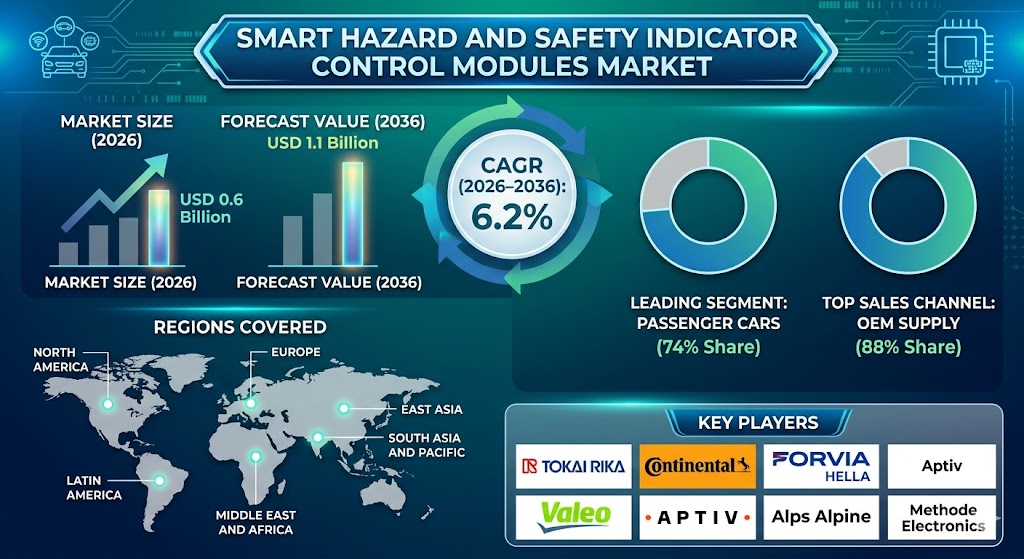
NEWARK, DE / ACCESS Newswire / May 5, 2026 / According to the latest analysis by Future Market Insights, the global Smart Hazard and Safety Indicator Control Modules Market is entering a new phase of value expansion, driven by tightening safety regulations and the rapid evolution of vehicle cockpit electronics. Valued at USD 0.6 billion in 2026, the market is projected to reach USD 1.1 billion by 2036, growing at a CAGR of 6.2% during the forecast period.
According to the latest insights from Future Market Insights (FMI), the market is transitioning from a basic switch assembly segment into a high-value intelligent cockpit electronics domain, where safety signaling, warning systems, and human-machine interface (HMI) integration are becoming mission-critical.
Get detailed market forecasts, competitive benchmarking, and pricing trends:
https://www.futuremarketinsights.com/reports/sample/rep-gb-32959
Quick Facts Snapshot (Featured Snippet Ready)
Market Size (2026): USD 0.6 Billion
Forecast Value (2036): USD 1.1 Billion
CAGR (2026-2036): 6.2%
Leading Segment: Passenger Cars (74% Share)
Top Sales Channel: OEM Supply (88% Share)
Key Growth Driver: Regulatory expansion in vehicle safety systems
Market Momentum: Safety Regulations Reshaping Module Demand
The demand for smart hazard and safety indicator control modules is being strongly influenced by global regulatory mandates and vehicle safety scoring systems.
The U.S. regulatory push-including enhanced rear seat belt reminder requirements-is expanding the functional scope of safety modules.
European safety frameworks and Euro NCAP 2026 assessments are reinforcing the importance of physical controls for essential safety functions, boosting demand for tactile hazard switches.
Rising global vehicle production-reaching 92.5 million units in 2024-continues to expand the addressable market for cockpit-integrated safety modules.
From Switches to Smart Systems: Evolution of Cockpit Safety Modules
The market is no longer limited to basic hazard activation switches. Instead, it now encompasses integrated safety control systems capable of:
Managing seat-belt reminders and passenger alerts
Supporting illuminated tell-tales and warning indicators
Integrating with vehicle body electronics and cockpit controllers
Enabling real-time communication via LIN and CAN networks
This transition aligns with the broader shift toward software-defined vehicles and zonal electronics architectures, where modular, intelligent control hubs are replacing standalone components.
Segment Insights: Passenger Cars and OEM Channels Dominate
Vehicle Type Leadership
Passenger cars are expected to account for 74% of total demand in 2026, supported by:
Higher safety feature penetration
Advanced cockpit electronics integration
Increasing consumer demand for safety and convenience
Interface & Installation Trends
Tactile switch interfaces: 48% share, driven by safety compliance and ease of use
Center stack installation: 57% share, ensuring accessibility and visibility
LIN-based modules: 52% share, favored for cost-effective communication
OEM Supply Dominance
OEM channels will contribute 88% of total sales, reflecting:
Stringent validation requirements
Integration into vehicle production cycles
Long-term supplier partnerships
Access the Complete Report in PDF Format: https://www.futuremarketinsights.com/reports/brochure/rep-gb-32959
Regional Outlook: Asia Leads, Global Markets Follow
High-Growth Regions
China (8.3% CAGR): Dominates due to massive vehicle production and rapid electronics adoption
India (7.9% CAGR): Growth fueled by expanding passenger vehicle manufacturing and feature-rich cabins
Mexico (7.1% CAGR): Benefiting from export-driven automotive assembly
Mature Markets
United States (6.4% CAGR): Growth driven by regulatory upgrades and large vehicle base
Germany (6.2% CAGR): Premium vehicle production and strict safety norms
Japan & South Korea: Stable growth supported by advanced automotive ecosystems
Key Growth Drivers and Opportunities
Primary Drivers
Expansion of seat-belt reminder regulations
Rising focus on driver distraction reduction
Increasing cockpit electronics integration
Growth of vehicle production globally
Emerging Opportunities
Zonal electronics architecture: Enabling compact, multi-function control hubs
Software-linked modules: Enhancing real-time safety intelligence
Premium vehicle content: Driving higher-value module adoption
Challenges: Cost Pressure and Complexity
Despite strong growth, the market faces notable constraints:
Cost sensitivity in entry-level vehicle programs
High validation and compliance requirements
Integration complexity with modern digital cockpit systems
However, suppliers focusing on compact design, durability, and integration efficiency are well-positioned to overcome these barriers.
Competitive Landscape: Specialized, Innovation-Driven Ecosystem
The market is characterized by a specialized supplier base, where success depends on technical capability and OEM alignment rather than scale alone.
Key Players Include:
Tokai Rika
Continental
FORVIA HELLA
Valeo
Aptiv
Alps Alpine
Methode Electronics
Strategic Developments
Expansion of software-defined cockpit capabilities
Investment in advanced electronics and semiconductor solutions
Adoption of innovative lighting and HMI technologies
Buy Report: Unlock 360° insights for strategic decision making and investment planning:
https://www.futuremarketinsights.com/checkout/32959
The Road Ahead: Intelligent Safety Becomes Standard
As vehicles become increasingly digital, smart hazard and safety indicator modules will evolve into intelligent safety command centers within the cockpit.
With regulatory frameworks tightening, consumer expectations rising, and automotive electronics advancing, these modules are set to play a critical role in enhancing vehicle safety, usability, and compliance.
By 2036, the market will not just reflect growth in volume-but a fundamental upgrade in value, intelligence, and integration, making smart safety modules an indispensable component of next-generation mobility.
Related Reports:
Smart HVAC Controls Market- https://www.futuremarketinsights.com/reports/smart-hvac-controls-market
Safety Motion Control System Market- https://www.futuremarketinsights.com/reports/safety-motion-control-system-market
Industrial Control Network Modules Market- https://www.futuremarketinsights.com/reports/industrial-control-network-modules-market
About Future Market Insights (FMI)
Future Market Insights (FMI) is a leading provider of market intelligence and consulting services, serving clients in over 150 countries. Headquartered in Delaware, USA, with a global delivery center in India and offices in the UK and UAE, FMI delivers actionable insights to businesses across industries including automotive, technology, consumer products, manufacturing, energy, and chemicals.
An ESOMAR-certified research organization, FMI provides custom and syndicated market reports and consulting services, supporting both Fortune 1,000 companies and SMEs. Its team of 300+ experienced analysts ensures credible, data-driven insights to help clients navigate global markets and identify growth opportunities.
For Press & Corporate Inquiries
Rahul Singh
AVP - Marketing and Growth Strategy
Future Market Insights, Inc.
+91 8600020075
For Sales - sales@futuremarketinsights.com
For Media - Rahul.singh@futuremarketinsights.com
For web - https://www.futuremarketinsights.com/
SOURCE: Future Market Insights, Inc.
View the original press release on ACCESS Newswire