
The canned wine market is witnessing strong growth driven by premiumization trends, convenient beverage demand, expanding retail distribution, and evolving consumer lifestyles.
NEWARK, DE / ACCESS Newswire / May 25, 2026 / The global canned wine market is entering a high-growth premiumization phase supported by rising demand for convenient alcoholic beverages, changing lifestyle preferences, expanding retail accessibility, and increasing adoption of portable wine formats across social and outdoor consumption occasions.
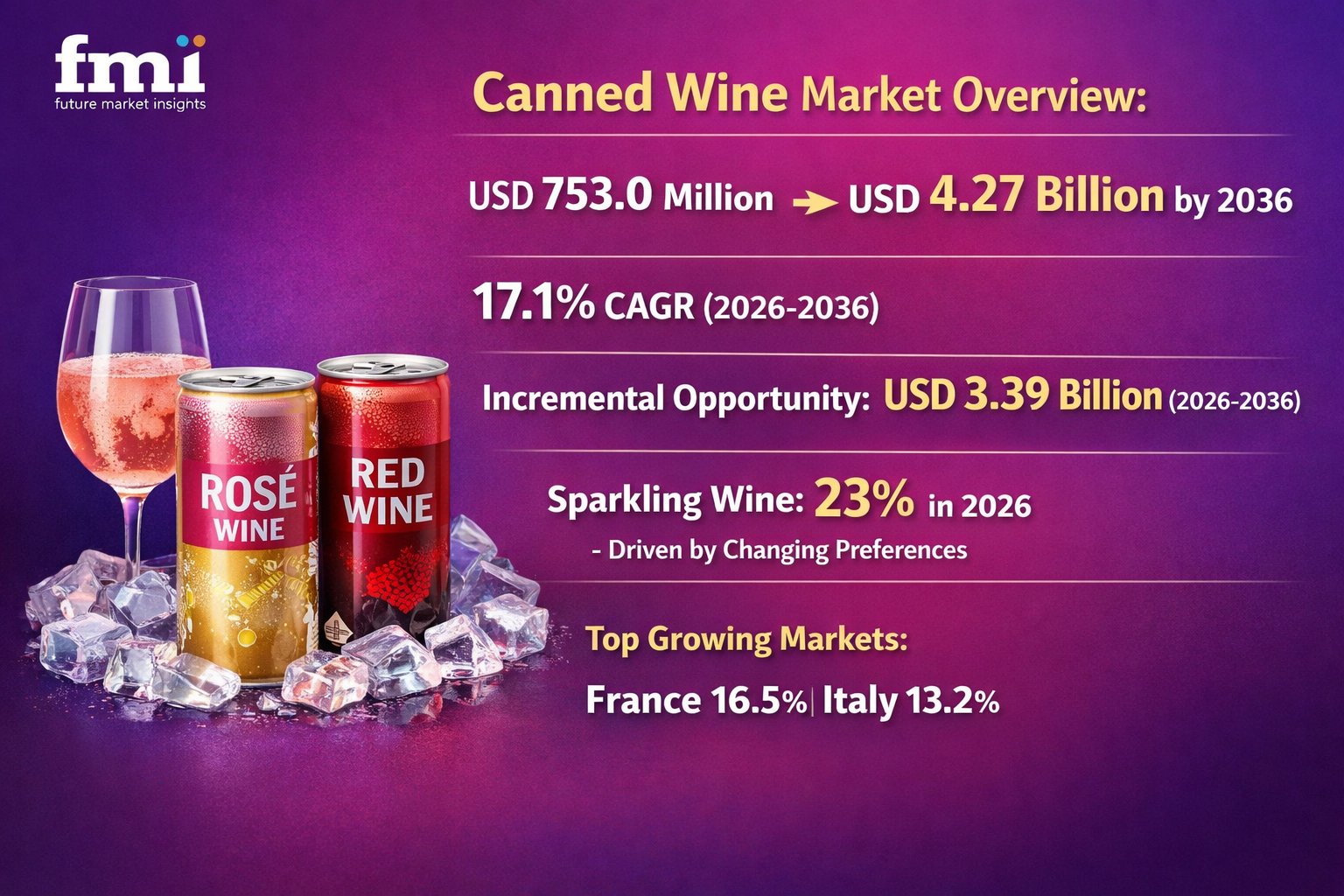
According to the latest market analysis by Future Market Insights, the canned wine market was valued at USD 753.0 million in 2025 and is projected to reach USD 881.8 million by 2026-end. The market is expected to expand at a CAGR of 17.1% between 2026 and 2036, ultimately reaching USD 4,274.8 million by 2036. Sparkling Wine is forecast to dominate the product segment with a 23.0% share, while Hypermarkets/Supermarkets are expected to lead distribution channels with a 44.0% share.
Quick Stats Snapshot
Global market CAGR (2026-2036): 17.1%
Market value (2025): USD 753.0 million
Expected market value (2026): USD 881.8 million
Forecast market value (2036): USD 4,274.8 million
Leading product type: Sparkling Wine (23.0% share)
Leading distribution channel: Hypermarkets/Supermarkets (44.0% share)
Top growth market: France (16.5% CAGR)
Strong growth market: Italy (13.2% CAGR)
Get detailed market forecasts, competitive benchmarking, and pricing trends: https://www.futuremarketinsights.com/reports/sample/rep-gb-18457
Market Outlook: Convenience Consumption and Premium Beverage Trends Support Long-Term Expansion
The canned wine market is evolving from a niche alternative beverage category into a mainstream retail and lifestyle-driven alcoholic beverage segment. Manufacturers, retailers, hospitality operators, and beverage distributors are increasingly focusing on portable packaging, premium product positioning, flavor innovation, and multi-channel distribution strategies to strengthen market penetration.
Demand growth continues to accelerate as consumers seek convenient, single-serve alcoholic beverages suitable for outdoor activities, social gatherings, travel consumption, festivals, and at-home occasions. At the same time, premiumization trends are encouraging brands to introduce organic wines, low-alcohol variants, clean-label formulations, and artisanal product offerings.
The category is increasingly positioned as a strategic growth segment within the broader alcoholic beverage industry, supported by evolving consumer lifestyles, sustainability-focused packaging adoption, and expanding retail shelf visibility.
Growth Drivers: Lifestyle Shifts and Retail Expansion Accelerate Market Growth
Several structural and consumer-driven factors are supporting expansion across global canned wine markets:
1. Changing Consumer Preferences Support Convenient Beverage Formats
Consumers increasingly prefer portable, easy-to-consume alcoholic beverages aligned with modern lifestyles, outdoor activities, and social occasions.
2. Retail Expansion and E-commerce Improve Product Accessibility
Expansion in supermarkets, convenience stores, online alcohol delivery platforms, and direct-to-consumer channels is strengthening product visibility and availability.
3. Premiumization Trends Create High-Value Growth Opportunities
Consumers are increasingly willing to pay premium prices for organic wines, sustainable packaging, low-alcohol formulations, and differentiated flavor profiles.
4. Sustainability and Packaging Innovation Support Adoption
Aluminum can packaging offers portability, recyclability, and convenience advantages, supporting broader consumer acceptance across younger demographics.
Key Challenges: Cost Pressure and Brand Differentiation Remain Critical
Despite strong growth prospects, the industry continues facing several operational and commercial challenges:
Raw material and packaging cost volatility
Intense competition from traditional bottled wine categories
Regulatory complexities across alcoholic beverage markets
Margin pressure from private-label competition
Supply chain disruptions affecting production consistency
Consumer sensitivity toward premium pricing
Companies capable of balancing product differentiation, scalable distribution, sustainable packaging, and brand credibility are expected to strengthen long-term competitive positioning.
Emerging Opportunities: Functional Positioning and Direct-to-Consumer Channels Expand Potential
Key commercial opportunities continue emerging across premium beverage and convenience-oriented consumption segments:
Rising demand for low/no-alcohol canned wine products
Expansion of direct-to-consumer beverage subscriptions
Growth in organic and natural wine categories
Increasing adoption across outdoor recreation and event consumption
Product innovation in flavor combinations and packaging formats
Premium and artisanal canned wine positioning
Customize insights for your business strategy@ https://www.futuremarketinsights.com/customization-available/rep-gb-18457
Segmentation Insights: Sparkling Wine and Hypermarkets Lead Market Demand
By Product Type
Sparkling Wine is projected to account for 23.0% of the product type segment in 2026 as consumers increasingly prioritize refreshing, portable, and occasion-friendly beverage options.
By Distribution Channel
Hypermarkets/Supermarkets are expected to capture 44.0% share in 2026 due to extensive retail reach, strong shelf visibility, and impulse purchasing behavior.
By Packaging Format
Slim cans and standard single-serve formats continue witnessing strong adoption because of portability, convenience, and improved branding flexibility.
By Consumer Type
Millennials and Gen Z consumers remain primary growth drivers due to increasing preference for experiential consumption and alternative alcoholic beverage formats.
Regional Analysis: France and Italy Lead Global Market Expansion
France (16.5% CAGR)
France is expected to remain the leading growth market supported by evolving wine consumption patterns, premium product adoption, and expanding convenience beverage demand.
Italy (13.2% CAGR)
Italy continues witnessing rapid market expansion driven by increasing product innovation, retail infrastructure development, and growing consumer acceptance of canned wine formats.
United Kingdom (11.6% CAGR)
The UK market is benefiting from increasing demand for portable alcoholic beverages, premium ready-to-drink categories, and strong retail penetration.
United States (10.5% CAGR)
The USA market continues expanding due to rising outdoor and lifestyle consumption trends, premiumization, and strong online retail growth.
Australia (7.8% CAGR)
Australia supports stable market expansion through growing event-based consumption, convenience beverage demand, and increasing product accessibility.
Competitive Landscape: Product Innovation and Distribution Reach Shape Market Competition
The canned wine market remains highly competitive, with beverage companies, wineries, and specialty alcohol brands competing across retail, hospitality, online, and direct-to-consumer channels.
Key companies include:
E & J Gallo Winery
Union Wine Company
Integrated Beverage Group LLC
SANS WINE CO
Sula Vineyards Pvt. Ltd.
The Family Coppola
Leading manufacturers continue strengthening market presence through packaging innovation, premium portfolio expansion, strategic retail partnerships, and multi-regional distribution optimization.
Analyst Opinion
Nandini Roy Choudhury observes, "Companies that balance cost competitiveness with credible product differentiation through premium positioning, sustainable packaging, and lifestyle-oriented branding are likely to outperform during the forecast period."
Strategic Implications for Industry Leaders
For beverage manufacturers, retailers, distributors, and hospitality operators, the market presents several strategic priorities:
Sparkling wine remains central to premium canned wine demand
Retail expansion continues strengthening consumer accessibility
Premium and organic positioning support margin expansion
Sustainable packaging is becoming a key competitive differentiator
Direct-to-consumer channels are reshaping sales strategies
Product innovation remains essential for brand differentiation
Supply chain consistency continues influencing profitability
Explore Industry Insights: https://www.futuremarketinsights.com/industry-analysis
Future Outlook: From Niche Beverage Format to Mainstream Lifestyle Category
The canned wine market is expected to evolve beyond a convenience-driven beverage segment into a more premiumized and lifestyle-focused alcoholic beverage ecosystem emphasizing portability, sustainability, flavor innovation, and experiential consumption.
Key trends expected to shape the market include:
Expansion of organic and natural canned wine categories
Rising demand for low-alcohol and functional beverage alternatives
Increased investment in sustainable packaging innovation
Greater adoption of direct-to-consumer sales models
Continued retail shelf expansion across global markets
Premiumization across artisanal and specialty wine categories
Executive Takeaways
Sparkling Wine continues leading global canned wine demand
Hypermarkets/Supermarkets remain dominant retail distribution channels
France and Italy are leading global growth momentum
Premiumization trends are reshaping consumer purchasing behavior
Sustainable packaging innovation supports long-term adoption
Direct-to-consumer and online retail channels are accelerating accessibility
Product differentiation and brand positioning remain central competitive factors
Distribution efficiency and retail partnerships continue shaping market leadership
As global demand for convenient, premium, and sustainable alcoholic beverage formats continues accelerating, companies capable of combining product innovation, scalable distribution, strong retail relationships, sustainable packaging capability, and premium consumer positioning will be best positioned to capitalize on long-term canned wine market growth.
Explore In-Depth Food & Beverages Market Insights: https://www.futuremarketinsights.com/industry-analysis/food-and-beverage
Related Reports:
Wine Market: https://www.futuremarketinsights.com/reports/wine-market
Wine Destemmer Market: https://www.futuremarketinsights.com/reports/wine-destemmer-market
Wine Crusher Market: https://www.futuremarketinsights.com/reports/wine-crusher-market
Canned Alcoholic Beverages Market: https://www.futuremarketinsights.com/reports/canned-alcohol-beverages-market
Canned Soup Market: https://www.futuremarketinsights.com/reports/canned-soup-market
About Future Market Insights (FMI)
Future Market Insights (FMI) is a leading provider of market intelligence and consulting services, serving clients in over 150 countries. Headquartered in Delaware, USA, with a global delivery center in India and offices in the UK and UAE, FMI delivers actionable insights to businesses across industries including automotive, technology, consumer products, manufacturing, energy, and chemicals.
An ESOMAR-certified research organization, FMI provides custom and syndicated market reports and consulting services, supporting both Fortune 1,000 companies and SMEs. Its team of 300+ experienced analysts ensures credible, data-driven insights to help clients navigate global markets and identify growth opportunities.
For Press & Corporate Inquiries
Rahul Singh
AVP - Marketing and Growth Strategy
Future Market Insights, Inc.
+91 8600020075
For Sales - sales@futuremarketinsights.com
For Media - Rahul.singh@futuremarketinsights.com
For web - https://www.futuremarketinsights.com/
For Web : https://www.factmr.com/
SOURCE: Future Market Insights, Inc.
View the original press release on ACCESS Newswire