

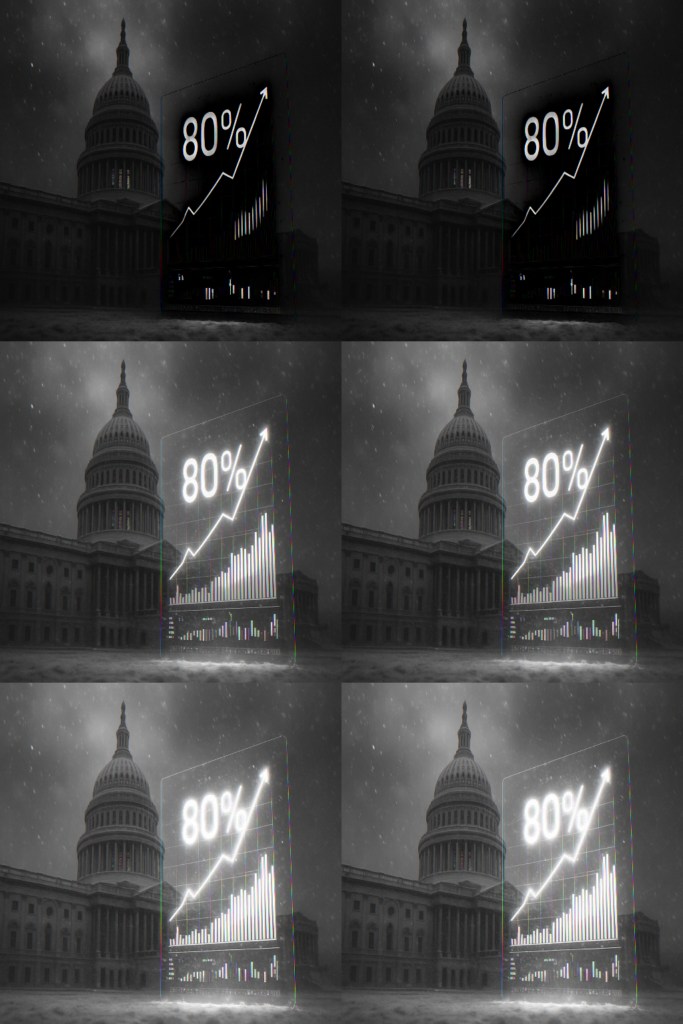
As the clock ticks toward a midnight deadline on January 31, 2026, the traditional halls of power in Washington D.C. are being outpaced by a different kind of authority: the collective intelligence of prediction markets. For weeks, political pundits maintained a cautious optimism that a funding deal would be reached, but the "smart money" has decisively pivoted. On major forecasting platforms, the probability of a federal government shutdown has surged to a staggering 80%, reflecting a bleak reality that many news outlets are only now beginning to acknowledge.
This sudden spike in odds—climbing from a mere 10% just days ago—comes amid a high-stakes standoff over Department of Homeland Security (DHS) funding. With over $17 million already wagered across regulated and decentralized exchanges, the market's conviction is serving as a real-time "truth signal," cutting through the partisan rhetoric to reveal the high likelihood of a significant lapse in federal operations.
The Market: What's Being Predicted
The current volatility is concentrated in two primary venues: Kalshi, a U.S.-regulated prediction market, and Polymarket, a decentralized platform that has seen a massive influx of global capital. On Kalshi, the contract asking "Will the government be shut down on Saturday?" has seen more than 880,000 active positions, with "Yes" shares currently trading at $0.79, implying a 79% probability. Polymarket shows an even higher conviction, with volumes on its shutdown contract crossing the $11 million mark and odds hovering around 80%.
The resolution criteria for these markets are specific: the federal government must experience a funding gap that lasts for at least 24 hours starting at 12:01 a.m. ET on February 1, 2026. While the primary market focuses on the "if," secondary markets are already debating the "how long." On Kalshi, the favored outcome in the "duration" market is currently "7+ days," suggesting that traders expect a protracted battle rather than a brief weekend "glitch."
This level of liquidity—exceeding $17 million in combined volume—is a testament to the maturation of the industry. Large-scale institutional hedging is now visible, as firms look to protect themselves against the "Data Fog" that occurs during a shutdown. When the government closes, agencies like the Bureau of Labor Statistics (BLS) and the Bureau of Economic Analysis (BEA) stop releasing critical economic indicators, such as CPI and employment reports, leaving investors blind.
Why Traders Are Betting
The catalyst for this market panic was a tragic and polarizing event: the fatal shooting of Alex Jeffrey Pretti, a U.S. citizen and nurse, by federal DHS agents during an enforcement operation in Minneapolis on January 24. This incident sparked domestic unrest and triggered an immediate legislative blockade. Senate Minority Leader Chuck Schumer and top Democratic appropriators have vowed to block any spending package that includes DHS funding without "radical" oversight reforms.
Republicans, led by Senate Majority Leader John Thune, have refused to decouple DHS funding from the broader $1.2 trillion appropriations package. The legislative math is currently impossible:
- The Recess Factor: The House of Representatives is currently in recess and not scheduled to return until February, making it nearly impossible to pass a last-minute compromise.
- The "Weather" Variable: A severe winter storm in the D.C. area has already delayed Senate proceedings, further compressing an already tight timeline.
- The Consensus Collapse: On January 23, markets saw only a 9% chance of a shutdown. The 70-point jump in four days represents a "violent repricing" of risk as the gravity of the DHS standoff became clear.
While cable news networks like CNN or Fox Business (operated by Fox Corporation, (NASDAQ: FOXA)) were still reporting on "ongoing negotiations" early this week, prediction markets were already cratering. Traders saw the combination of a House recess and a Senate stalemate as a mathematical dead end, leading to the current high-conviction "Yes" positions.
Broader Context and Implications
The 2026 shutdown market marks a turning point for prediction platforms as a tool for public information. We are seeing what some analysts call the "Financialization of Truth." In an era of deep political polarization and "fake news," prediction markets provide a neutral, incentive-compatible metric. Unlike a pundit who loses nothing by being wrong, a trader on Kalshi or Polymarket loses their principal. This "skin in the game" creates a more reliable forecast than traditional polling or expert analysis.
The real-world implications of an 80% shutdown signal are already being felt in the broader financial markets. Defense contractors such as Lockheed Martin (NYSE: LMT) and Raytheon Technologies (NYSE: RTX) often see short-term stock volatility during funding gaps due to payment delays. Similarly, financial services firms like Interactive Brokers Group, Inc. (NASDAQ: IBKR) are seeing increased activity as retail investors use these prediction markets to hedge their portfolios against a potential market-wide dip.
Regulatory scrutiny is also evolving. The success of Kalshi in operating a regulated U.S. market for such high-stakes political events shows a shifting tide at the Commodity Futures Trading Commission (CFTC). By allowing these markets to function, regulators are implicitly acknowledging their value as an "early warning system" for the economy.
What to Watch Next
Over the next 72 hours, three key milestones will determine if the 80% probability holds or if a "black swan" compromise emerges. First, monitor any emergency "pro forma" sessions in the House. If leadership calls members back to D.C. despite the recess, the "No" shares on Kalshi will likely skyrocket as a deal becomes feasible.
Second, keep an eye on the "Minneapolis Reform Rider." There are whispers of a stripped-down Continuing Resolution (CR) that would fund the government for 14 days while specifically sequestering DHS funds. If this gains traction in the Senate, expect a rapid sell-off in "Yes" shares.
Finally, the weather in the capital remains a literal and figurative cooling factor. If the winter storm prevents a quorum in the Senate on Friday, the shutdown becomes a procedural certainty. Traders are currently monitoring NOAA weather feeds with as much intensity as they are monitoring C-SPAN.
Bottom Line
The 2026 DHS funding standoff has proven that prediction markets are no longer a niche hobby for "crypto bros" or math nerds; they are a vital piece of the global information infrastructure. The 80% probability currently priced into the market is a sobering "truth signal" that a federal shutdown is the most likely path forward.
While politicians continue to trade barbs on social media, the $17 million committed to these markets tells a more honest story: the legislative process has broken down. For the average citizen and the sophisticated investor alike, the lesson is clear: when the rhetoric of Washington clashes with the cold hard cash of the markets, follow the money. As of late January 2026, the money is betting on a very quiet—and very closed—federal government.
This article is for informational purposes only and does not constitute financial or betting advice. Prediction market participation may be subject to legal restrictions in your jurisdiction.
PredictStreet focuses on covering the latest developments in prediction markets. Visit the PredictStreet website at https://www.predictstreet.ai/.