

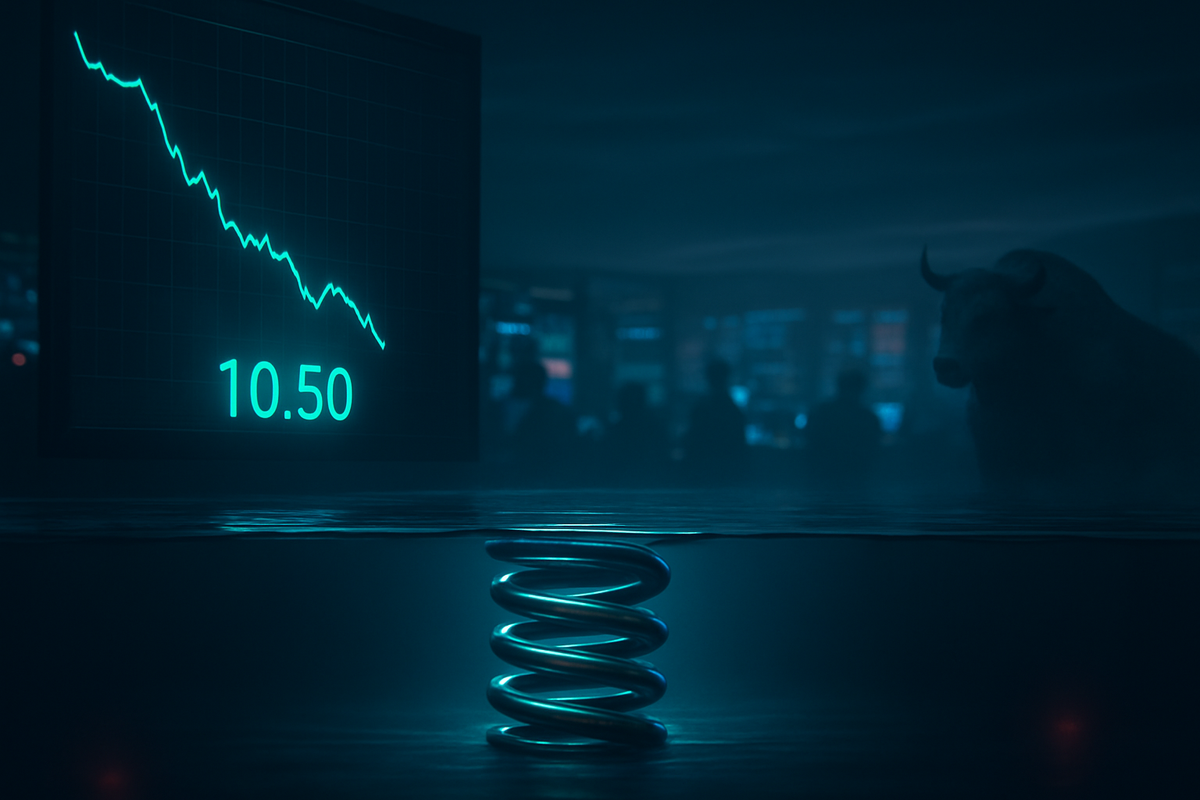
The financial world woke up this morning to a rare and unsettling sight on their monitors: the Cboe Volatility Index, better known as the VIX, has officially dipped below the 11.00 mark. As of April 8, 2026, the market's "fear gauge" is trading in a tight range between 10.20 and 10.80, a level not seen in over seven years. While on the surface this suggests a market characterized by absolute tranquility and confidence, seasoned analysts are beginning to ring the alarm bells, warning that such extreme lows often signal a dangerous level of investor complacency that could precede a sharp market correction.
This descent into sub-11 territory comes amidst a "Goldilocks" economic backdrop where cooling inflation and steady corporate earnings have led many to believe that systemic risk has been effectively managed. However, the cost of portfolio insurance—essentially the price of put options on the S&P 500—has now become so cheap that it suggests a market "pricing in perfection." When the VIX reaches these depths, it no longer measures just stability; it measures the absence of protection, leaving the broader equity markets vulnerable to sudden "black swan" events that could trigger a violent reversal.
The Long Road to Absolute Quiet
The path to today’s multi-year low has been a steady grind downward that began in the latter half of 2025. After the volatility spikes of the early 2020s, driven by post-pandemic inflation and shifting interest rate regimes, the market entered a period of remarkable stasis. Throughout the first quarter of 2026, realized volatility remained consistently low, emboldening institutional "vol-sellers" to aggressively short the VIX as a way to harvest yield in a low-yield environment. This mechanical selling of volatility has created a self-reinforcing loop, pushing the index lower and lower.
The key players in this narrative are not just the retail traders, but massive systematic funds and "yield-enhancement" desks at major investment banks. By selling call and put options to collect premiums, these institutions have effectively acted as a ceiling on market movement. The timeline leading up to this morning’s sub-11 print shows a steady erosion of the VIX from the mid-15s in late 2025 to the current 10.50 level. Initial market reactions today have been a mixture of quiet celebration among bulls and intense scrutiny from risk managers at firms like Goldman Sachs (NYSE: GS) and Morgan Stanley (NYSE: MS), who are now questioning if the market is "coiling" for a massive breakout.
Winners and Losers in the Low-Vol Regime
In an environment where volatility is practically non-existent, the winners and losers are clearly defined by their relationship to the VIX. Cboe Global Markets (BATS:CBOE), the exchange that owns and calculates the VIX, finds itself in a complex position. While low volatility can sometimes suppress the demand for traditional hedging, Cboe has seen a massive surge in "Zero Days to Expiration" (0DTE) options trading. These ultra-short-term contracts have become the new frontier for speculators, allowing Cboe to maintain high transaction volumes even as the "spot" VIX remains suppressed.
On the product side, the ProShares Short VIX Short-Term Futures ETF (BATS:SVXY) has been a primary beneficiary of the current trend. Because the VIX futures curve is currently in a state of "contango"—where long-term futures are more expensive than the current spot price—SVXY gains value every day through "roll yield." However, at these historic lows, the upside for SVXY is mathematically limited, while the downside risk of a sudden spike is catastrophic. Conversely, the ProShares VIX Short-Term Futures ETF (BATS:VIXY) has been a significant loser, with its shares suffering from constant "time decay" as it pays a premium to maintain long exposure to a volatility index that refuses to move. For investors, VIXY has become a very cheap, but very expensive-to-hold, lottery ticket against a market crash.
The Danger of the "Coiled Spring"
The broader significance of a sub-11 VIX cannot be overstated, as it historically serves as a "coiled spring" for the financial markets. The last time the VIX spent significant time at these levels was in 2017, a period that famously ended in the "Volmageddon" event of February 2018. During that crisis, the VIX doubled in a single day, causing the total collapse of several inverse-volatility products and triggering a rapid 10% correction in the S&P 500. Analysts fear that the proliferation of 0DTE options in 2026 has made the market even more fragile than it was in 2018.
This trend fits into a wider industry shift toward "volatility suppression" strategies. When volatility is low, many risk-parity funds—which adjust their exposure based on market swings—are forced to increase their leverage to maintain their target risk profiles. This means that if the VIX were to suddenly jump from 10 to 20, these funds would be forced to sell hundreds of billions of dollars in equities simultaneously to de-lever. This mechanical selling creates a "feedback loop" where higher volatility leads to more selling, which in turn drives volatility even higher, potentially turning a minor news event into a major systemic shock.
What Comes Next: The Roadmap for a Volatility Shock
In the short term, the market may continue to drift higher or sideways as the momentum of the "low-vol" regime carries it forward. However, the long-term outlook suggests that a strategic pivot is becoming necessary for most diversified portfolios. We are likely entering a phase where the "cost of protection" is at its absolute floor, providing a rare window for investors to buy long-term hedges at generational lows. The market opportunity here is not in chasing the rally, but in preparing for the inevitable "mean reversion" of the VIX toward its long-term average of 18-20.
The most likely scenario for the remainder of 2026 is a "volatility shock" triggered by an exogenous factor—perhaps a geopolitical shift or a surprise central bank move—that catches the over-leveraged "short-vol" community off guard. If the VIX breaks back above 15 with momentum, it could trigger a series of forced liquidations. Investors should be watching for any signs of "widening spreads" in the options market or a sudden increase in the "VIVIX" (the volatility of the VIX), which often serves as a leading indicator that the quiet period is about to end.
Conclusion: Pricing in Perfection
The drop of the VIX below 11 is a milestone that demands respect and caution. While it reflects a period of undeniable economic stability and corporate strength, it also highlights a dangerous lack of fear among market participants. The key takeaway for investors is that while the market looks healthy on the surface, the underlying plumbing—governed by volatility-linked strategies and automated hedging—is currently under immense pressure from the "coiled spring" effect.
Moving forward, the market's resilience will be tested. A healthy correction of 5-10% would actually be a positive development at this stage, as it would "reset" the VIX to more sustainable levels and shake out the excessive complacency. Investors should keep a close eye on the Cboe Global Markets (BATS:CBOE) data and the performance of volatility-linked ETPs like SVXY and VIXY in the coming months. In the world of finance, the greatest risks are often the ones that no one is willing to pay to insure against—and right now, the market is telling us that "risk" has never been cheaper.
This content is intended for informational purposes only and is not financial advice