
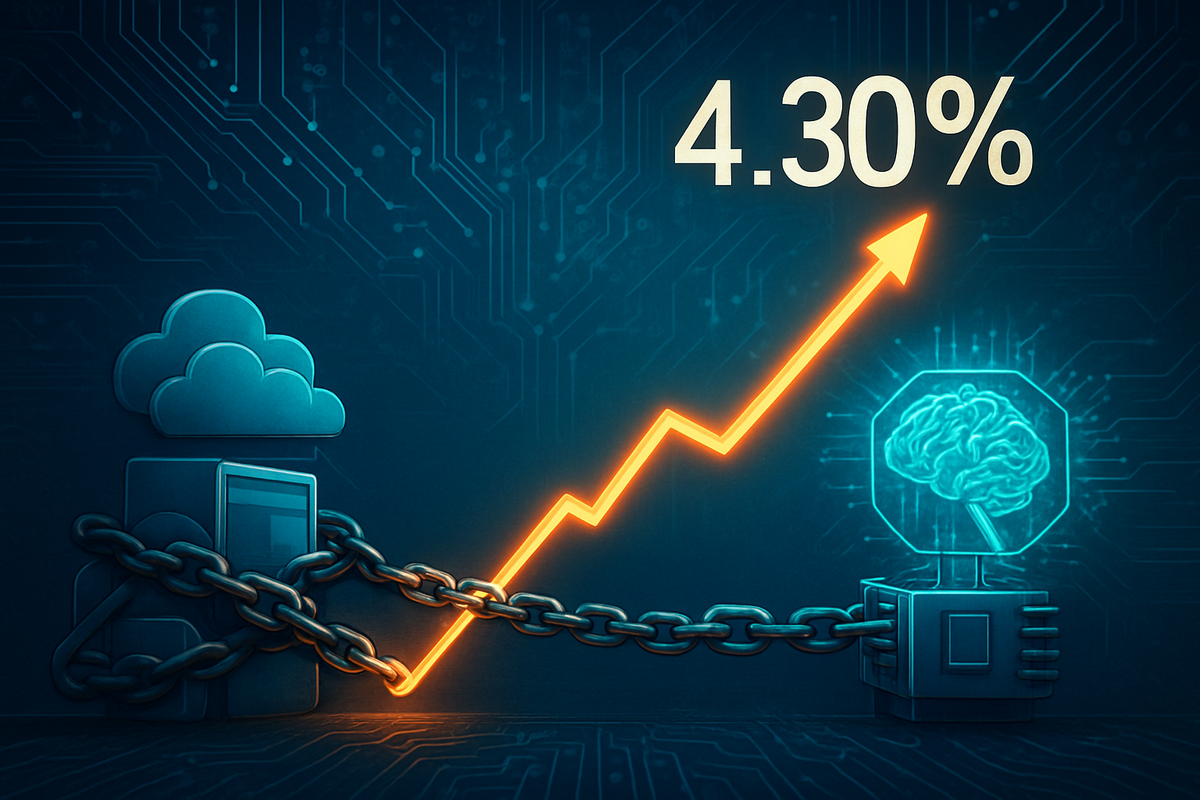
The financial markets were jolted this week as the 10-year Treasury yield surged to 4.30%, marking a significant multi-month high that has forced investors to recalibrate their expectations for the remainder of 2026. This breach of the 4.30% threshold—a level many analysts had labeled a critical technical and psychological barrier—immediately triggered a wave of selling across the tech-heavy Nasdaq-100 (NASDAQ: QQQ), as the "risk-free rate" of return began to look increasingly attractive relative to the high-multiple valuations of the technology sector.
The sudden ascent in yields represents a direct challenge to the "AI productivity" thesis that has buoyed equity markets through much of the early 2020s. While investors have largely been willing to overlook high interest rates in favor of the transformative potential of artificial intelligence, the return of the 10-year yield to levels not seen consistently since the volatile periods of 2024 is forcing a "duration check" on growth-oriented portfolios. As the cost of capital climbs, the market is beginning to demand more than just promises of future efficiency; it is looking for tangible margin expansion that can outpace the rising discount rate.
The Path to 4.30%: A Perfect Storm of Economic Resilience
The journey to 4.30% was not an overnight phenomenon but the culmination of several weeks of stronger-than-expected economic data that has kept the Federal Reserve in a "higher-for-longer" defensive stance. Throughout March 2026, a series of robust labor reports and stickier-than-anticipated inflation figures effectively extinguished the market's hopes for an early-summer rate cut. The bond market, often described as the "smart money" of the financial world, began pricing in a more hawkish path for the central bank, pushing the 10-year yield from its January lows of 3.85% to its current peak.
Key stakeholders, from institutional asset managers to sovereign wealth funds, have been closely watching the 4.30% mark. Historically, this level has served as a "danger zone" where the cost of borrowing begins to meaningfully erode the profitability of small-to-mid-cap firms that lack the massive cash reserves of their larger peers. The initial market reaction was swift, with the Invesco QQQ Trust (NASDAQ: QQQ) sliding 2.4% in the sessions following the yield spike, as traders pivoted away from "long duration" assets—companies whose cash flows are expected to arrive far into the future.
This move mirrors the yield volatility witnessed in April 2024, when a similar surge to 4.30% triggered a significant monthly drawdown for the S&P 500. However, the 2026 version of this narrative is more complex. While 2024 was defined by the anticipation of AI gains, 2026 is defined by the implementation. Investors are no longer buying the hype; they are scrutinizing the return on investment (ROI) for massive capital expenditures in data centers and specialized hardware.
The Great Divide: AI Titans vs. Long-Duration Laggards
The impact of the 4.30% yield has created a stark bifurcation in the market, separating the "AI Quality" leaders from the "High-Multiple" growth stocks that are more sensitive to interest rate fluctuations.
The Relative Winners:
- NVIDIA (NASDAQ: NVDA): As the primary architect of the AI era, Nvidia remains a "valuation outlier." Despite the higher yields, Nvidia’s triple-digit revenue growth and dominant market share in the Blackwell and Hopper GPU architectures allow it to maintain investor interest. For Nvidia, the earnings growth is simply faster than the discount rate compression, making it a "yield-resistant" play for many.
- Microsoft (NASDAQ: MSFT): With its fortress balance sheet and successful monetization of Copilot and Azure AI, Microsoft is viewed as a "safe haven" in the tech space. Its ability to self-fund tens of billions in capital expenditures without relying on high-cost debt markets gives it a significant advantage over smaller rivals.
- Alphabet (NASDAQ: GOOGL): Having introduced dividends and aggressive share buybacks in previous years, Alphabet has transitioned into a "quality growth" stock. Its cash-flow generation provides a buffer against rising yields that less mature tech firms do not possess.
The Strategic Losers:
- Snowflake (NYSE: SNOW) and ServiceNow (NYSE: NOW): These cloud software giants represent "long duration" assets par excellence. Because much of their projected value is tied to cash flows five to ten years out, a higher 10-year yield drastically reduces their present value in Discounted Cash Flow (DCF) models. Both stocks have seen double-digit corrections as yields climbed toward 4.30%.
- Tesla (NASDAQ: TSLA): Tesla remains caught in a difficult pincer movement. Higher yields make auto loans more expensive for consumers, dampening demand, while its "AI-first" narrative (Robotaxis and Optimus) is viewed as a very long-term bet that many investors are less willing to finance in a 4.30%+ environment.
- Small-Cap Growth (NYSEARCA: IWM): The iShares Russell 2000 ETF has been one of the hardest-hit segments. Many of these companies are not yet profitable and rely on floating-rate debt or frequent equity raises, both of which become more painful as the 10-year Treasury yield rises.
Analyzing the Significance: Is AI the Antidote to Higher Rates?
The broader significance of the current yield spike lies in the ongoing debate over whether AI-driven productivity can justify higher nominal interest rates. Economists at firms like Goldman Sachs and J.P. Morgan have suggested that AI could boost global GDP by as much as 1.5% annually over the next decade. If AI makes the economy more efficient, it could theoretically support a "No Landing" scenario where growth remains high even if the Fed keeps rates elevated.
This creates a "supply-side" shock logic: if AI allows a company to produce more goods or services with 20% less labor (as some early 2025 case studies have shown), then that company can afford to pay higher interest on its debt because its operating margins are fundamentally higher. However, the risk is that the transition to an AI-efficient economy takes years, while the impact of 4.30% yields on corporate debt refinancing is immediate.
We are currently seeing a historical parallel to the late 1990s, where high interest rates and massive technology investment co-existed for several years. The difference today is the sheer scale of the investment. Companies like Meta Platforms (NASDAQ: META) and Amazon (NASDAQ: AMZN) are spending record amounts on infrastructure, betting that the productivity gains will eventually allow them to "grow into" their valuations, regardless of what the bond market says.
The Road Ahead: Scenarios for the Second Half of 2026
In the short term, the market will be hyper-focused on the 4.50% level for the 10-year yield. If yields continue to climb past this point, we could see a more systemic "de-risking" event where even the AI leaders face a valuation reset. Companies will likely respond by doubling down on "efficiency" narratives, potentially leading to further corporate restructuring and a pivot toward AI-enabled cost-cutting rather than just AI-enabled growth.
The strategic pivot required for most firms will involve a move toward "capital discipline." In a 2% yield world, growth is the only metric that matters. In a 4.30% yield world, profitable growth becomes the mandate. We should expect more tech companies to follow the lead of Alphabet and Meta by initiating or increasing dividends to attract a broader base of "value-oriented" investors who are currently being tempted by the 4.3% "risk-free" return of government bonds.
Market Wrap-Up: Watch the Margins, Not the Tickers
As we move forward in 2026, the key takeaway for investors is that the "AI Free Pass" is expiring. While the transformative potential of artificial intelligence remains the dominant secular theme, it no longer exists in a vacuum. The 10-year yield hitting 4.30% is a reminder that macroeconomics still dictates the "hurdle rate" for every investment.
The market is currently in a "show me" phase. Investors should watch for the upcoming quarterly earnings reports from firms like Palantir Technologies (NYSE: PLTR) and Salesforce (NYSE: CRM) to see if their AI integration is actually translating into higher revenue per employee and improved operating margins.
Moving forward, the primary metric to watch will not be the Federal Reserve's dot plot, but rather the spread between corporate earnings growth and the 10-year yield. If AI can deliver the promised productivity boom, 4.30% will eventually be seen as a manageable cost of doing business. If not, the current yield spike may be the beginning of a much-needed valuation reset for the technology sector.
This content is intended for informational purposes only and is not financial advice.