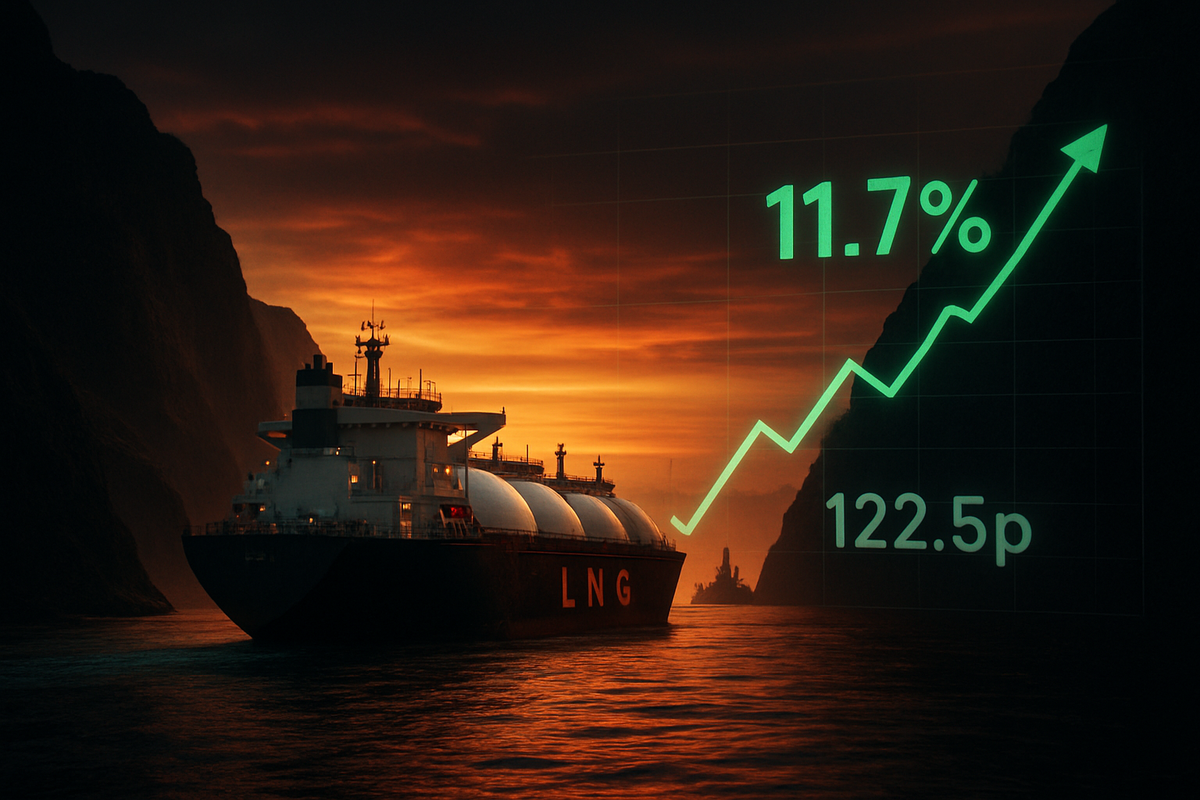
LONDON — In a dramatic escalation of global energy concerns, British wholesale natural gas prices surged by 11.7% on Monday, April 13, 2026, as the threat of a blockade in the Strait of Hormuz sent shockwaves through European trading floors. The front-month May contract for the UK’s National Balancing Point (NBP) climbed to 122.5 pence per therm, its highest level in over eighteen months, reflecting a market gripped by the fear of a total cessation of Qatari Liquefied Natural Gas (LNG) deliveries.
The spike underscores a growing rift in the global energy landscape. While European and Asian markets are reeling from the geopolitical volatility in the Middle East, the United States remains largely shielded. US natural gas futures at the Henry Hub continue to trade at a relatively stable $2.70 per MMBtu, bolstered by record-breaking domestic production and storage levels that sit nearly 20% above the five-year average. This divergence highlights the "energy fortress" status of North America compared to the supply-sensitive pipelines and shipping lanes of the Old World.
Market Turmoil as a Strategic Chokepoint Looms
The current crisis was precipitated by a series of aggressive maneuvers in the Persian Gulf over the weekend. Following heightened regional tensions, local naval forces issued a formal warning that the 21-mile-wide Strait of Hormuz—the primary artery for one-sixth of the world’s LNG supply—could be closed to international shipping "indefinitely." By Monday morning, traders at major European hubs like the Dutch TTF and the British NBP began pricing in a worst-case scenario where Qatar, the world’s largest exporter of LNG through the Strait, is effectively cut off from its Western customers.
The timeline of this surge has been rapid. Just two weeks ago, gas prices were trending downward as Europe exited a milder-than-expected winter with high storage inventories. However, the sudden shift from diplomatic posturing to military threats has forced a massive liquidation of short positions. Key stakeholders, including National Grid (NYSE: NGG) and major utility providers across the UK, are now scrambling to secure alternative supplies, though the lack of pipeline flexibility makes immediate replacement nearly impossible.
Initial market reactions have been characterized by extreme volatility. In London, the price for the May contract opened at 110p/therm before a wave of panic buying pushed it past the 120p resistance level within the first three hours of trading. Analysts note that while the UK has significant regasification infrastructure, it lacks the deep geological storage capacity of its continental neighbors, making it uniquely vulnerable to immediate supply shocks in the maritime LNG trade.
Corporate Impact: Winners and Losers in the Energy Shift
The surge in prices is creating a stark divide between energy producers and industrial consumers. Major integrated oil and gas companies with significant LNG portfolios, such as Shell (NYSE: SHEL) and BP (NYSE: BP), are poised to see a significant boost in margins for their non-Middle Eastern assets. These companies have spent years diversifying their supply chains, and their "flexible" cargoes—those not tied to specific long-term destination contracts—are now being diverted to the highest bidder in the UK and Northern Europe at massive premiums.
Conversely, US-based exporters like Cheniere Energy (NYSE: LNG) and Chevron (NYSE: CVX) are finding themselves in an enviable position. With Henry Hub prices remaining low due to an oversupply in the Permian Basin, the "arbitrage window"—the profit made by buying gas in the US and selling it in Europe—has blown wide open. Cheniere, as the largest US exporter of LNG, is expected to maximize its liquefaction capacity to fill the void left by the potential absence of Qatari volumes, potentially leading to record quarterly earnings if the blockade persists.
On the losing side of this equation are the heavy industrial users and domestic energy suppliers. Companies like Centrica (LON:CNA), the owner of British Gas, face the daunting task of navigating extreme wholesale volatility while being limited by retail price caps. Furthermore, energy-intensive sectors such as chemical manufacturing and steel production in the UK are warning of potential "demand destruction." If prices remain above 120p/therm, several large-scale industrial plants may be forced to curtail operations, leading to broader economic slowdowns and potential layoffs.
Geopolitical Fragility and the New Energy Order
This event fits into a broader trend of "energy regionalism" that has accelerated since the 2022 invasion of Ukraine. As Europe successfully pivoted away from Russian pipeline gas, it inadvertently traded one form of dependency for another: a reliance on the global LNG sea lanes. This latest crisis proves that the maritime "pipelines" of the 21st century are just as susceptible to geopolitical interference as the physical pipes of the 20th century. The 11.7% spike is a stark reminder of the "fragility premium" that now defines European energy security.
The ripple effects are already being felt in Asia, where major importers like Japan and South Korea are competing for the same "swing" cargoes from West Africa and the United States. This competition is creating a global bidding war that threatens to trigger "fossilflation"—a phenomenon where energy-driven inflation undermines central bank efforts to stabilize prices. Regulators in the European Union are already discussing the reactivation of emergency "solidarity mechanisms" to share gas supplies among member states, a move that could lead to mandatory consumption cuts if the Strait remains closed for more than 30 days.
Historically, the Strait of Hormuz has been the "mother of all chokepoints" for oil, but its role in the gas market is now arguably more critical. Unlike oil, which can be rerouted through pipelines in Saudi Arabia or the UAE, there is virtually no bypass capacity for LNG. This makes the current threat an existential one for the global gas trade, echoing the supply shocks of the 1970s but with the added complexity of a hyper-connected, just-in-time delivery system.
The Path Forward: Strategic Pivots and Scenarios
In the short term, the market will likely remain in a state of "backwardation," where current prices are significantly higher than future prices, reflecting the immediate fear of a supply vacuum. If the blockade threat is neutralized through diplomatic channels in the coming weeks, prices could collapse just as quickly as they rose. However, the psychological damage to the market is already done. Strategic planners at companies like ExxonMobil (NYSE: XOM) are likely to accelerate investments in "Atlantic Basin" projects that bypass Middle Eastern chokepoints entirely.
A more dire scenario involves a prolonged closure. This would necessitate a massive strategic pivot for the UK government, potentially involving the reopening of mothballed coal plants or the implementation of emergency rationing for non-essential industries. Market opportunities may emerge in the renewable energy sector and long-duration energy storage, as the volatility of natural gas reinforces the argument for energy independence through domestic green power.
Closing the Loop: What Investors Should Watch
The 11.7% surge in British gas prices is more than just a daily market fluctuation; it is a signal of the inherent risks in the modern energy transition. While the United States remains an island of stability with its $2.70/MMBtu gas, the rest of the world is finding that the path to a post-Russian energy world is fraught with new geographic and geopolitical risks. The "Hormuz Premium" is now a permanent fixture of the global gas market.
Moving forward, investors should keep a close eye on shipping data from the Persian Gulf and the "spread" between US and European gas benchmarks. Any sign of a permanent naval presence or a diplomatic breakthrough will be the primary catalysts for price movements in the months ahead. Additionally, the earnings reports from major LNG players in the coming quarter will provide a clear picture of who successfully navigated this volatility and who was caught in the crossfire of the Hormuz blockade threat.
This content is intended for informational purposes only and is not financial advice.