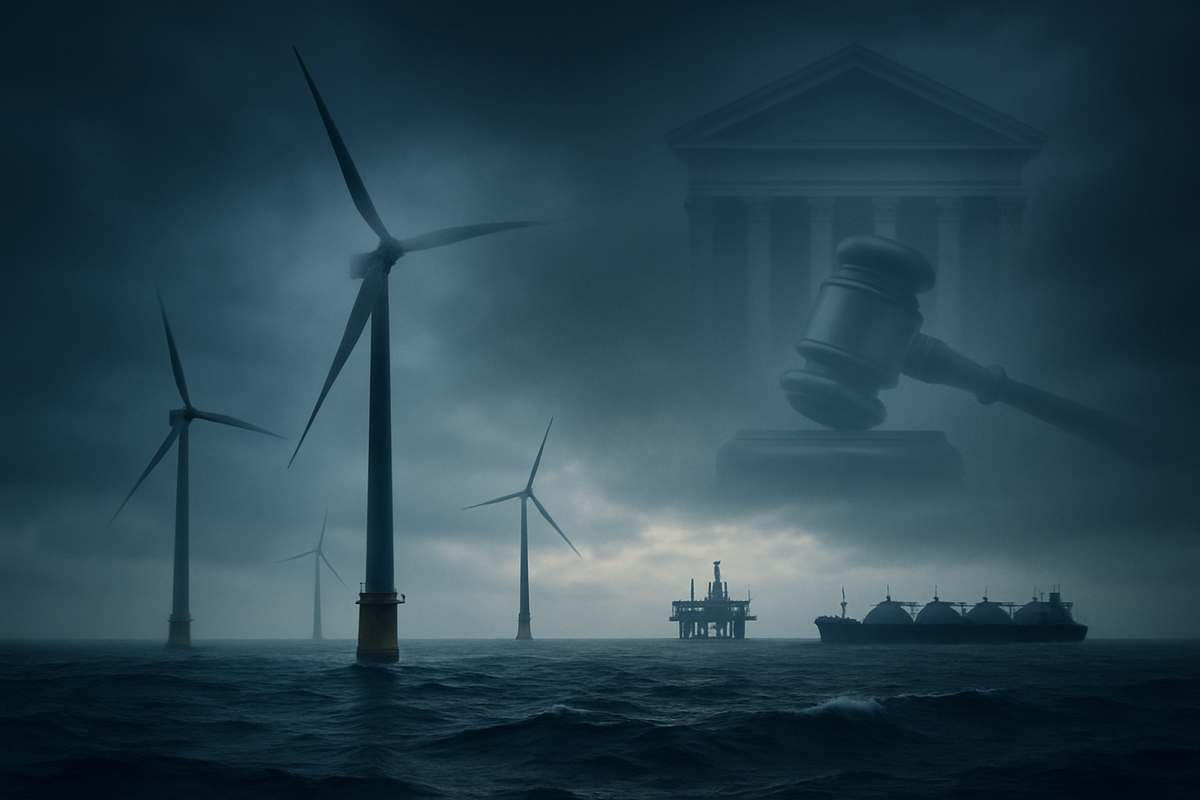
In a dramatic escalation of the "Energy Dominance 2.0" agenda, the Trump administration’s December 2025 decision to suspend major offshore wind leases has run into a formidable wall: the U.S. federal court system. As of March 9, 2026, work has resumed on several multi-billion dollar projects, including those led by Ørsted (CPH:ORSTED), after judges issued preliminary injunctions against the Department of the Interior’s sweeping stop-work orders. The administration had justified the suspension of five massive East Coast projects by citing classified "national security" reports concerning radar interference and potential drone vulnerabilities, a move that sent shockwaves through the renewable energy sector and global capital markets.
The immediate implications of this standoff extend far beyond the coast of Rhode Island. While the judicial reprieve offers temporary stability for developers like Ørsted and their partner Skyborn Renewables, the broader regulatory landscape has been fundamentally altered. The administration’s aggressive pivot toward fossil fuels—codified in the "One Big Beautiful Bill Act" (OBBBA) of 2025—has created a bifurcated energy market. Traditional oil and gas majors are enjoying a renaissance of deregulation and expanded leasing, while clean energy firms are forced to navigate a hostile federal environment, relying on state-level support and the courts to protect their investments.
The December Freeze: A "National Security" Pretext?
The current crisis traces back to December 22, 2025, when Secretary of the Interior Doug Burgum announced a 90-day blanket suspension of all active offshore wind construction on the Outer Continental Shelf. The primary target was the Revolution Wind project, a 704-megawatt development off the coast of Rhode Island and Connecticut, which was nearly 90% complete at the time. The administration’s justification centered on a newly formed Department of War (formerly the Department of Defense) assessment, which claimed that the height and density of modern turbines created "blind spots" in regional radar systems. President Trump publicly reinforced this stance, characterizing the projects as "bird-killing machines" and a "scam" that compromised the nation's ability to detect aerial threats.
This was not the administration's first attempt to stall the industry. Following the January 20, 2025, inauguration, the Bureau of Ocean Energy Management (BOEM) initiated a "comprehensive assessment" of all existing leases, effectively pausing new permits. However, the December stop-work order was unprecedented in its scope, affecting not only Revolution Wind but also Sunrise Wind, Vineyard Wind 1, and Coastal Virginia Offshore Wind, a project owned by Dominion Energy (NYSE: D). The move triggered a 15% drop in Ørsted’s share price within 48 hours and forced the company to absorb nearly $90 million in impairment charges as construction vessels sat idle in the Atlantic.
The legal counteroffensive was swift. In late January 2026, federal judges, including Judge Royce Lamberth, granted preliminary injunctions to the developers. The court ruled that the administration’s "national security" claims were "arbitrary and capricious," noting that the government failed to provide concrete evidence that the risks outweighed the "irreparable economic harm" caused by halting projects so close to completion. By early March 2026, Revolution Wind was back under construction, with a revised commercial operation date set for the second half of the year, though the threat of further federal interference looms over the industry.
Market Winners and Losers in the "Energy Dominance" Era
The shift in U.S. energy policy has created a stark divide in the financial performance of energy companies. The clear winners have been the "Big Oil" giants, such as ExxonMobil (NYSE: XOM) and Chevron (NYSE: CVX), which have benefited from a 55% increase in drilling permits on federal lands over the past year. The OBBBA legislation also slashed federal royalty rates for onshore drilling to 12.5%, a move that has helped these companies reach record production levels. Furthermore, the administration’s immediate lifting of the pause on Liquefied Natural Gas (LNG) export permits has been a massive boon for Cheniere Energy (NYSE: LNG) and Sempra (NYSE: SRE), as the U.S. cements its position as a global energy superpower.
Conversely, the renewable sector has faced "policy whiplash." Solar manufacturers like First Solar (NASDAQ: FSLR) and inverter specialists like Enphase Energy (NASDAQ: ENPH) saw their valuations tumble after the repeal of several Inflation Reduction Act (IRA) tax credits in mid-2025. Offshore wind developers like Equinor (NYSE: EQNR) and Eversource Energy (NYSE: ES) are now pricing in a "Trump Premium"—a higher cost of capital necessitated by the risk of sudden federal intervention. Even companies with diversified portfolios, such as Dominion Energy, find themselves in a complex position: winning through their nuclear and data center power businesses while losing momentum on their green energy transition goals.
Interestingly, a new class of winners has emerged from the administration’s focus on "firm, baseload" power for the AI boom. Bloom Energy (NYSE: BE) has seen its stock soar as its natural gas fuel cells have become the go-to solution for tech giants looking to bypass the aging electrical grid. Under the "Ratepayer Protection Pledge" of March 2026, major technology companies have agreed to fund their own power infrastructure, creating a massive private market for industrial-scale energy solutions that favor reliability over carbon neutrality. Similarly, Cameco (NYSE: CCJ) has thrived as the administration funnels billions into domestic uranium enrichment and the development of Small Modular Reactors (SMRs).
A Broader Shift: Dismantling the Green Transition
The suspension of Ørsted’s projects is not an isolated event but a tactical maneuver in a broader strategy to dismantle the Biden-era focus on decarbonization. The "One Big Beautiful Bill Act" of 2025 represents the most significant shift in American energy law in decades. By sunsetting green energy subsidies and redirecting those funds toward fossil fuel infrastructure and "Clean Coal" initiatives, the administration is betting that low energy prices and "American-made" fossil fuels will drive superior economic growth. This "Energy Dominance 2.0" philosophy views climate policy as a secondary concern to national security and industrial output.
This shift mirrors historical precedents where energy policy was used as a geopolitical tool. By opening the Arctic National Wildlife Refuge (ANWR) and rescinding protections for millions of acres of offshore waters, the administration is seeking to leverage domestic production as a bargaining chip in international trade. However, the move has created a significant rift between the federal government and coastal states like Rhode Island, Massachusetts, and New York. These states remain committed to their own climate mandates, leading to a "state-versus-federal" regulatory war that creates immense uncertainty for long-term infrastructure projects.
The regulatory landscape for offshore wind has been effectively weaponized. The BOEM, once an agency focused on facilitating lease auctions, has been repurposed as an enforcement arm to review the environmental and security impacts of "legacy" projects. While the courts have checked this power in the short term, the administration’s ability to slow-walk future permits and environmental impact statements remains a potent tool. The "national security" hook, even if temporarily blunted by the judiciary, provides a recurring template for the executive branch to challenge any project that does not align with the current administration's ideological goals.
The Road Ahead: Strategic Pivots and Legal Battlefronts
In the short term, offshore wind developers are likely to adopt a "defensive construction" strategy—accelerating work on projects with existing permits to reach completion before the next regulatory hurdle. For Ørsted and its peers, the focus will be on the second half of 2026, when Revolution Wind and Sunrise Wind are scheduled to begin delivering power. However, the appetite for new offshore wind investments in U.S. waters has cooled significantly. International developers may pivot their capital toward European or Asian markets where policy environments are more predictable, potentially leading to a "lost decade" for American offshore wind.
Market opportunities are emerging in the "resiliency" and "firming" sectors. As the administration pushes for nuclear and coal-fired power to support AI data centers, investors are looking closely at companies that can bridge the gap between traditional power and high-demand tech infrastructure. We may see a wave of consolidation as struggling renewable firms are acquired by larger industrial conglomerates or private equity groups that have the legal resources to fight federal mandates. The "Ratepayer Protection Pledge" also suggests a future where the private sector, rather than the government, becomes the primary driver of energy innovation, albeit with a focus on gas and nuclear over wind and solar.
The long-term scenario remains a battle of attrition in the courts. If the administration continues to challenge the legality of state-level power purchase agreements or seeks to further modify the OBBBA, the energy market will remain volatile. Investors should watch for the upcoming Supreme Court term, which is expected to take up several cases regarding the "Major Questions Doctrine" as it applies to the Department of the Interior’s authority to suspend existing leases. A definitive ruling could either permanently cripple federal oversight of renewable projects or give the administration a green light to continue its "Energy Dominance" agenda.
Conclusion: A Market in Flux
The Trump administration’s suspension of Ørsted’s leases marks a turning point in the U.S. energy transition. While the courts have provided a temporary reprieve for projects like Revolution Wind, the event has signaled a definitive end to the era of guaranteed federal support for clean energy. The broader shift toward fossil fuels, nuclear power, and "AI-first" energy solutions has created a new set of market leaders while leaving the renewable sector in a state of high-stakes litigation and financial uncertainty. The "Energy Dominance" agenda is no longer just a campaign slogan; it is a lived reality for the American power grid.
As we move into the second half of 2026, investors must keep a close eye on two fronts: the operational progress of the "Big Five" offshore wind projects and the ongoing legislative efforts to finalize the dismantling of the IRA. The resilience of Ørsted and its peers will depend entirely on their ability to navigate a hostile federal bureaucracy while maintaining the support of state governments. The lasting impact of this period will likely be a more fragmented and politically sensitive energy market, where policy risk is just as important as geological or technological viability.
This content is intended for informational purposes only and is not financial advice.