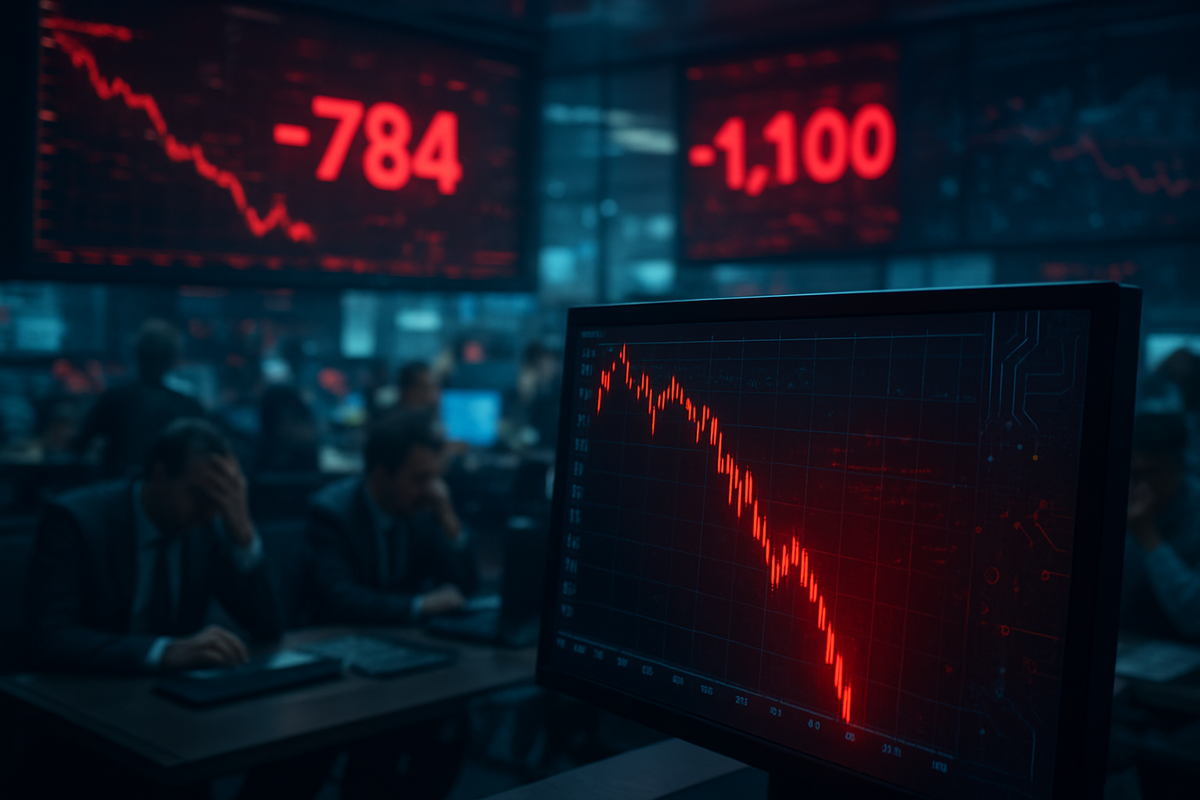
NEW YORK — The Dow Jones Industrial Average (DJIA) endured one of its most turbulent sessions in recent memory on Thursday, March 5, 2026, closing down 784 points after a day defined by extreme intraday volatility. At its lowest point during the late morning session, the blue-chip index had plummeted more than 1,100 points, sparking fears of a systemic "flash crash" before a modest afternoon recovery pared the steepest losses.
The sell-off was ignited by a "perfect storm" of economic pressures: a hotter-than-expected private payrolls report released on Wednesday, a sudden spike in crude oil prices following renewed tensions in the Strait of Hormuz, and a growing skepticism regarding the return on investment for the massive artificial intelligence (AI) capital expenditures that have driven the market for the past two years. Investors are now bracing for tomorrow’s official U.S. Non-Farm Payrolls report, which many fear could solidify the Federal Reserve’s "higher-for-longer" interest rate stance.
A Morning of Panic on Wall Street
The day began with an ominous gap down at the opening bell, following overnight reports of maritime disruptions in the Middle East that sent Brent Crude soaring past $95 a barrel. By 10:30 AM ET, the selling intensified as automated trading algorithms reacted to a break in key technical support levels for the Dow. The index hit its intraday nadir shortly before noon, down 1,124 points, as the 10-year Treasury yield surged toward 4.5%, a level not seen since the height of the 2024 inflation scares.
Key stakeholders, including institutional fund managers and retail investors, appeared to be caught in a de-leveraging cycle. "What we saw today was a total repricing of risk in real-time," said Marcus Thorne, Chief Market Strategist at a leading New York firm. "The market has been pricing in a 'goldilocks' scenario for 2026, but the combination of sticky inflation and geopolitical instability is forcing a reality check." The initial reaction across trading floors was one of confusion, as the CBOE Volatility Index (VIX) spiked nearly 30% in a single session, reflecting a level of anxiety that has been largely absent from the market since the early post-pandemic years.
The timeline leading to this correction began earlier in the week. On Monday, China’s "Two Sessions" political meetings failed to provide the aggressive fiscal stimulus many global investors had anticipated. This was followed on Wednesday by the ADP National Employment Report, which showed private sector jobs growing at a pace that suggests the U.S. economy is still running too hot for the Federal Reserve’s liking. By the time Thursday morning’s energy headlines hit, the market was primed for a significant pullback.
Winners and Losers in the March 5 Meltdown
The primary victims of the day’s carnage were the technology giants that have carried the index to record highs. NVIDIA Corporation (NASDAQ: NVDA), which was recently added to the Dow to reflect the dominance of the semiconductor industry, saw its shares tumble 6.4% as investors questioned if the "AI Capex Boom" had finally reached a plateau. Similarly, Microsoft Corporation (NASDAQ: MSFT) and Apple Inc. (NASDAQ: AAPL) saw heavy selling, losing 4.2% and 3.8% respectively, as rising yields dampened the present value of future earnings for high-growth tech firms.
The banking sector also felt the sting. JPMorgan Chase & Co. (NYSE: JPM) fell 3.1% on concerns that sustained high interest rates could eventually lead to a more severe credit contraction or a "hard landing" for the broader economy. UnitedHealth Group Incorporated (NYSE: UNH), another heavyweight in the price-weighted Dow, faced pressure as part of a general rotation out of high-priced equities, despite its traditional defensive qualities.
Conversely, the energy and defensive sectors provided the only glimmers of green on a blood-red day. Exxon Mobil Corporation (NYSE: XOM) rose 2.2% as oil prices climbed, benefiting from the same geopolitical instability that plagued the rest of the market. Walmart Inc. (NYSE: WMT) also held its ground, finishing the day essentially flat as investors sought refuge in "essential" retail stocks that can withstand inflationary pressures and a cooling labor market. The Procter & Gamble Company (NYSE: PG) saw a modest 0.5% gain, serving as a classic safe-haven play during the intraday 1,100-point rout.
Wider Significance and Historical Context
Today’s 784-point drop is more than just a bad day at the office; it signals a potential shift in the market's long-term trajectory. For much of 2025, the narrative was centered on the "AI Dividend"—the idea that productivity gains from artificial intelligence would offset the pain of higher interest rates. However, today's volatility suggests that the "valuation reckoning" analysts have warned about is finally here. This event mirrors historical precedents such as the 2000 dot-com bubble burst or the 2022 tech correction, where high-multiple stocks were suddenly re-evaluated against a backdrop of rising macro risks.
The ripple effects are likely to be felt globally. European and Asian markets are expected to open significantly lower as they process the U.S. sell-off. Furthermore, the regulatory environment for AI is under increasing scrutiny; if the technology is perceived as a "bubble" that threatens financial stability, we may see accelerated calls for stricter oversight and transparency regarding corporate AI spending. This event may also force the Federal Reserve into a corner. While they want to fight inflation, a collapsing stock market could force a pivot back toward easing to prevent a broader financial crisis, a policy tightrope that Chair Jerome Powell and the FOMC will have to walk at their upcoming meeting on March 17.
The Road Ahead: What Comes Next?
In the short term, all eyes are on tomorrow’s February U.S. Jobs Report. If the data shows continued hot labor growth, the "higher-for-longer" narrative will be cemented, potentially leading to further testing of today’s 1,100-point intraday low. However, if the report shows a cooling economy, it may give the Fed the cover it needs to soften its tone, potentially sparking a "relief rally" heading into next week.
Longer-term, public companies will likely need to undergo a "strategic pivot." The era of "growth at any cost," fueled by AI hype, may be ending. Investors will now demand more tangible evidence of AI-driven revenue and earnings per share (EPS) growth rather than just optimistic guidance. This shift will favor companies with strong balance sheets and "quality" earnings over speculative growth plays. We may also see an increase in mergers and acquisitions as smaller AI startups, unable to secure new funding in a higher-rate environment, are scooped up by cash-rich incumbents.
Summary and Investor Outlook
The events of March 5, 2026, serve as a stark reminder that even the most resilient bull markets are subject to the gravity of economic reality. The Dow’s 784-point drop—and its terrifying 1,100-point intraday plunge—highlights a market that is increasingly sensitive to interest rates, energy shocks, and valuation extremes.
The key takeaways for investors are clear: diversification and quality are paramount. The "magnificent" concentration in a few tech names has created a vulnerability in the major indices that was exposed today. Moving forward, the market will likely enter a period of heightened volatility as it searches for a new equilibrium. Investors should watch for the March 11 CPI data and the subsequent FOMC decision for clues on whether this is a healthy correction or the start of a more prolonged bear market. For now, caution is the word of the day on Wall Street.
This content is intended for informational purposes only and is not financial advice.