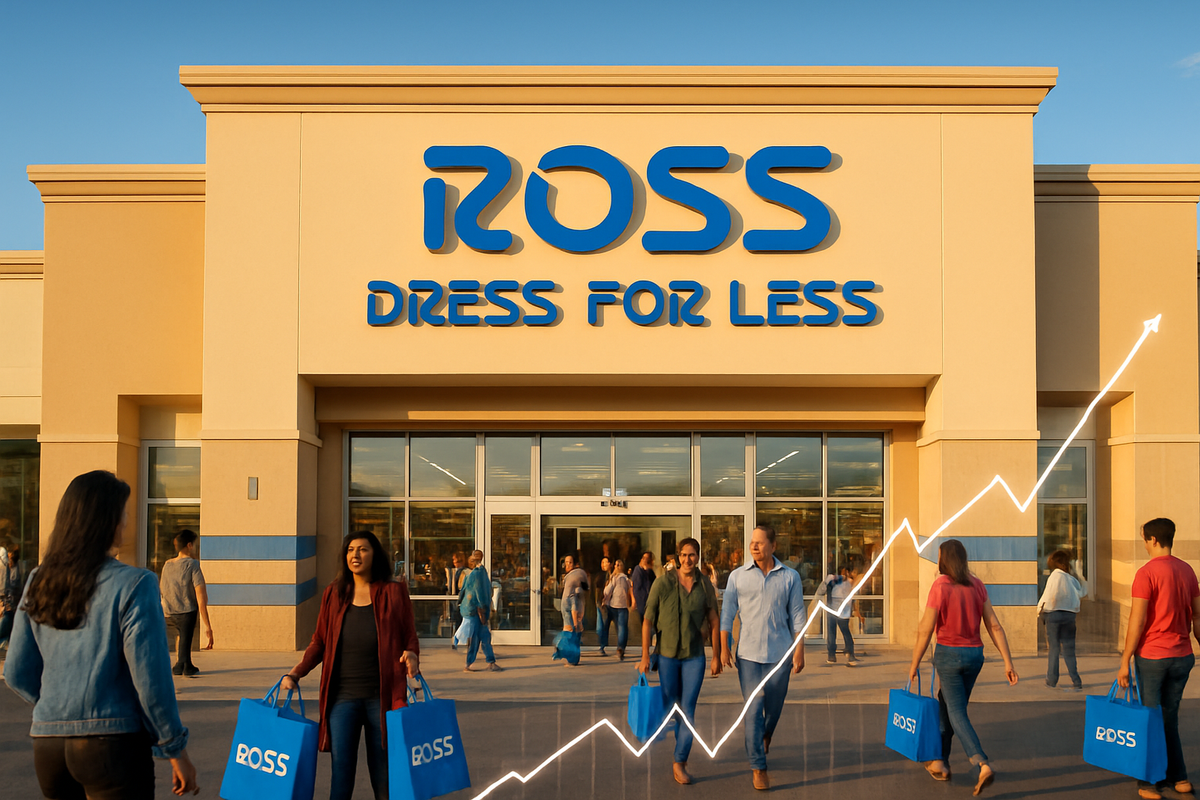
On March 4, 2026, shares of Ross Stores, Inc. (Nasdaq: ROST) skyrocketed 7.4% after the discount retail giant reported fourth-quarter results that shattered Wall Street expectations. The company delivered a significant beat on both the top and bottom lines, fueled by a surge in holiday traffic and a strategic "trade-down" effect as consumers across all income brackets seek higher value in a shifting retail landscape.
The market's enthusiastic reaction reflects growing confidence in Ross's ability to maintain "solid momentum" as it enters the new fiscal year. Beyond the immediate financial metrics, the retailer is reaping the benefits of a favorable macroeconomic environment, characterized by easing gasoline prices and a resilient consumer base that is increasingly prioritizing branded goods at steep discounts over traditional department store offerings.
A Dominant Q4 Performance and the "Solid Momentum" Narrative
The earnings report released today covers the fourth fiscal quarter ending January 31, 2026, a period that proved to be exceptionally lucrative for the Dublin, California-based retailer. Ross Stores reported total sales of $6.64 billion, a 12.2% increase compared to the previous year and well ahead of the $6.38 billion consensus estimate. Profitability was equally impressive, with earnings per share (EPS) coming in at $2.00, far outstripping the $1.88 analyst forecast and the company’s own upper-end guidance of $1.85.
The primary engine of this growth was a robust 9% increase in comparable store sales, more than double what most analysts had modeled. This surge was driven by a sharp uptick in customer transactions and high demand across core categories including ladies' apparel, shoes, and cosmetics. CEO Jim Conroy emphasized that the company exited the year with "solid momentum," noting that business accelerated throughout the fourth quarter as holiday assortments resonated deeply with shoppers. This acceleration has reportedly carried over into the first weeks of the 2026 Spring season, setting a high bar for the months ahead.
The timeline of this success can be traced back to the company's aggressive inventory management and marketing pivots in late 2025. By securing high-quality branded merchandise during a period of supply chain stabilization, Ross was able to offer a "treasure hunt" experience that traditional retailers struggled to match. The initial market reaction on March 4 saw the stock gap up at the open, maintaining its gains throughout the trading session as institutional investors digested the implications of the company's raised operating margins, which hit 12.3% for the quarter.
Identifying the Winners and Losers in the Off-Price Pivot
The primary winner of today’s news is undoubtedly Ross Stores, Inc. (Nasdaq: ROST), which has now solidified its position as a top-tier performer in the retail sector. However, the ripple effects extend to its closest peers. The TJX Companies, Inc. (NYSE: TJX) and Burlington Stores, Inc. (NYSE: BURL) are also seeing sympathy gains, as Ross’s results suggest a "rising tide" for the entire off-price industry. TJX, the parent company of T.J. Maxx and Marshalls, recently reported record influxes of high-income shoppers, a trend that Ross’s Q4 numbers appear to confirm.
On the losing side of this equation are traditional department stores and mid-tier retailers who are failing to compete on price and variety. Companies like Macy's, Inc. (NYSE: M) and Kohl's Corporation (NYSE: KSS) continue to face headwinds as foot traffic migrates toward off-price destinations. As Ross and Burlington (NYSE: BURL) both plan to open over 100 new stores each in 2026, the physical footprint of the off-price sector is expanding into territories once dominated by local malls and department store anchors, further eroding the market share of legacy retailers who are burdened by higher price points and less flexible supply chains.
The "Pump-to-Pocket" Effect and Broader Industry Trends
A critical factor in Ross's 2026 success is the significant decline in gasoline prices. As of early March 2026, the national average for gas has dropped to approximately $2.74 per gallon, the lowest level since the early 2020s. For the typical Ross customer—who often falls into the low-to-middle income demographic—this "pump-to-pocket" relief functions as an immediate stimulus. Lower transportation costs translate directly into higher discretionary spending power, which is frequently funneled back into value-oriented retail.
This event fits into a broader industry trend where "value" is no longer just a niche for low-income shoppers but a mainstream preference. The structural shift away from full-price department stores is accelerating, fueled by a permanent change in consumer psychology that prioritizes brand names at 20-60% discounts. Historically, off-price retailers have performed well in both inflationary and deflationary environments; in the former, they benefit from trade-down traffic, and in the latter (as seen now in early 2026), they benefit from lower operating costs and increased consumer wallet share.
The Road Ahead: 110 New Doors and Billions in Buybacks
Looking forward, Ross Stores is not resting on its laurels. The company has announced an aggressive expansion plan for 2026, aiming to open 110 new locations, including 85 Ross Dress for Less stores and 24 dd’s DISCOUNTS outlets. This is part of a long-term strategic pivot to reach a total of 3,600 stores nationwide. This expansion suggests that Ross sees ample "white space" in the market, particularly as other retailers vacate prime real estate.
Financially, the company is doubling down on shareholder value. Along with the earnings beat, the Board of Directors authorized a massive $2.55 billion share repurchase program for the 2026-2027 period and increased the quarterly dividend by 10%. These moves signal that management believes the stock remains undervalued despite today’s 7.4% jump. The primary challenge moving forward will be maintaining these high comparable sales figures against the difficult year-over-year comparisons that 2025’s success will create.
Final Assessment: Why Ross is a Retail Bellwether
The surge in Ross Stores (Nasdaq: ROST) stock on March 4, 2026, is a testament to the enduring power of the off-price business model. By delivering a "double beat" and raising its outlook, Ross has proven that its inventory-led strategy and value proposition are perfectly tuned to the current economic climate. The company is successfully navigating the transition into a post-inflationary world by capturing a broader segment of the American consumer base.
For investors, the key takeaways are the company's superior operating leverage and its aggressive return of capital to shareholders. As the retail landscape continues to bifurcate between high-end luxury and deep-discount value, Ross is firmly positioned in the winner's circle. In the coming months, the market will be watching to see if the Spring season lives up to management's "strong start" rhetoric and if the decline in energy prices continues to provide a tailwind for the discount retail sector.
This content is intended for informational purposes only and is not financial advice