
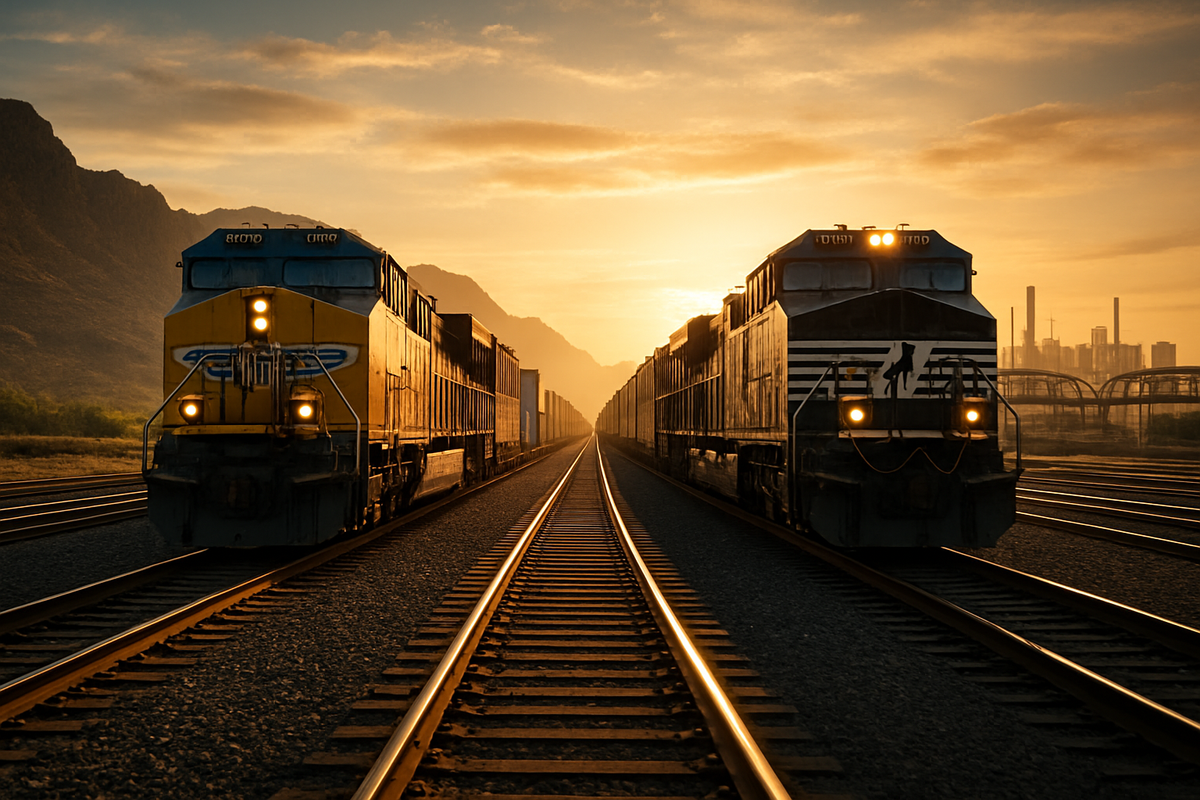
In a move that could fundamentally reshape the movement of goods across North America, Union Pacific (NYSE: UNP) is aggressively moving forward with its planned $85 billion acquisition of Norfolk Southern (NYSE: NSC). Announced in mid-2025 and currently navigating a high-stakes regulatory battle as of March 2026, the deal represents the most significant consolidation in the railroad industry since the 1990s. By merging the dominant carrier of the West with the titan of the East, Union Pacific aims to create the first truly transcontinental rail network, promising a seamless "single-line" service that stretches from the Pacific Coast to the Atlantic seaboard.
The immediate implications are profound: a combined entity would control approximately 45% of all U.S. rail freight, effectively ending the historical "Mississippi Divide" that has separated Eastern and Western carriers for over a century. Proponents argue the merger is a necessary evolution to compete with long-haul trucking and streamline global supply chains, while critics warn of a "Goliath" that could stifle competition and drive up costs for industries ranging from agriculture to energy.
A High-Stakes Timeline and the Regulatory Wall
The path to this $85 billion union has been anything but smooth. After a flurry of negotiations in early 2025, the two companies reached a definitive agreement on July 29, 2025. The deal structure—offering Norfolk Southern shareholders 1.0 share of Union Pacific stock plus $88.82 in cash—valued the target at roughly $320 per share. By November, shareholders from both camps had signaled their overwhelming approval, with over 99% of votes cast in favor of the merger. However, the momentum hit a significant roadblock on January 16, 2026, when the Surface Transportation Board (STB) unanimously rejected the initial 7,000-page merger application as "incomplete," citing missing market share projections and opaque details regarding "materially burdensome" regulatory conditions.
Despite this procedural setback, Union Pacific CEO Jim Vena has remained steadfast. On February 17, 2026, the companies formally notified the STB of their intent to refile a more comprehensive application by April 30, 2026. Vena has championed the merger as a solution to the "hand-off" inefficiencies at major hubs like Chicago and St. Louis, which have long plagued the industry with delays. Supporting this vision is the SMART-TD union, the nation's largest rail labor group, which secured career-long job protections for its members in exchange for its endorsement—a rare win for labor in a period of intense automation.
Winners, Losers, and the Battle for the Tracks
The potential merger has divided the corporate landscape into camps of cautious optimists and vocal opponents. Among the winners, Union Pacific and Norfolk Southern expect to reap at least $2.75 billion in annual synergies through optimized routing and reduced overhead. Wall Street analysts at Baird have recently upgraded Union Pacific to "Outperform," suggesting that the operational gains could exceed initial estimates. Furthermore, the SMART-TD union members stand to benefit from unprecedented job security at a time when other Class I railroads are leaning into leaner, precision-scheduled railroading models.
On the losing side, rival railroads like CSX Corporation (NASDAQ: CSX) and Canadian Pacific Kansas City (NYSE: CP) have sounded the alarm. CPKC CEO Keith Creel has been particularly vocal, arguing that the merger would create an insurmountable competitive advantage that could force smaller players into defensive, and perhaps sub-optimal, mergers. Shippers are equally concerned; the American Farm Bureau Federation and energy giants like ExxonMobil (NYSE: XOM) and Chevron (NYSE: CVX) have expressed fears that a lack of competition at key interchanges will lead to skyrocketing freight rates, ultimately passed down to consumers in the form of higher prices for food and fuel.
Breaking the 2001 Regulatory Barrier
This acquisition is the first "Major Merger" to be tested under the STB’s stringent 2001 merger rules. These regulations were designed to prevent the industry from consolidating into a duopoly and require that any new combination must not only maintain but actively enhance competition. The STB’s scrutiny of the St. Louis interchange—a critical chokepoint—suggests that regulators are prepared to demand significant concessions. Historically, such concessions have included "trackage rights," where a merging company must allow its competitors to use its rails to ensure shippers still have choices.
The deal also signals a broader trend toward "National Champions"—massive infrastructure companies capable of securing U.S. supply chains against global volatility. This is the culmination of a wave that began with the Canadian Pacific and Kansas City Southern merger in 2023. If Union Pacific is successful, the industry anticipates a "tit-for-tat" response, potentially involving BNSF Railway—owned by Berkshire Hathaway (NYSE: BRK.B)—and CSX. This would effectively leave North America with only two massive transcontinental systems, a scenario that has prompted regulators to move with extreme caution to avoid a total collapse of competitive pricing.
The Road Ahead: April Refiling and Beyond
All eyes are now on the April 30, 2026, refiling date. The "missing schedules" that led to the STB's January rejection must be addressed with surgical precision. Investors should expect a period of heightened volatility for both UNP and NSC as the STB begins its deep dive into the revised application. In the short term, Union Pacific must convince regulators that it can manage the integration without the service meltdowns that followed the UP-Southern Pacific merger of 1996.
The long-term outlook hinges on whether the STB will demand the divestiture of certain key lines to competitors like CSX or Canadian National Railway (NYSE: CNI). If the concessions are too "burdensome," Union Pacific may be forced to exercise its walk-away rights, potentially triggering a $2.5 billion break fee. However, if approved, the deal would likely close in early 2027, ushering in a new era of "single-line" logistics that could significantly reduce transit times for cross-country freight, offering a powerful counter-narrative to the reliability of long-haul trucking.
A Defining Moment for American Infrastructure
The Union Pacific-Norfolk Southern merger is more than just a corporate marriage; it is a stress test for the American regulatory system and a gamble on the future of scale in the industrial sector. By seeking to unify the East and West, Union Pacific is attempting to solve a century-old logistical puzzle at a price tag that reflects the immense value of owning the "iron arteries" of the nation.
Moving forward, the market will be watching for any signs of regulatory softening or increased political pressure. The "National Champion" argument may gain more traction in an election year, but the Surface Transportation Board remains a fiercely independent body. For investors, the coming months will be a masterclass in regulatory arbitrage and strategic maneuvering, as the giants of the rail industry fight for a seat at the table of the newly consolidated North American logistics landscape.
This content is intended for informational purposes only and is not financial advice.