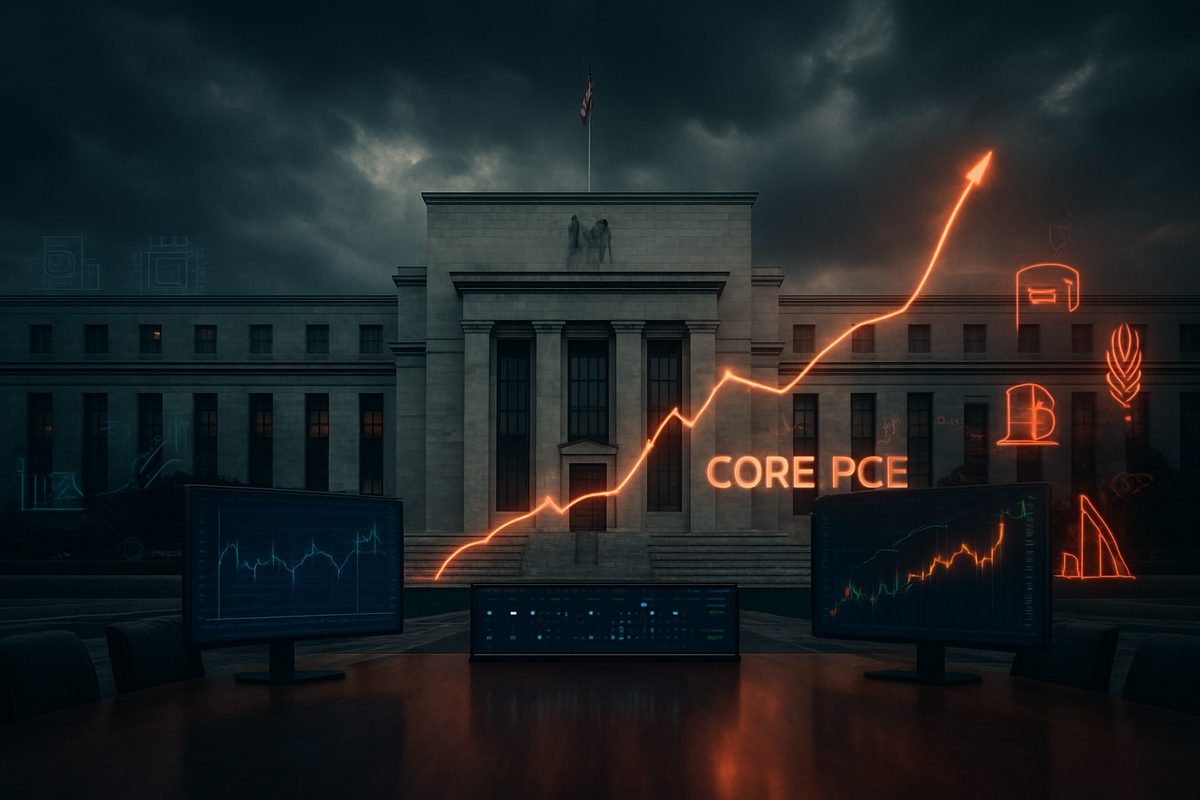
The Federal Reserve concluded its March 2026 Federal Open Market Committee (FOMC) meeting this week with a decision that has sent ripples through a fragile market: interest rates will remain unchanged at the 3.5% to 3.75% range. For the second consecutive meeting, Chair Jerome Powell and his colleagues opted for a "patient" posture, a stark departure from the pivot hopes that dominated Wall Street forecasts at the start of the year. The primary driver behind this caution is a stubborn resurgence in price pressures, specifically a core Personal Consumption Expenditures (PCE) reading that has climbed back to 3.1%, significantly overshooting the central bank's 2.0% mandate.
This decision marks a critical juncture in the 2026 economic narrative. After a brief period of disinflation in late 2025, the economy has hit a "sticky" patch, complicated by rising energy costs and new international trade tariffs. For investors, the Fed’s message was clear: the era of "higher for longer" is not quite over. The immediate market reaction saw the S&P 500 index slide 1.4%, as traders recalibrated their expectations from multiple rate cuts this year to potentially just one—or none at all.
A Hawkish Pause and the Resurgence of Inflation
The two-day FOMC meeting that wrapped up on March 18, 2026, was characterized by a rare lack of consensus among committee members. While the 11-1 vote to maintain rates appeared stable on the surface, the updated Summary of Economic Projections (SEP), often called the "dot plot," revealed deep internal fissures. Seven of the nineteen officials now project no rate cuts for the entirety of 2026, a significant shift from the more dovish projections seen in December 2025. This internal division reflects a central bank caught between a resilient labor market and an inflation dragon that refuses to stay down.
The timeline leading to this "hawkish pause" began in early February when energy markets were upended by renewed volatility in the Middle East. Brent crude oil prices breached the $100 per barrel mark, quickly filtering through to transportation and manufacturing costs. Simultaneously, the core PCE index—the Fed's preferred inflation gauge—surprised economists by rising to 3.1% year-over-year in January, up from 3.0% the previous month. This upward drift effectively killed the momentum for a spring rate cut.
During his post-meeting press conference, Chair Powell emphasized that the committee is prepared to remain "patient" as it evaluates the impact of recent trade policy shifts. New tariffs on imported core goods have begun to exert upward pressure on prices, complicating the Fed's path to the 2.0% target. Powell noted that while the labor market remains healthy with an unemployment rate of 4.4%, the Fed "will not hesitate to maintain restrictive policy for longer" if the progress on inflation continues to stall.
Winners and Losers in the 'Higher for Longer' Era
The technology sector, which flourished during the AI-driven boom of 2024 and 2025, is currently bearing the brunt of the Fed’s restrictive stance. Apple (NASDAQ: AAPL) and Microsoft (NASDAQ: MSFT) have seen their valuations compressed as the "Great Rotation" accelerates. Apple shares fell 1.69% following the meeting, contributing to an 8% year-to-date decline. Similarly, Microsoft saw a nearly 2% drop as investors questioned whether "Capex fatigue" in artificial intelligence would be exacerbated by high borrowing costs. Nvidia (NASDAQ: NVDA), despite reporting continued strong demand for its latest Blackwell and Vera Rubin chip architectures, has faced significant volatility as retail sentiment sours on growth-at-any-price models.
On the winning side, the energy and financial sectors are finding a silver lining in the current environment. As oil prices remain elevated, energy giants like Exxon Mobil (NYSE: XOM) and Chevron (NYSE: CVX) have become safe havens for investors seeking yield and inflation protection. These companies are benefiting from both the commodity price surge and a narrative shift toward defensive value. In the financial space, JPMorgan Chase (NYSE: JPM) and Goldman Sachs (NYSE: GS) are navigating the environment with mixed results, benefiting from higher net interest margins but facing headwinds in capital markets as high rates dampen IPO and M&A activity.
The real estate sector continues to be the primary casualty of the 3.5-3.75% range. Real Estate Investment Trusts (REITs) like Realty Income (NYSE: O) have seen their stock prices struggle as the cost of financing remains prohibitive for new development and property acquisitions. For these "bond proxy" stocks, the Fed’s patience is a recipe for continued stagnation, forcing a strategic shift toward deleveraging and asset sales rather than expansion.
A Global Shift in Trade and Policy
The Fed’s March 2026 decision does not exist in a vacuum; it is part of a broader shift in global economic policy. The introduction of new trade tariffs in late 2025 has created a structural inflationary floor that central banks around the world are struggling to manage. This "no-landing" scenario—where growth remains positive but inflation refuses to hit target—is a significant departure from the boom-and-bust cycles of the previous decade. Comparisons are increasingly being made to the 1970s, where multiple "false dawns" of disinflation led to premature easing followed by even sharper spikes in price levels.
This policy landscape is also influenced by the upward revision of the "long-run neutral rate" to 3.1%. This suggests that even when the Fed eventually does cut rates, they are unlikely to return to the near-zero levels of the 2010s. The implications for government debt are profound. With the U.S. national debt continuing to climb, the cost of servicing that debt at a 3.5% floor is placing increased pressure on fiscal policy, potentially leading to a clash between the Fed's inflation mandate and the Treasury’s funding needs.
Furthermore, the "Great Rotation" out of hyperscale tech and into commodities reflects a market that is maturing past the initial AI hype. Investors are now looking for tangible earnings and "hard assets" as the 3.0% core PCE suggests that the era of cheap goods and services may be over. This trend is likely to continue as long as geopolitical tensions keep supply chains brittle and energy markets on edge.
The Road to June: Markets in Wait-and-See Mode
Looking ahead, the next three months will be a period of intense data-dependency. The Fed has clearly stated that it needs to see a "convincing" string of lower inflation prints before it considers a policy pivot. The June FOMC meeting is now being eyed as the next potential window for a move, but only if the core PCE begins to descend toward the 2.7% end-of-year projection. Short-term volatility is expected to remain high as every weekly jobless claim and monthly CPI report is treated as a high-stakes event.
Strategically, corporations are adapting to this "patient" Fed by prioritizing cash flow over aggressive expansion. We are seeing a pivot toward stock buybacks and debt reduction among mid-cap companies that are most sensitive to interest rates. If the labor market begins to cool significantly—hitting the 4.6% unemployment threshold some economists fear—the Fed may be forced to choose between its dual mandates of price stability and maximum employment. For now, however, price stability remains the priority.
Potential scenarios range from a "goldilocks" soft landing if inflation resumes its downward trend without a spike in unemployment, to a "stagflationary" trap if energy prices remain above $100 per barrel. Investors should prepare for a landscape where market leadership is far more diversified than the tech-heavy rallies of years past.
Summary and Investor Takeaways
The March 2026 FOMC meeting has effectively reset the market's clock. By maintaining the 3.5-3.75% range and adopting a "patient" tone, the Federal Reserve has signaled that it will not be bullied by market expectations into cutting rates prematurely. The 3.0-3.1% core PCE inflation figure is the primary hurdle, and until it clears, the "higher for longer" regime will dictate market dynamics.
Key takeaways for the coming months include:
- Watch the Energy Sector: Oil prices are now a primary driver of Fed policy; any further escalation in the Middle East could push rate cuts into 2027.
- Tech Valuations Under Pressure: High-multiple growth stocks like Microsoft and Nvidia may continue to face headwinds as the discount rate remains high.
- Diversification is Mandatory: The "Great Rotation" suggests that a balanced portfolio including energy, value, and commodities may outperform traditional growth-heavy strategies.
As we move toward the summer, the question is no longer when the Fed will cut, but if the structural shifts in the global economy will allow them to cut at all in 2026. For investors, the mantra for the second quarter is simple: watch the data, respect the Fed's patience, and prepare for a long, slow grind toward the 2% target.
This content is intended for informational purposes only and is not financial advice.