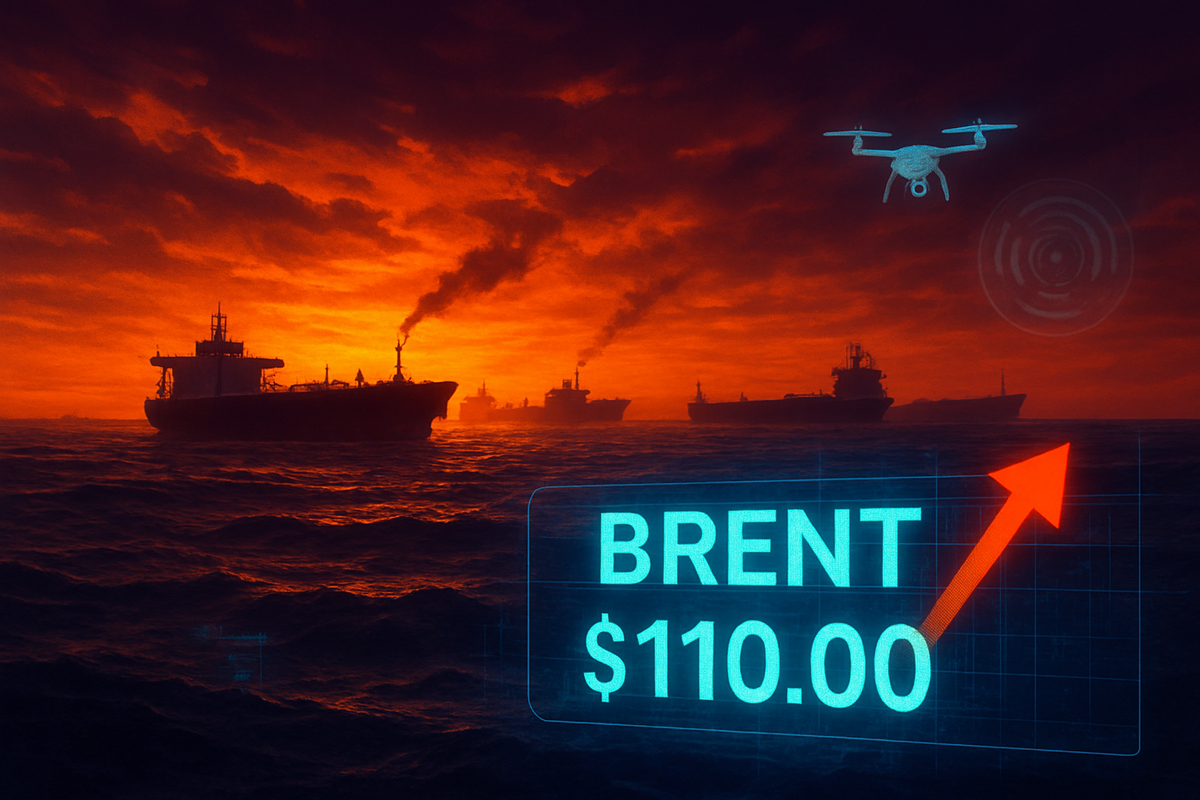
The global energy landscape reached a fever pitch this week as Brent crude oil prices solidified their position at $110 per barrel, following a volatile surge that briefly touched $120. The primary catalyst is the rapidly deteriorating military situation in the Middle East, where a direct confrontation between Western allies and Iran has effectively shuttered the Strait of Hormuz, the world’s most vital oil artery. With nearly 20% of the world’s petroleum supply currently at risk, markets are pricing in a prolonged "war premium" that has sent shockwaves through Wall Street and global supply chains.
The immediate implications are stark: fuel prices at the pump have spiked by an average of $1.25 per gallon in the United States over the last fortnight, and maritime shipping costs have quadrupled as tankers are rerouted around the Cape of Good Hope. While the S&P 500 has shown surprising resilience—buoyed by a flight to "energy-insulated" technology stocks—the specter of $110 oil is beginning to exert significant downward pressure on consumer discretionary spending and the transportation sector, raising fears of a stagflationary shock not seen in decades.
The Path to Conflict: A Timeline of Escalation
The current crisis traces its roots to the total collapse of nuclear diplomacy in late 2025. Following an IAEA declaration of Iranian non-compliance, the "E3" nations—France, Germany, and the United Kingdom—triggered the "snapback" mechanism of the JCPOA on September 28, 2025. This move effectively reinstated all pre-2015 UN sanctions and isolated Tehran from the global financial system. Tensions reached a breaking point on February 28, 2026, with "Operation Epic Fury," a coordinated series of airstrikes by U.S. and Israeli forces targeting Iranian nuclear infrastructure and leadership.
In the wake of these strikes, the Islamic Revolutionary Guard Corps (IRGC) initiated what it calls a "maritime blockade" of the Strait of Hormuz. Since early March, over 20 commercial vessels have been targeted by Iranian suicide drones and sea mines. Notable casualties include the tankers Skylight and MKD Vyom, both of which suffered significant damage. This has led to a near-total halt of traffic through the chokepoint, with tanker volume dropping by an estimated 85% as major shipping firms like Maersk and Hapag-Lloyd refuse to enter the Persian Gulf.
The supply shock is unprecedented in the modern era. Iraq has seen its southern exports crater by 70%, while Kuwait and Qatar have been forced to declare force majeure on several shipments of oil and Liquefied Natural Gas (LNG). As of March 20, 2026, the global market is facing a daily deficit of approximately 14 million barrels. While the U.S. Strategic Petroleum Reserve (SPR) has been tapped to mitigate the blow, the sheer scale of the disruption has kept Brent prices stubbornly high, oscillating between $108 and $115 per barrel over the last three trading sessions.
Market Winners and Losers: A Bifurcated Economy
The surge in energy prices has created a sharp divide in the U.S. stock market. The clear winners are the domestic energy titans, which are reporting record-high margins and extraordinary free cash flow. ExxonMobil (NYSE: XOM) and Chevron (NYSE: CVX) have seen their stock prices climb by 27% and 26% respectively since the conflict began, as investors bet on the profitability of U.S. shale and non-OPEC production. Similarly, Occidental Petroleum (NYSE: OXY) has benefited from the pivot toward Western-controlled supply, reaching multi-year highs as the "war premium" flows directly to their bottom lines.
Conversely, the airline and logistics sectors are reeling under the weight of astronomical fuel costs. Major carriers like Delta Air Lines (NYSE: DAL), United Airlines (NASDAQ: UAL), and American Airlines (NASDAQ: AAL) have all seen double-digit percentage drops in their share prices this month. Analysts estimate that the industry’s quarterly fuel bill has increased by an aggregate $5 billion, forcing several carriers to announce emergency surcharges and reduced flight schedules. The logistics giant FedEx (NYSE: FDX) and United Parcel Service (NYSE: UPS) are also facing heavy selling pressure as the cost of global trade skyrockets and "just-in-time" delivery models are abandoned in favor of "just-in-case" inventory hoarding.
Interestingly, the technology sector has acted as an unexpected hedge. Companies like NVIDIA (NASDAQ: NVDA) and Microsoft (NASDAQ: MSFT) have remained relatively stable, as investors view these "AI-centric" firms as being decoupled from the immediate physical constraints of the oil market. This "AI Narrative" has prevented the broader S&P 500 from a total capitulation, even as traditional industrial and retail stocks like Macy's (NYSE: M) and Lululemon (NASDAQ: LULU) face a "tax at the pump" that is rapidly eroding the American consumer's disposable income.
Wider Significance and Geopolitical Shifts
This event marks a definitive end to the era of "cheap energy security." The current conflict fits into a broader trend of deglobalization, where energy independence is no longer a policy goal but a national security requirement. Comparisons are already being drawn to the 1973 oil embargo; however, the 2026 crisis is distinct because the U.S. is now a net exporter of energy. This fundamental shift has prevented the catastrophic "gas lines" of the 1970s but has not shielded the U.S. consumer from the globalized nature of Brent crude pricing.
The regulatory implications are likely to be profound. We expect a renewed, bipartisan push for accelerated domestic drilling permits and a simultaneous surge in funding for nuclear and renewable energy to reduce long-term dependence on the Middle East. Furthermore, the "Strait of Hormuz threat" has forced a massive rethink of global naval strategy. The inability of Western navies to fully secure the Strait against low-cost drone swarms and mines suggests a new era of asymmetric maritime warfare that will require significant defense spending shifts toward autonomous naval systems and electronic warfare.
Historically, oil shocks of this magnitude have often preceded global recessions. The Federal Reserve now faces an impossible dilemma: hike interest rates further to combat the energy-driven inflation or pause to prevent a collapse in the transport and retail sectors. The "ripple effect" is also being felt by U.S. partners in Europe and Asia, particularly Japan and South Korea, which are almost entirely dependent on Middle Eastern imports. Their economic distress could weaken global demand for U.S. exports, creating a secondary wave of economic slowdown later this year.
The Road Ahead: Scenarios for the Global Economy
In the short term, the market remains on a knife-edge. If the U.S. and its allies can establish a "protected corridor" through the Strait of Hormuz using intensified naval escorts, we could see Brent crude retreat toward the $90 range. However, any further escalation—such as a direct strike on Saudi Arabian or Emirati oil processing facilities—could easily push prices toward the $150 mark. Strategic pivots are already occurring; we are seeing a massive shift in capital toward "Short-Cycle" shale projects in the Permian Basin as producers race to fill the supply gap.
Market opportunities are emerging in the defense and alternative energy sectors. Companies specializing in anti-drone technology and maritime surveillance are seeing a surge in government contracts. Long-term, this crisis may act as the final catalyst for the "Great Energy Transition," as the volatility of fossil fuels becomes an unbearable risk for corporate balance sheets. Scenarios for late 2026 range from a fragile truce that keeps oil at a "new normal" of $85, to a sustained regional war that necessitates a total restructuring of the global energy trade.
Conclusion and Investor Outlook
The surge of Brent crude to $110 per barrel is more than just a price fluctuation; it is a symptom of a fundamental breakdown in the geopolitical order. The primary takeaway for investors is the return of "geopolitical risk" as a primary driver of equity valuations. While the S&P 500 has been cushioned by its heavy weighting in technology, the underlying health of the global economy is being severely tested by the closure of the Strait of Hormuz and the ensuing energy scarcity.
Moving forward, the market is likely to remain in a state of high volatility. Investors should closely monitor the "war premium" and watch for any signs of demand destruction—the point at which high prices cause consumers to stop spending entirely. Key indicators to watch in the coming months include SPR release levels, updates on naval "escort" operations in the Gulf, and the Q2 earnings calls of major transportation and retail firms, which will reveal the true depth of the margin erosion. For now, energy remains the dominant theme, and $110 oil is the new, precarious baseline for a world in conflict.
This content is intended for informational purposes only and is not financial advice.