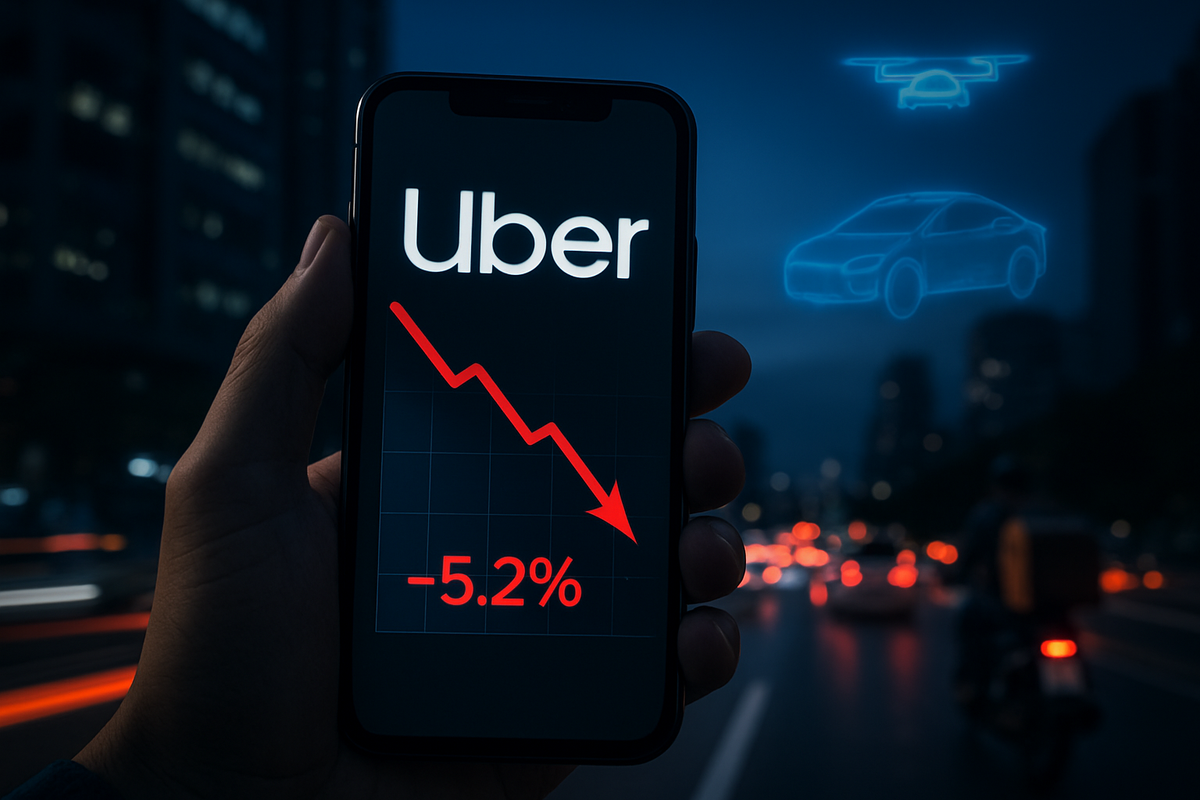
SAN FRANCISCO – Shares of Uber Technologies, Inc. (NYSE: UBER) fell 5.2% in early trading on February 5, 2026, following the release of its fourth-quarter 2025 financial results. Despite reaching record trip volumes and reporting a nominal beat on top-line revenue, the ride-hailing giant failed to convince investors that its high-octane growth era can be sustained in an increasingly mature and competitive market.
The market's sharp reaction underscores a shift in investor sentiment from celebrating "profitability at any cost" to demanding clear evidence of long-term scalability. While the company reported quarterly revenue of $14.37 billion, a 20% year-over-year increase, the stock's decline was primarily driven by a disappointing earnings per share (EPS) figure and cautious guidance for the first half of 2026, signaling that the hurdles to maintaining dominance are growing steeper.
Growth Deceleration and Margin Pressures Take Center Stage
The financial report released late on February 4, 2026, painted a picture of a company caught between its past as a disruptor and its future as a utility. Uber reported a record 3.6 billion trips for the quarter, yet the financial efficiency of those trips came under intense scrutiny. Adjusted EPS came in at $0.71, missing the analyst consensus of $0.80 by nearly 11%. This shortfall was largely attributed to a $1.6 billion pre-tax headwind stemming from the revaluation of the company's equity investments and rising operational costs.
More concerning for analysts was the guidance provided by the outgoing management team. Uber projected Q1 2026 adjusted EBITDA and bookings that fell below Wall Street's aggressive targets. This forecast suggested a sequential slowdown in demand for both its Mobility and Delivery segments. Furthermore, the company admitted that its push into more affordable service tiers, such as UberX Share, while successful in boosting trip volume, has inadvertently compressed profit margins as riders trade down from more premium options in a cost-conscious economy.
The timing of the report also coincided with a major leadership transition. Alongside the financial data, Uber announced that CFO Prashanth Mahendra-Rajah will step down on February 16, 2026. He is set to be succeeded by Balaji Krishnamurthy, currently a senior vice president of corporate finance. While the transition was characterized as orderly, the departure of a key architect of Uber’s recent profitability push added a layer of uncertainty to an already jittery market.
Winners and Losers in the Shifting Gig Economy
The ripple effects of Uber's 5.2% slide were felt across the broader "sharing economy" sector. Lyft, Inc. (NASDAQ: LYFT), Uber's primary domestic rival, saw its own shares dip 3.1% in sympathy. Investors fear that if Uber is struggling to find incremental growth in the U.S. market, Lyft—which lacks Uber’s diversified delivery and international footprint—may face even more severe headwinds. Conversely, some analysts suggest Lyft could benefit if Uber continues to prioritize margins over market share, leaving an opening for Lyft to compete on price.
In the delivery space, DoorDash, Inc. (NASDAQ: DASH) emerged as a notable "winner" in terms of relative performance. As Uber's delivery growth showed signs of plateauing, DoorDash’s specialized focus on deep-market penetration in suburban areas has allowed it to maintain a slight edge in retention rates. However, the overall sector remains under pressure as consumer spending on discretionary services like food delivery faces exhaustion.
The most significant winners may not be traditional competitors but technology platforms. Alphabet Inc. (NASDAQ: GOOGL), through its Waymo subsidiary, and Tesla, Inc. (NASDAQ: TSLA) are increasingly viewed as the ultimate beneficiaries of a mature ride-hailing market. As Uber grapples with the high costs of human drivers and insurance, the autonomous vehicle (AV) "robotaxi" threat looms larger. Uber's recent stock drop reflects a growing consensus that the company may have to share an increasing portion of its revenue with AV tech providers to stay relevant.
Navigating a Saturated Market and the Autonomous Pivot
Uber’s current predicament fits into a broader industry trend of "maturity malaise." After a decade of explosive growth, the ride-hailing market in North America and Europe has reached a high level of saturation. With nearly every potential user already on the platform, Uber is forced to look toward "marginal gains"—such as advertising revenue and grocery delivery—which carry different risk profiles and competitive landscapes.
The event also highlights the regulatory and structural shift toward autonomous transportation. For years, Uber’s bull case was built on the eventual elimination of the human driver, its largest cost. However, as companies like Tesla prepare to launch dedicated robotaxi fleets, Uber is transitioning from a platform owner to a potential partner. CEO Dara Khosrowshahi emphasized during the earnings call that Uber aims to be the "largest facilitator of AV trips," but the market remains skeptical about the toll this transition will take on Uber’s balance sheet in the short term.
Historically, this moment mirrors the transition of other tech giants like Microsoft (NASDAQ: MSFT) or Alphabet in their middle years, where they had to pivot from pure growth to becoming "cash flow machines" while simultaneously investing billions in the next technological frontier—in this case, AI-driven logistics and autonomous fleets.
What Lies Ahead: A Pivot to Efficiency and Autonomy
In the short term, Uber is expected to undergo a period of rigorous cost optimization under its new CFO. Investors will be looking for the company to defend its margins even if it means sacrificing some top-line growth. The market will also be hyper-focused on the Q1 2026 results to see if the current "miss" was a one-off event or the beginning of a sustained downward trend in bookings growth.
Strategically, the next 12 to 18 months will be defined by Uber’s ability to integrate autonomous technology into its app seamlessly. We may see the company pursue more aggressive partnerships with AV manufacturers to ensure it remains the "operating system" for urban mobility, even if it no longer controls the entire value chain. The success of these integrations will likely determine whether Uber remains a growth stock or settles into the role of a stable, low-growth utility.
The Bottom Line for Investors
Uber's 5.2% stock drop serves as a reality check for the gig economy. The primary takeaway is that "record usage" is no longer enough to satisfy a market that is increasingly focused on the quality and sustainability of earnings. While Uber remains the dominant player in the space, the "low-hanging fruit" of market expansion has been picked, leaving the company to navigate the complex challenges of margin compression and the looming autonomous revolution.
Moving forward, investors should watch for three key indicators: the company’s ability to scale its high-margin advertising business, any shifts in the competitive landscape from Tesla’s robotaxi initiatives, and the first few quarters of leadership under the new CFO. Uber’s journey is far from over, but the path to its next leg of growth is significantly more complicated than the one it traveled to get here.
This content is intended for informational purposes only and is not financial advice.