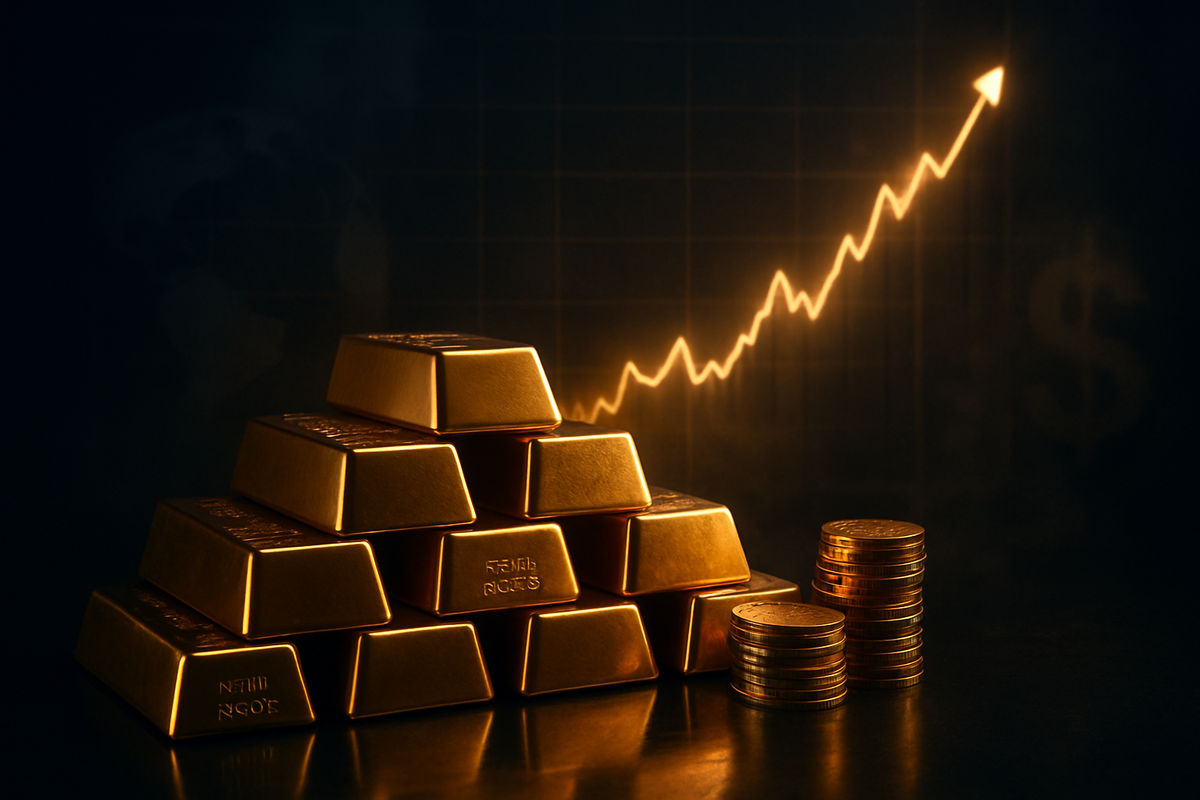
As of February 19, 2026, the global financial landscape is grappling with a paradigm shift in the valuation of hard assets. Gold, the perennial store of value, has shattered all previous psychological and technical barriers, consolidating near the $5,000 per ounce mark after reaching a breathtaking all-time high of $5,595 in late January. This meteoric rise—a gain of over 150% in just twenty-four months—has moved beyond a mere "flight to safety," signaling what many experts now describe as a structural "supercycle" that could see the precious metal reach $7,000 or even $10,000 before the decade is out.
The immediate implications are profound: a massive reallocation of global capital is underway. As investors flee the volatility of fiat currencies and the mounting risks of sovereign debt, the physical gold market is struggling to keep pace with demand. This surge is not merely a reflection of market anxiety but a fundamental revaluation of the U.S. dollar’s role as the world’s primary reserve currency. With interest payments on U.S. national debt now exceeding $1 trillion annually, the "gold standard" of the 21st century is increasingly being defined by the metal itself rather than the paper that once promised it.
The Road to $5,000: A Timeline of the Unprecedented
The current gold mania did not happen overnight; it is the culmination of a two-year escalation that began in late 2024. After spending years oscillating between $1,800 and $2,000, gold established a firm floor above $2,800 in December 2024 as markets braced for a more aggressive U.S. trade posture. The momentum accelerated in 2025, a year that will be remembered in financial history as the "Year of the Bull." The metal breached the $3,000 mark in April 2025 and crossed the once-unthinkable $4,000 threshold on October 8, 2025, driven by a "perfect storm" of fiscal instability and geopolitical conflict.
The primary catalysts for this ascent have been three-fold: an explosion in U.S. deficit spending, aggressive "de-dollarization" by global central banks, and a series of acute geopolitical flashpoints. In April 2025, the "Liberation Day" executive order, which imposed sweeping 100% tariffs on several major trade partners, ignited a global trade war that devalued trade-dependent currencies and sent institutional investors scurrying toward gold. Concurrently, the conflict in Ukraine entered its fourth year, while renewed tensions in the Middle East—specifically involving maritime security in the Strait of Hormuz—provided a consistent "geopolitical floor" for prices.
Central banks have played an unprecedented role in this rally. In 2024, net purchases by institutions like the People’s Bank of China and the National Bank of Poland exceeded 1,000 tonnes for the third consecutive year. Even as prices soared in 2025, buying remained more than double the historical ten-year average. Central banks are no longer just hedging against inflation; they are strategically accumulating gold to insulate their reserves from the potential weaponization of the U.S. dollar and the mounting instability of the global financial system.
The Corporate Winners and Losers of the Gold Rush
The primary beneficiaries of this price surge are the major mining conglomerates, which are currently seeing record-breaking profit margins. Newmont Corporation (NYSE: NEM) and Barrick Gold (NYSE: GOLD) have seen their share prices skyrocket as their All-In Sustaining Costs (AISC), which typically range between $1,300 and $1,500, have remained relatively stable while the selling price of their product has doubled. Royalty and streaming companies, such as Franco-Nevada Corporation (NYSE: FNV), have also emerged as major winners, benefiting from the upside of higher prices without the direct operational risks of mining.
On the investment side, the SPDR Gold Shares (NYSEARCA:GLD) and the iShares Gold Trust (NYSEARCA:IAU) have seen record inflows, making them some of the most liquid and heavily traded instruments on the market. Smaller producers like Agnico Eagle Mines (NYSE: AEM) have also benefited, particularly those with low geopolitical risk profiles in jurisdictions like Canada and Australia. These companies are now flush with cash, leading to a wave of mergers and acquisitions as they race to secure remaining high-grade reserves.
However, the rally has created significant headwinds for other sectors. The luxury goods industry and high-end jewelry manufacturers have been forced to implement drastic price hikes, leading to a slump in consumer demand. More critically, technology and industrial manufacturers—particularly those in the semiconductor and electronics sectors where gold is a vital component—are facing surging input costs. Companies that rely on gold for high-conductivity plating are seeing their margins squeezed, forcing a desperate search for cheaper alternatives like silver or copper, though neither offers the same chemical stability as gold.
A Macroeconomic Turning Point: Deficits and De-dollarization
The wider significance of gold’s ascent lies in what it reveals about the health of the global economy. As of February 2026, the U.S. National Debt has surpassed a staggering $38.6 trillion. The Congressional Budget Office (CBO) is projecting a deficit of $1.9 trillion for the 2026 fiscal year alone. For the first time in history, the U.S. government is spending more on interest payments—roughly 15% of all federal revenue—than it is on its entire defense budget. This "debt spiral" is the primary driver behind the institutional shift into gold.
Historically, gold rallies of this magnitude have signaled a transition between economic eras. The current trend mirrors the inflationary 1970s but on a much larger scale. Unlike the 70s, however, the current move is compounded by the "Q-Day" threat—the fear that quantum computing will soon be capable of breaking traditional digital encryption. This has prompted a retreat from digital assets and cryptocurrencies back into physical "hard" assets that cannot be hacked or deleted. Analysts at Saxo Bank have cited this as a key reason why $10,000 gold is not just possible, but perhaps inevitable.
Furthermore, the "neutrality" of gold has become its greatest asset. In an era where the U.S. dollar is used as a tool of foreign policy through sanctions and seizures, gold remains a politically "blind" asset. This has led to the emergence of a bifurcated global financial system: a dollar-based Western system and a gold-backed Eastern system. The historical precedent for this is the Bretton Woods era, but in reverse; we are moving away from a gold-backed currency toward a currency-backed gold market, where the metal dictates the value of the paper rather than the other way around.
The Path to $10,000: Scenarios and Strategic Pivots
As we look toward the remainder of 2026 and into 2027, the projections for gold are becoming increasingly bold. Bank of America (NYSE: BAC) has raised its "blue sky" forecast to $8,000, suggesting that if investment demand increases by just 14%, the physical market will enter a permanent supply deficit. Mining legend Pierre Lassonde has remained even more bullish, pointing to the Dow-to-Gold ratio. Historically, this ratio converges toward 1:1 or 2:1 during major crises. With the Dow Jones Industrial Average trading at record levels, a convergence to a 2:1 ratio would imply a gold price north of $10,000.
However, this path is not without its challenges. Such high prices may eventually trigger government intervention. Historical precedents, such as Executive Order 6102 in 1933, which criminalized the possession of monetary gold in the U.S., are being discussed in hushed tones by institutional investors. While a full confiscation is unlikely in the modern era, new windfall taxes on mining profits or "gold-specific" capital gains taxes could be introduced to curb the speculative fervor and recoup some of the fiscal losses from the devaluing dollar.
In the short term, investors should expect significant volatility. The "euphoria" phase seen in January 2026 often leads to sharp technical corrections, as witnessed by the current consolidation near $5,000. However, these dips are increasingly being viewed as buying opportunities by sovereign wealth funds and "diamond-handed" retail investors. The strategic pivot for many portfolios will be moving from a 5% "insurance" allocation in gold to a 20% or even 30% "core" allocation as the traditional 60/40 stock-bond portfolio fails to keep pace with the hidden tax of currency debasement.
Conclusion: The New Golden Age
The ascent of gold to $5,000 and beyond represents more than just a bull market in a single commodity; it is a global vote of no confidence in the prevailing fiscal and monetary order. The combination of a $38 trillion U.S. debt, a $1 trillion annual interest bill, and a fragmented geopolitical landscape has created a "perfect storm" that has vindicated the "gold bugs" who have predicted this moment for decades. As we move further into 2026, the metal’s performance will continue to serve as a high-definition thermometer for the heat of the global debt crisis.
Moving forward, the market will likely be defined by a persistent supply-demand imbalance. With central banks continuing to buy and new mine discoveries at all-time lows, the upward pressure on prices remains structural rather than speculative. Investors should watch for further signs of "de-dollarization" in trade settlements and any move by the Federal Reserve that suggests a surrender to "fiscal dominance"—the point where the central bank must keep interest rates low to fund the government, regardless of inflation.
In summary, the narrative of $10,000 gold has moved from the fringes of financial theory into the mainstream of institutional strategy. While the journey to five digits will undoubtedly be volatile, the fundamental drivers—deficits, distrust, and de-dollarization—show no signs of abating. For the global markets, the "New Golden Age" is no longer a distant possibility; it is the current reality.
This content is intended for informational purposes only and is not financial advice.