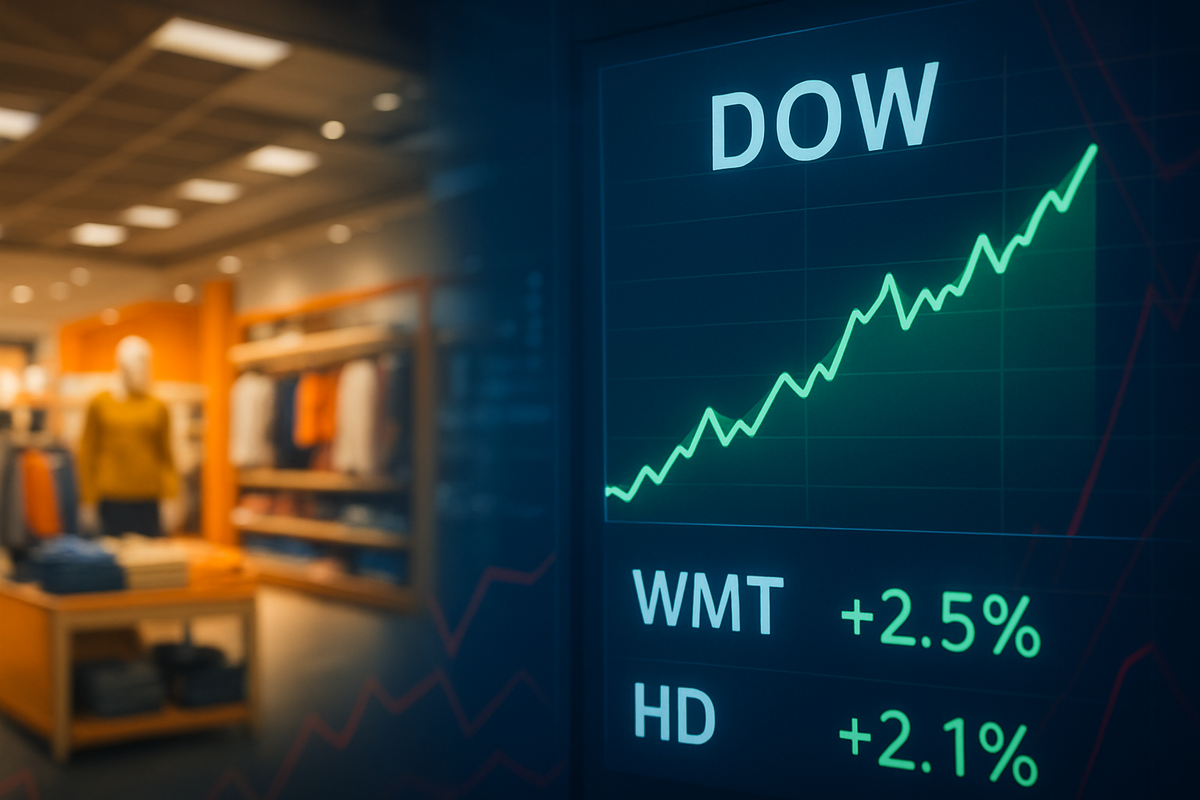
As the financial markets navigate a precarious start to 2026, investors are increasingly looking toward the retail sector as a stabilizing force. This trend echoes the remarkable market performance of late February 2025, when retail giants emerged as the primary "bright spot" for the Dow Jones Industrial Average, providing a much-needed buffer against a significant downturn in technology and growth-oriented stocks.
The divergence between traditional retail and high-growth sectors has become a recurring theme in recent years. While the tech-heavy Nasdaq often bears the brunt of geopolitical tensions and interest rate fluctuations, the steady earnings and defensive positioning of blue-chip retailers have consistently offered a "safe haven" for capital.
The 2025 Retail Surge: A Blueprint for Stability
The defining moment for this narrative occurred on February 25, 2025. On that day, the Dow Jones Industrial Average managed a modest gain of 0.4%, while the Nasdaq Composite and S&P 500 slumped for their fourth consecutive session. This split was driven almost entirely by the reporting cycles of Walmart Inc. (NYSE: WMT) and The Home Depot, Inc. (NYSE: HD).
Walmart led the charge with a 4% surge in its share price following a robust earnings report that showcased its dominance in both grocery and digital commerce. The company reported a 4.6% rise in U.S. comparable store sales and a 16% jump in global e-commerce. Simultaneously, Home Depot climbed nearly 3% after exceeding fourth-quarter sales estimates with $39.7 billion in revenue, despite providing a cautious outlook for the coming year.
The timeline leading up to this divergence was marked by rising investor anxiety over newly announced trade tariffs on Canada, Mexico, and China, which had introduced a wave of volatility into international trade-sensitive sectors. While tech giants like NVIDIA Corporation (NASDAQ: NVDA) faced pre-earnings jitters and Tesla, Inc. (NASDAQ: TSLA) struggled with weak international delivery data, Walmart and Home Depot demonstrated that domestic consumer demand remained a resilient anchor for the American economy.
Winners and Losers in the Volatility Cycle
The clear winners in this shifting market landscape have been the "defensive powerhouses" that can leverage scale to mitigate inflationary pressures. Walmart’s strategic acquisition of Vizio Holding Corp. (NYSE: VZIO) in early 2024 proved to be a catalyst for its high-margin advertising business, Walmart Connect, which grew by 24% in the U.S. by early 2025. This diversification allowed the retail giant to maintain profitability even as it aggressively lowered prices to gain market share from struggling competitors.
Conversely, the losers during these periods of volatility have typically been "risk-on" assets. In late February 2025, Bitcoin fell below the $90,000 threshold, and high-growth tech stocks saw valuations compressed by rising Treasury yields. Home Depot, while a winner in terms of share price during that specific February window, has occupied a more precarious middle ground. As a discretionary retailer heavily tied to the housing market, it has faced headwinds from high mortgage rates, leading to a projected 19.2% decline in earnings per share for the quarter ending in early 2026.
Other traditional retailers have struggled to keep pace. Smaller specialty chains and department stores have lacked the logistics infrastructure of the "Big Two," leading to a widening gap between the market leaders and the rest of the retail pack.
Broader Significance and Industry Shifts
The strength of Walmart and Home Depot in late February fits into a larger industry trend of "retail polarization." Investors are no longer viewing the sector as a monolith; instead, they are rewarding companies that have successfully integrated physical and digital storefronts. Walmart’s store-fulfilled pickup and delivery services have become a major pillar of its growth, effectively turning thousands of retail locations into mini-distribution centers.
The ripple effects on competitors have been profound. To compete with Walmart’s logistics prowess, rivals have been forced to increase capital expenditures on automation, often at the expense of short-term margins. Furthermore, the defensive rotation seen in early 2025 underscored a shift in institutional sentiment, as fund managers moved away from the "Magnificent Seven" tech stocks toward more reliable dividend payers.
Historically, this mirrors the market behavior of the early 2000s, where consumer staples often led the recovery following tech-led corrections. However, the modern iteration is complicated by the "politics of energy" and protectionist trade policies. The potential for new tariffs has forced retailers to "front-load" inventory, a strategy that Home Depot utilized in early 2026 to hedge against rising import costs.
Looking Ahead: The February 2026 Outlook
As of late January 2026, the market is bracing for a potential repeat of the 2025 retail rally. Walmart is scheduled to report its next set of earnings on February 19, 2026, with analysts expecting a 10.6% year-over-year increase in earnings per share. The company continues to benefit from affluent households "trading down" to seek value, a trend that has accelerated as consumer confidence wavered in early January.
Home Depot faces a more complex hurdle when it reports on February 24, 2026. While the company has seen a sentiment boost from recent government efforts to lower mortgage rates, its reliance on large-scale remodeling projects remains a vulnerability. The market will be watching closely to see if the company’s dividend—which was hiked to $2.30 in 2025—remains a sufficient lure for income-seeking investors.
Short-term volatility is likely to persist as the Federal Reserve weighs its next move on interest rates. However, the strategic pivots made by these retail leaders—focusing on e-commerce profitability and supply chain efficiency—have positioned them to potentially lead the Dow to new heights once again this February.
Conclusion: A New Era of Defensive Growth
The resilience of Walmart and Home Depot during periods of broader market instability has fundamentally changed how investors view the retail sector. No longer just a play on consumer spending, these companies are now viewed as essential components of a defensive portfolio, capable of generating growth through advertising, data, and logistics even when the macro environment is unfavorable.
The key takeaway for the months ahead is the importance of "quality" in a volatile market. Moving forward, investors should watch for any signs of margin compression due to new tariff escalations or a significant cooling in consumer spending. However, if the trends of the past two years hold true, the late February earnings cycle will likely serve as a critical litmus test for the health of the American economy.
As we move toward the mid-point of the decade, the ability of these retail titans to provide stability amidst the storm remains one of the few certainties in an otherwise unpredictable market.
This content is intended for informational purposes only and is not financial advice.